
If you're over 50 and waiting for a decision on your Social Security Disability Insurance (SSDI) benefits, one of the biggest questions is about back pay. Claimants often ask, "What's the ssdi back pay maximum?"
The short answer is a bit surprising: there is no set dollar amount or legal cap. Instead, the maximum you can receive is all about time.
What Is the Real Maximum for Your SSDI Back Pay

When you're over 50 and a medical condition forces you to stop working, the financial strain is immense. Whether it's degenerative disc disease, severe knee and neck issues, a neurological disease, cancer, or a heart condition, the months—or years—spent waiting for an SSDI approval can be devastating.
The good news is that the Social Security Administration (SSA) designed back pay to help fill this gap. It's meant to compensate you for the period you were disabled but not yet approved for benefits.
But a common myth creates a lot of confusion: the idea of a fixed dollar limit. Let's clear that up.
Time, Not Money, Defines Your Maximum Payment
This is the most important thing to understand about back pay. The SSA doesn't have a rule that says, "no one can get more than $X in back pay." Your total award is based entirely on a timeline, not a financial ceiling.
The confusion comes from the fact that while there's no dollar cap, the SSA does have strict rules about the time they will pay for. Your final back pay amount is a simple calculation: your monthly benefit amount multiplied by the number of months you're owed.
So, the real "maximum" is determined by a few key time limits that control that timeline. These rules can be a bit confusing, but you can discover important insights about disability benefits on lawofficesofkarenkrausbill.com to better understand the process.
Let's break down the main rules that shape your potential back pay award.
Key Time Limits That Determine Your SSDI Back Pay
Three critical time-based rules set the boundaries for your back pay calculation. Understanding how they work together is key to estimating what you might receive.
| Rule | Description | Impact on Your Back Pay |
|---|---|---|
| Established Onset Date (EOD) | The date the SSA officially agrees your disability (e.g., orthopedic problems, cancer) began, based on medical records and work history. | This is the start date for your potential eligibility. Everything is calculated from this date. |
| The 12-Month Retroactive Limit | The SSA will only pay retroactive benefits for a maximum of 12 months before your application date. | Even if your EOD is years ago, you can only "look back" one year from when you applied. This makes applying promptly very important. |
| The 5-Month Waiting Period | A mandatory, unpaid waiting period. The SSA does not pay benefits for the first five full months after your EOD. | Five months of benefits are always subtracted from your potential back pay period. This is non-negotiable. |
These rules show why filing your application as soon as possible is so crucial. Delaying your application can directly reduce the amount of back pay you are eligible to receive, even if your medical records show you were disabled much earlier.
For claimants over 50, this is especially important. Even if your orthopedic problems, heart condition, or neurological disease made work impossible three years ago, the absolute maximum retroactive period is just one year before you filed. Filing as soon as you and your doctors agree you can't work is the best way to protect your back pay.
How SSDI Back Pay Is Calculated for Claimants Over 50

If you're between 50 and 64 and can no longer work due to orthopedic problems, a heart condition, cancer, or other serious health issues, your SSDI back pay is a financial lifeline. Many people ask if there's an ssdi back pay maximum, but the answer is no. Instead, the amount you receive is determined by a specific formula that depends entirely on getting a few key dates right.
Think of it like this: your back pay is a financial bridge, built month by month, from the day your disability started until the day the Social Security Administration (SSA) finally approved your benefits. Your goal is to make sure every single month you're owed is accounted for.
The whole calculation comes down to three crucial dates:
- Your Application Date: This is simply the day you officially file your SSDI application with the SSA.
- Your Alleged Onset Date (AOD): This is the date you claim your disability (e.g., degenerative disc disease, knee issues) became severe enough to stop you from working.
- Your Established Onset Date (EOD): This is the date the SSA officially agrees your disability began, based on the medical proof you provide.
Turning Dates into Dollars
The SSA reviews your medical records—for conditions like degenerative disc disease, a neurological disease, or cancer—to pinpoint the exact date your health truly prevented you from working. This becomes your Established Onset Date (EOD), which is the official starting line for calculating your benefits.
The key to maximizing your back pay is getting the SSA to agree that your EOD is the same as your AOD. This requires clear, consistent, and powerful medical evidence from your doctors.
Once your EOD is set, the math is pretty simple. You count the total number of months between your EOD and your approval date. From that total, you have to subtract the mandatory five-month waiting period. The number you’re left with is your total payable months.
The formula is straightforward: (Total Months from EOD to Approval) – 5 Months = Payable Months. Your total back pay is then that number multiplied by your monthly benefit amount.
A Real-World Example for an Older Claimant
Let's walk through how this plays out for a 58-year-old claimant who stopped working due to severe knee and neck problems from degenerative disc disease.
- Established Onset Date (EOD): January 1, 2025
- Claim Approved: July 1, 2026
- Monthly Benefit Amount: $2,000
First, we figure out the total time that passed. From January 2025 to July 2026 is 18 months. Next, we subtract the five-month waiting period, which leaves 13 payable months.
The final back pay calculation is 13 months x $2,000 = $26,000.
This example highlights just how critical the EOD is. If the SSA had decided the disability began just six months later, it would have cost this claimant $12,000 in lost benefits. For anyone over 50, proving an accurate onset date is the single most important fight in securing the back pay you rightfully deserve.
Understanding Retroactive Pay and Back Pay
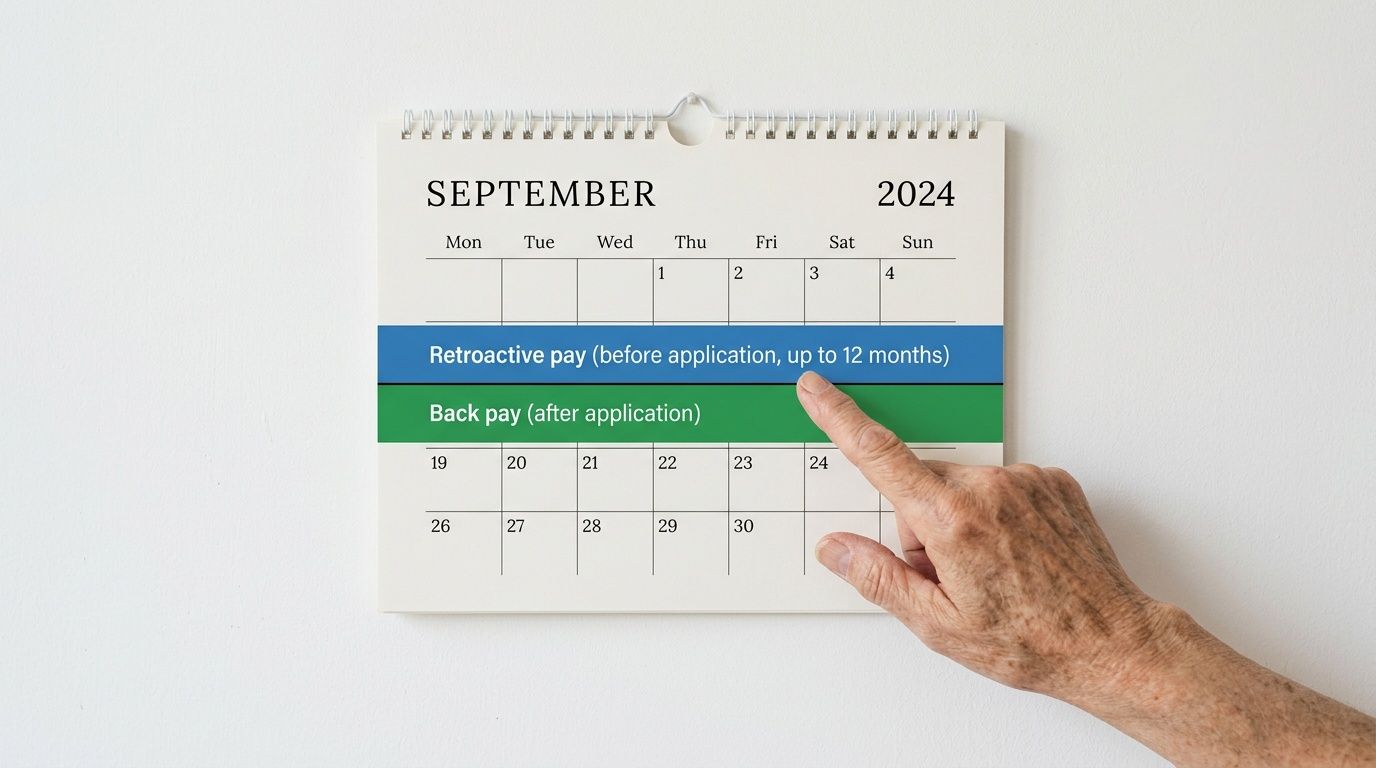
When we talk about past-due SSDI benefits, two terms often cause confusion: retroactive pay and back pay. Many people use them interchangeably, but they represent two completely different time periods. Knowing the difference is crucial for understanding your total potential award and whether a true SSDI back pay maximum exists.
Think of it this way: your application date is the dividing line on the calendar. Everything before that date is one thing, and everything after it is another.
- Retroactive Pay: This covers the period from when your disability began (your Established Onset Date or EOD) up to the date you filed your application. Critically, this is capped at a maximum of 12 months.
- Back Pay: This covers the long waiting period from the day you applied until the day your claim is finally approved by the Social Security Administration (SSA). There is no time limit on this.
This distinction is especially important for people in their 50s and 60s. Many older workers struggle with conditions that worsen over time—like degenerative disc disease or bad knees—and they often stop working long before they decide to apply for benefits.
How Different Conditions Impact Your Award
Let's look at two real-world examples to see how this works. One involves a sudden disability, and the other a more gradual one.
Scenario 1: The Sudden Onset (Cancer Diagnosis)
Imagine a 58-year-old is diagnosed with an aggressive form of cancer and has to stop working right away. They file for SSDI just one month later. In this case, there’s almost no retroactive period. Their payment will almost entirely be back pay—the benefits that build up while the SSA processes their claim.
Scenario 2: The Gradual Onset (Degenerative Disc Disease)
Now, picture a 55-year-old with severe degenerative disc disease and orthopedic neck issues. They push through the pain for years but are finally forced to stop working in January. Hoping they might get better, they don't apply for SSDI until December of that same year. If the SSA agrees their disability began in January, they can claim a full 12 months of retroactive pay, plus any additional back pay that accrues while their case is pending.
The most critical takeaway is this: Delaying your application costs you money. Because retroactive pay is capped at 12 months, for every month you wait to file after that first year of disability, you permanently lose a month of benefits you can never recover. Filing promptly is the single best strategy to secure the maximum possible payment.
Common Reductions to Your Back Pay Amount

Seeing that approval letter for a large back pay award is an incredible feeling. For claimants aged 50-64 who have been struggling with a serious physical condition, it’s a moment of profound relief after a long and difficult fight. However, before you start making financial plans, it’s important to know that the gross amount on that award letter is almost never the final amount you’ll receive.
Think of your total back pay award as the starting point. From there, the Social Security Administration (SSA) is legally required to make a few deductions. Understanding these common reductions helps you set realistic expectations and avoid any unwelcome surprises when the payment arrives.
Attorney Fees: A Predictable and Regulated Deduction
Let's be honest: navigating the SSDI process is tough. For many people, especially those over 50 with complex cases involving conditions like cancer, heart disease, or neurological disorders, hiring an experienced attorney is a necessity. The good news is that the government strictly regulates how these attorneys get paid to protect you.
You will never have to pay your disability attorney out of pocket. Instead, the SSA pays them directly from your back pay award after you've won your case.
By law, the fee is capped at 25% of your back pay or $9,200, whichever is less. For example, if you were awarded $40,000 in back pay, the attorney fee would hit the $9,200 maximum. Your payment would be reduced by that amount, leaving you with $30,800. You can read more about how SSDI payments are calculated at cannonlaw4u.com for more detailed examples.
This system makes sure that everyone can afford good legal help, since there are no upfront costs and the fee only comes out of the benefits you successfully secure.
How Other Benefits Can Reduce Your Payment
On top of attorney fees, other benefits you might have received while waiting for your SSDI approval can also lower your final back pay amount. This is called an "offset," and its purpose is to prevent you from "double-dipping" by receiving benefits for the same period from two different government programs.
The most common offsets that affect claimants in their 50s and 60s are:
- Workers' Compensation: If you received workers' comp benefits for a disability that happened on the job, like a severe back or knee injury, the SSA will almost certainly reduce your SSDI benefits to account for it.
- Public Disability Benefits (PDB): These are disability payments from certain state or local government retirement systems (not private pensions). Receiving PDB can also trigger an offset.
It's just as important to know what doesn't cause a reduction. For example, Veterans Affairs (VA) disability benefits typically do not reduce your SSDI back pay. The same goes for any payments from a private disability insurance policy you had through an employer or bought yourself. The SSA will look at your specific situation to figure out which offsets, if any, apply to your award.
Sample Back Pay Calculations for Older Claimants
Theory is one thing, but seeing the numbers play out in the real world makes all the difference. When it comes to Social Security Disability back pay, the timing of when you stopped working and when you applied can have a massive impact on your final payment. This is especially true for claimants between 50 and 64 suffering from physical conditions.
Let’s walk through a few common scenarios to see how the math works. We'll use a monthly benefit of $1,600 for these examples. Keep in mind, your actual benefit amount is based on your unique work history, but this figure helps illustrate how the rules are applied.
Scenario 1: The Delayed Filer with Degenerative Disc Disease
Meet John, a 55-year-old mechanic. He stopped working on January 1, 2025, because of severe degenerative disc disease and debilitating orthopedic back pain. He held off on applying for SSDI, hoping he'd get better. He finally filed his application on July 1, 2026—a full 18 months after he stopped working. His claim is finally approved on January 1, 2027.
- Established Onset Date (EOD): January 1, 2025 (the day he stopped working)
- Application Date: July 1, 2026
- The 12-Month Retroactive Limit: This is the key. Because John waited so long to apply, his benefits can only go back 12 months from his application date. This means his back pay can start no earlier than July 1, 2025.
- The 5-Month Waiting Period: This is always subtracted from the onset date. While his waiting period technically ended in May 2025, the 12-month rule is stricter here.
- Final Payable Start Date: His benefits begin on July 1, 2025. By waiting to file, he unfortunately forfeited six months of benefits from January to June 2025.
- Total Back Pay: From July 2025 to his approval in December 2026 is 18 months.
- Calculation: 18 months x $1,600 = $28,800
Scenario 2: The Immediate Filer with a Heart Condition
Now, let’s look at Maria. She’s a 62-year-old office manager who had a major heart attack on June 1, 2025, and couldn't work anymore. She wisely applied for SSDI just one month later, on July 1, 2025. Her claim was approved on July 1, 2026.
- Established Onset Date (EOD): June 1, 2025
- Application Date: July 1, 2025
- The 5-Month Waiting Period: This is the main factor. The waiting period starts from her onset date and runs from June through October 2025.
- Final Payable Start Date: Her benefits are first payable starting November 1, 2025.
- Total Back Pay: From November 2025 through her approval month (June 2026) is 8 months.
- Calculation: 8 months x $1,600 = $12,800
These examples clearly show there is no "ssdi back pay maximum" dollar amount. Maria's back pay is smaller because her case was decided faster and she filed right away—which is a good thing! John’s is larger due to a longer wait for approval, but he still lost six months of benefits he could have received if he'd filed sooner.
Scenario 3: The Long Hearing Battle with a Neurological Disease
Finally, there’s David. At 59, he has a progressive neurological disease and had to stop working on March 1, 2024. He applied right away, but his case was denied and he had to go through a long appeals process. He finally won his case at a hearing on March 1, 2026.
- Established Onset Date (EOD): March 1, 2024
- Application Date: March 1, 2024
- The 5-Month Waiting Period: His waiting period ran from March through July 2024.
- Final Payable Start Date: Because he filed right away, his benefits begin as early as possible: August 1, 2024.
- Total Back Pay: The period from August 2024 to the month before his approval (February 2026) is 19 months.
- Calculation: 19 months x $1,600 = $30,400
Of course, the final check you receive will be different, since deductions for attorney fees and other offsets still need to be factored in. You can discover more insights about SSDI back pay on nashdisabilitylaw.com to get a fuller picture of how these factors affect your net total.
Common Questions After Winning Your SSDI Case
Winning your disability case is a huge relief, but it almost always brings up a new set of questions. After the long fight for approval, you’re suddenly faced with practical concerns about back pay, taxes, and what happens next.
For people in their 50s and 60s who have been out of work for months—or even years—due to conditions like degenerative disc disease, severe orthopedic injuries, heart conditions, or cancer, getting clear answers is essential for planning a stable financial future. Let's walk through some of the most common questions we hear from clients after they’ve won their case.
How Long Does It Take to Get My Back Pay After an Approval?
Once you have that official award letter in hand, the wait for your back pay is usually not too long. Thankfully, the Social Security Administration (SSA) has gotten much better at processing these payments.
Most people receive their SSDI back pay as a single lump sum within 60 days of their approval. It's almost always sent by direct deposit to the same bank account you set up for your ongoing monthly benefits.
If 90 days go by and you still haven't received your payment, it's a good idea to contact the SSA or your attorney. They can look into the status and make sure there isn't a snag in the process.
Will I Owe Taxes on My SSDI Back Pay?
It’s possible, yes. A large, one-time back pay award can create a tax headache if you aren't prepared for it. Whether your Social Security benefits are taxable depends on what the IRS calls your "provisional income."
Your provisional income is calculated by adding up:
- Half of your Social Security benefits for the year.
- All your other income, both taxable and non-taxable (like a pension or investment returns).
If that total comes out to more than $25,000 for an individual or $32,000 for a married couple, a portion of your benefits can be taxed. Because a back pay award covers many months, receiving it all at once can easily push you over that threshold for the year you get the payment.
The good news? The IRS lets you spread the income back to the years it was supposed to be paid. Instead of counting it all as income in one year, you can "attribute" the back pay to the prior years it covers. This simple step can significantly lower or even get rid of the tax bill. We always recommend talking to a qualified tax professional to make sure this is handled correctly.
What if I Also Qualified for SSI Benefits?
Some people, especially those with a limited work history before becoming disabled due to a chronic condition like a neurological disease or orthopedic problems, get approved for both SSDI and Supplemental Security Income (SSI) at the same time. When this happens, the SSA has a specific rule to prevent "double-dipping" for the same months. It's called the windfall offset.
It’s a bit complicated, but here’s the gist of how it works:
- First, the SSA figures out how much SSI you were owed for the back pay period.
- They pay you that SSI amount.
- Then, they subtract the amount of SSI you just received from your much larger SSDI back pay award.
This calculation can be tricky, and it’s one of the key areas where an experienced disability representative earns their keep. They’ll double-check the SSA’s math to ensure the offset is calculated properly and you get every penny you’re owed.
Does Waiting to Apply for Benefits Mean I Get More Back Pay?
Absolutely not. This is one of the most damaging and costly myths out there. In reality, waiting to file your application will almost always reduce the total amount of back pay you can receive.
Remember, the SSA only pays retroactive benefits for a maximum of 12 months before the date you officially apply. Every single month you wait to file (after the first year of being disabled) is a month of benefits you lose forever. You can never get it back. This is particularly devastating for older individuals with progressive conditions like heart disease, degenerative disc disease, or neurological disorders who may have stopped working long before they finally applied.
The single best thing you can do to get the most back pay you are entitled to is to apply for benefits as soon as it’s clear your medical condition will keep you out of work for a year or more.
Navigating an SSDI claim is challenging, but you don't have to do it alone. The team at Melanson Law Group combines the insight of a former Social Security judge with the dedication of an experienced litigator to fight for your benefits. If you are over 50 and need help with your application for a physical condition, or are preparing for a hearing, contact Melanson Law Group today for a free consultation.