
You are probably reading this with a denial letter on the table, a bad back or failing knee that still limits you every day, and the same question I hear from people across Massachusetts: how can Social Security say I am not disabled when I can barely get through a workday?
For workers ages 50 to 64, that shock is especially common. Many spent decades doing physical jobs, supervisory work that still required time on their feet, or skilled work that now cannot be done because of neck problems, degenerative disc disease, joint damage, neuropathy, heart disease, cancer treatment, or another serious physical condition. They are not guessing about their limits. They have lived them.
A denial from disability determination services ma is not the end of the case. It is usually the first hard lesson in how the system works. The agency is not asking only whether you have a diagnosis. It is asking whether the medical file proves specific work limits under Social Security's rules. For older workers, that includes a set of vocational rules that can help, but only if the evidence is developed correctly.
Your SSDI Claim Was Denied What Happens Now
A common Massachusetts case looks like this. A warehouse supervisor in his late fifties stops working after lumbar disc disease, knee degeneration, and numbness down one leg make standing and walking unpredictable. He files on his own. He includes MRI reports, office notes, and a medication list. Then the denial arrives.
The letter feels personal, but it usually is not. It often means the file did not answer the questions DDS needed answered. A diagnosis by itself rarely carries a claim.
Who denied the claim
Massachusetts Disability Determination Services (often shortened to DDS) made the medical decision for Social Security. DDS reviews medical records, work history, and any exams it orders. It applies federal disability rules to the evidence in your file.
For a claimant over 50, that distinction matters. The issue is not whether you are hurting. The issue is whether the record proves you cannot do your past work or adjust to other work under Social Security's framework.
What the denial usually means
Most denials fall into one of these categories:
- The records prove a condition, but not work limits. DDS may see degenerative changes, surgery history, cardiac treatment, or neuropathy, but still say the file does not show how long you can sit, stand, walk, lift, or use your hands.
- DDS thinks you can still do some work. That does not mean your old job. It may mean lighter or simpler work in the national economy.
- The case needs better vocational framing. Older claimants often lose winnable cases for this reason. Age matters, but only after the file clearly shows the right functional restrictions and the demands of past work.
Practical takeaway: A denial is often a sign that the file was incomplete, not that the case was hopeless.
If you are between 50 and 64, your next steps should focus on two things. First, identify exactly why DDS denied the claim. Second, rebuild the evidence around function, not diagnosis alone.
What Is Massachusetts Disability Determination Services
A 58-year-old machine operator files for SSDI after back surgery, ongoing leg pain, and numbness in both feet. He assumes Social Security will call his doctors, see he cannot return to the plant, and approve the claim. Instead, the file goes to Massachusetts Disability Determination Services, the agency that reviews the medical and vocational evidence and makes the disability decision at the early stages.
Massachusetts Disability Determination Services, or DDS, functions as the medical review agency for Social Security disability claims in the state. Social Security sets the legal standard. DDS applies that standard to the records, forms, and exams in the file.
DDS does not handle benefit payments. Its job is to decide whether the evidence shows a disabling impairment under federal law.
Where DDS sits in the system
In Massachusetts, DDS operates through the Massachusetts Rehabilitation Commission and makes disability findings for Social Security using federal rules. That state-federal arrangement confuses claimants all the time, especially workers who assume a Massachusetts office is applying a separate state test. It is not. The decision is federal from start to finish.
DDS usually handles the initial application and the first appeal, called reconsideration. At those stages, the file is often still underdeveloped. That matters for claimants between 50 and 64 because many of these cases turn less on diagnosis and more on whether the record clearly shows functional limits, past job demands, and whether the Grid Rules may direct a finding of disabled.
What DDS reviews
DDS reviews more than a diagnosis list. The examiner and medical consultants are looking for proof of work-related limits, with enough detail to fit Social Security's rules. In a physical disability claim, that usually includes:
- Treatment records from primary care doctors, orthopedists, neurologists, cardiologists, pain specialists, and physical therapists
- Imaging and test results such as MRIs, X-rays, EMGs, stress tests, pulmonary testing, or vascular studies
- Work history information showing what your past jobs required, including lifting, standing, walking, climbing, bending, and hand use
- Questionnaires and function reports describing what you can still do during a normal day
- Consultative examinations ordered by DDS when the medical record does not answer key questions
In practice, DDS is deciding whether the file gives it permission to approve the claim. A diagnosis opens the door. Specific functional evidence is what gets the case through it.
Why DDS decisions frustrate older workers
Claimants in their fifties and early sixties often hear that age helps, then get denied anyway. The reason is usually straightforward. DDS cannot apply the favorable vocational rules in a useful way unless the medical record first shows concrete restrictions.
For example, a chart that says "lumbar degenerative disc disease, continue medication" confirms treatment. It does not say how long the person can stand, whether he needs to alternate positions, how much he can lift, or whether he can stoop or use foot controls. Those details are often what separate a denial from an approval under the Grid Rules for workers over 50.
DDS decides cases from documents. If the records are thin, vague, or outdated, DDS fills the gaps with its own reading of the file. Claimants usually lose that kind of inference battle.
How DDS Evaluates Claims From Workers Over 50
A 58-year-old warehouse worker with a bad back often walks into this process assuming age will carry the claim. Then DDS denies the case because the file does not show enough work-related limits, or because the past job was described too loosely. That is the practical problem for workers between 50 and 64. The favorable rules can help, but only if the record gives DDS a legal basis to use them.
Step 1 through Step 3
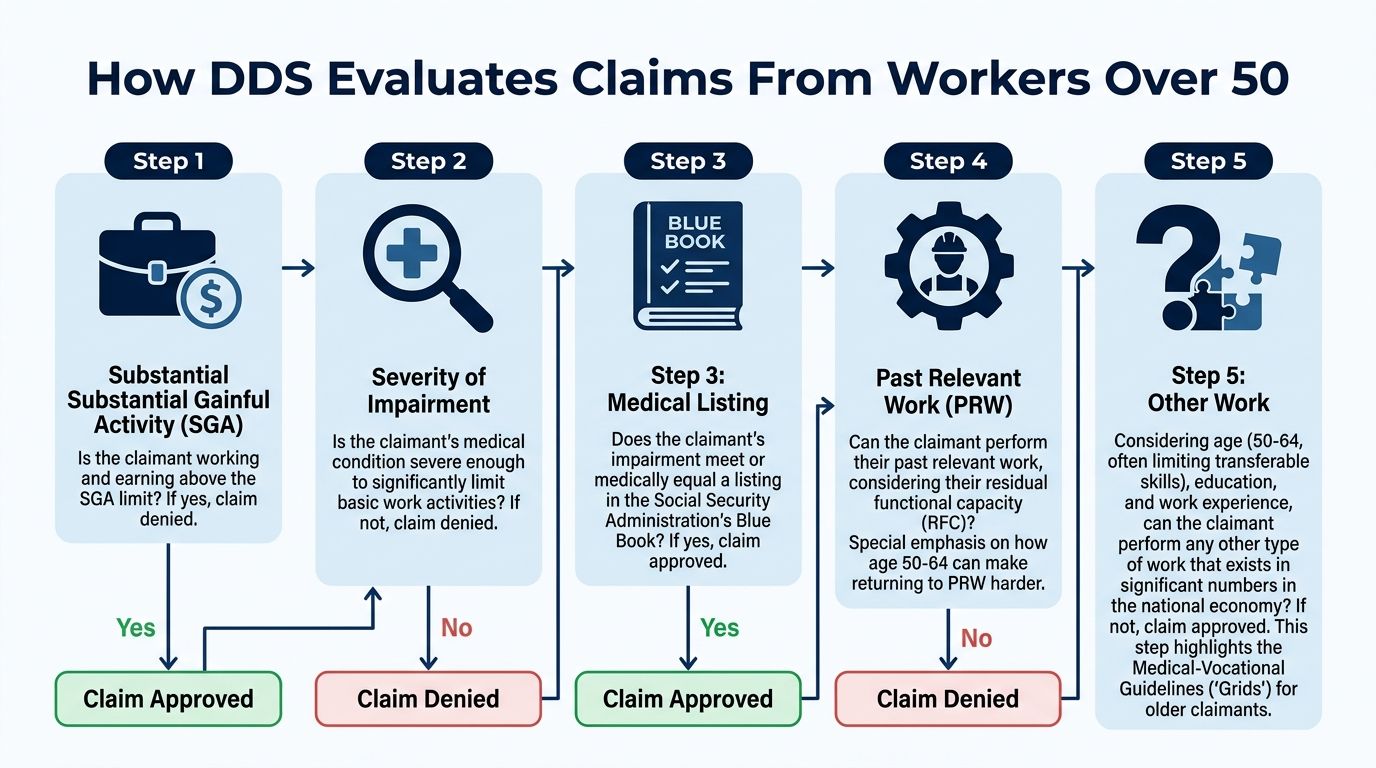
DDS still starts with the standard five-step framework.
At Step 1, DDS checks whether you are working at a level Social Security considers substantial gainful activity. If your earnings are over the monthly limit, DDS can deny the claim without ever reaching the medical issues.
At Step 2, DDS decides whether your condition causes a severe limitation in basic work activities. Many physical claims clear this step, especially when the records show ongoing treatment, abnormal imaging, specialist care, surgery, repeat injections, or consistent examination findings.
At Step 3, DDS asks whether the medical evidence matches one of Social Security's listed impairments. Some cardiac, neurological, or cancer cases are approved here. Many musculoskeletal claims are not, even when the claimant plainly cannot sustain full-time work, because the listing criteria are narrow and technical.
Step 4 and Step 5 are where age matters
For claimants over 50, the main fight usually happens at Step 4 and Step 5.
DDS assigns a Residual Functional Capacity, or RFC. That finding is supposed to reflect what you can still do in a work setting despite your medical problems. Then DDS asks whether you can return to your past relevant work. If the answer is no, DDS decides whether you can adjust to other work.
For workers ages 50 to 64, that second question can change the outcome. Social Security uses the Medical-Vocational Guidelines, usually called the Grid Rules, to account for age, education, and work background. The agency recognizes a simple reality. A 55-year-old laborer with a lifetime of heavy work and no transferable clerical or technical skills is not judged the same way as a 30-year-old with the same lifting limits.
That does not mean age wins the case by itself. The medical record still has to support an RFC that fits the grid category. A person limited to medium work may still lose. A person limited to light or sedentary work, with the right age and vocational profile, may have a much stronger claim.
Why job history matters so much for older workers
DDS often gets older claimants wrong in this area.
Past work is not judged by job title alone. DDS looks at what the job required and how that work is classified under Social Security's rules. A "maintenance supervisor" may have spent most of the day carrying tools, climbing ladders, and doing hands-on repair work. A "manager" title on paper does not help if the job was physical.
Skill transfer matters too. If DDS decides skills from past work transfer to easier jobs, the Grid Rules may not help as much. That issue comes up often with workers in manufacturing, warehouse, transportation, construction, and skilled trades. The file has to show not just what job you had, but what you did.
What this looks like in a claim
Take a 54-year-old claimant with degenerative disc disease, knee arthritis, and a long history of medium to heavy work. DDS may agree he cannot return to his past job. The harder question is whether the records support a limitation to light work, sedentary work, or something in between.
That distinction matters. If DDS finds light work with transferable skills, the claim may be denied. If the evidence supports sedentary work, limited education, and no transferable skills, the Grid Rules may direct an approval.
I have seen many cases turn on a few overlooked details. Need to alternate sitting and standing. Limited stooping. Reduced use of foot controls. A cane prescribed or documented consistently. Those facts can change both the RFC and the grid analysis.
Key point: For workers ages 50 to 64 with physical conditions, DDS is not just asking whether you hurt. DDS is deciding whether the record proves you cannot do your past work or make a realistic adjustment to other work under the Grid Rules.
Delays are part of the process
Claimants should expect delay. The SSA Office of the Inspector General report on DDS workloads and delays found that initial claim processing times increased sharply over recent years.
That matters for older workers with worsening physical conditions. A file that looked incomplete six months ago may support a stronger RFC today if it includes updated treatment, surgery, failed conservative care, or new restrictions from a treating doctor.
Common Reasons DDS Denies Physical Disability Claims
Most denied physical disability cases are not denied because the claimant is exaggerating. They are denied because DDS does not see enough proof of functional loss.
That distinction is everything for workers with back disease, knee damage, neck conditions, cardiac disease, neuropathy, and cancer-related weakness.
Diagnosis is not enough
DDS often receives records that clearly confirm the medical problem. The MRI shows disc herniations. The X-ray shows joint degeneration. The cardiology record confirms heart disease. The oncology file confirms treatment.
But the records still may not answer questions like:
- How long can you sit before you must change position?
- How far can you walk without stopping?
- How much can you lift repeatedly?
- Can you use your hands consistently?
- How often would symptoms interrupt pace, attendance, or concentration?
Without that detail, DDS may decide you can still perform some type of work.
Consultative exams often appear when the file is thin
When treating records are not enough, DDS may order a Consultative Examination, often called a CE. The problem is not that a CE is always wrong. The problem is that it is usually brief and may not capture the full picture of a long-term condition.
According to Social Security's description of the determination process, DDS examiners often deny claims if treating source records are insufficient, mandating a Consultative Examination, and orthopedic or chronic pain claims often fail if the records lack quantifiable functional limitations such as those documented on an RFC form like SSA-4734 in the SSA disability determination process materials.
That is why many denials read as though DDS accepted the diagnosis but rejected the level of limitation.
Common weak spots in physical cases
Here is where I most often see the record break down for older workers:
| Problem in the file | How DDS tends to read it |
|---|---|
| Imaging without functional detail | Serious condition, but unclear work limits |
| Sporadic treatment | Symptoms may not be as limiting as alleged |
| No clear lifting, standing, or sitting limits | Able to do at least some work |
| No description of past job demands | DDS may underestimate how hard the old work was |
| Short CE with normal-looking findings | Temporary snapshot used against long history |
Condition-specific examples
Degenerative disc disease and neck problems
A claimant may have years of treatment, injections, therapy, and imaging. But if the file does not show reduced motion, sensory loss, weakness, gait disturbance, need to alternate positions, or limits on reaching and lifting, DDS may place the claimant at a higher RFC than the evidence really supports.
Knee and orthopedic claims
These cases often fail when the records mention pain but do not describe instability, use of assistive devices, limited walking tolerance, trouble with stairs, or inability to stand for sustained periods.
Heart conditions and cancer
A person can look stable on paper while still being unable to sustain full-time work. Fatigue, shortness of breath, treatment side effects, and recovery time need to be documented with the same care as the diagnosis itself.
What works: Ask treating providers to describe specific work-related limits. A narrative that connects the diagnosis to lifting, standing, walking, use of the arms, attendance, and pace is far stronger than a chart note that only repeats symptoms.
Appealing a DDS Decision The Reconsideration Step
After an initial denial, the next move is usually a Request for Reconsideration. This is not optional if you want to keep moving the case forward. It is the first appeal level.
In Massachusetts, the reconsideration stage is often frustrating because it sends the case back through the same general system. A different examiner reviews the file, but the framework remains the same. If the evidence gap is still there, the result is often the same.
What the numbers tell you
In Massachusetts, the approval rate at the reconsideration level is 23%, according to Massachusetts disability approval rate data. That low rate is the reason I tell claimants to treat reconsideration as a necessary procedural step, not the main event.
You still need to file it. You should just file it strategically.
What to do during reconsideration
Do not press the appeal button and wait. Use this stage to repair the file.
- Update treatment records: Include new orthopedic visits, cardiology follow-up, neurology notes, surgery records, therapy notes, and imaging.
- Add functional evidence: Ask your treating doctor to explain what you can and cannot do during a workday.
- Clarify past work: Describe your jobs the way they were performed, not the way a job title sounds on paper.
- Address changes in condition: If symptoms worsened, medication changed, or a surgery occurred, make sure DDS sees it.
Keep the deadline in mind
The appeal deadline is strict. Missing it can force you to start over, which can mean lost time and a weaker onset picture.
For workers over 50, reconsideration is still important even when the odds are low. A better file at reconsideration often becomes the foundation for a stronger hearing case later.
How Melanson Law Group Wins Appeals After DDS Denials
A common pattern shows up after a DDS denial. A 57 year old machinist with a bad back, shoulder limits, and decades of heavy work is told he can do light or sedentary work. On paper, that sounds clean. At a hearing, it often falls apart once the judge hears what the job required, what the medical records say about function, and whether any skills transfer.
That is why many physical disability cases for workers between 50 and 64 become much stronger at the hearing level. The issue is often not whether the claimant has a medical problem. The issue is whether the file proves work limits in a way that fits Social Security's rules, especially the Grid Rules and the vocational realities for older workers.
Why hearings change these cases
A judge can test the weak points in a DDS denial that never got proper attention on paper.
For older claimants with physical conditions, those weak points usually include:
- the exertional demands of past work, not just the job title
- whether a supposed light or sedentary RFC is sustainable
- whether any past skills transfer to other jobs in a realistic way
- whether age, education, and work history point toward a Grid Rule finding of disabled
That last point matters more than many claimants realize. In the 50 to 64 age group, a case can turn on whether the record supports light work, sedentary work, or less than sedentary work, and whether prior jobs created skills that carry over to other work. A hearing gives counsel room to develop those facts carefully instead of letting DDS rely on shorthand descriptions.
What improves the odds on appeal
Cases improve when the record is built around function and work history, not diagnosis alone.
Medical proof tied to work limits
Judges need to see how the condition affects an eight hour workday. In a physical case, that usually means limits on standing, walking, lifting, reaching, handling, climbing, stooping, pace, and attendance. Imaging helps, but imaging by itself rarely wins the case.
The stronger file usually includes treating records that explain endurance, flare-ups, medication side effects, and what happens after repeated activity. For claimants over 50, that evidence often determines whether the Grid Rules help or whether the case has to be won another way.
A precise description of past work
Many denied claims are repaired here. A job listed as "supervisor" may have required constant standing, lifting parts, climbing stairs, stocking materials, or working on a line. A driver may also have loaded freight. A maintenance worker may have spent the day bending, carrying, and reaching overhead.
If that detail is missing, DDS may classify past work too lightly and assume the claimant can return to it or shift to something else.
Testimony that is accurate and controlled
Claimants should answer clearly and specifically. A good answer explains what happens during an ordinary day, how long an activity can be done before symptoms increase, what causes a flare, and what recovery looks like afterward.
Judges hear exaggerated testimony all the time. They also hear claimants minimize their limitations out of pride. Both hurt the case. The goal is a description that matches the treatment record and gives the judge a usable picture of function.
Melanson Law Group is a Massachusetts SSDI practice that represents claimants at the hearing level and beyond. The firm's published background states that Jack Melanson is a retired Social Security judge, and the practice focuses on record development, medical evidence review, and hearing preparation in disability cases involving physical impairments such as orthopedic injuries and chronic pain.
Mistakes that weaken a hearing case
Several mistakes show up again and again:
- relying on raw medical records without a functional explanation
- assuming a judge will fill in missing work limits from an MRI or surgical report
- describing past jobs in broad labels instead of actual duties
- ignoring transferability of skills for workers in the 50 to 64 range
- giving testimony that conflicts with treatment notes, work history, or daily activity evidence
A strong appeal after a DDS denial is usually built the same way I would want to see it if I were deciding the case. The medical evidence has to describe function. The work history has to be accurate. The theory of the case has to fit Social Security's rules for older workers, not just the claimant's understandable belief that working has become impossible.
Frequently Asked Questions About the DDS Process
What are the Grid Rules
The Grid Rules are Social Security's medical-vocational rules for cases where a claimant does not meet a listed impairment but still has serious work limits. They matter most at the later steps of the disability analysis.
For workers over 50, the rules can help because Social Security gives more weight to age, education, past work, and whether skills transfer to new jobs. In plain terms, the system recognizes that changing careers gets harder as workers get older, especially after a lifetime of physical work.
Do I have to attend a consultative exam
Usually, yes. If DDS schedules a consultative exam, you should attend unless you have a valid reason and reschedule properly.
Missing it can give DDS a reason to decide the case on an incomplete record. If the exam is brief or inaccurate, the better response is usually to supplement the file with stronger treating records rather than skip the exam.
Can I work part-time while my claim is pending
Sometimes, but it has to be handled carefully. Work activity can raise questions about whether you can sustain substantial work.
If you are trying part-time work despite pain, weakness, or fatigue, keep records of hours, duties, absences, reduced productivity, and any help or accommodations you need. In some cases, a failed work attempt can support the claim. In other cases, work can undercut it if it is not explained well.
Is the hearing level really better than DDS
In Massachusetts, yes. Approval rates are higher at the hearing level than at the initial level, and specific hearing offices in Massachusetts report similarly higher approval rates, as noted in the verified Massachusetts approval-rate data discussed earlier in this article. That does not mean every hearing is easy. It means the hearing is often the point where a stronger, more complete case can finally be presented.
What should I gather first after a denial
Start with three categories:
- Recent medical records from the doctors treating the disabling condition
- A detailed work history that explains what your jobs required physically
- Provider opinions about function that describe sitting, standing, walking, lifting, reaching, and attendance limits
If you were denied SSDI in Massachusetts and need help evaluating the next step, Melanson Law Group represents claimants through reconsideration, hearings, Appeals Council review, and federal court. For workers ages 50 to 64 with orthopedic, neurological, cardiac, or cancer-related impairments, the key issue is often not whether the condition is real, but whether the evidence is developed well enough to prove the right vocational result under Social Security's rules.