A lot of people land here at the same moment in life. They are in their late 50s or early 60s, they worked for decades, and now their back, knees, heart, or nerves will not let them keep going. The paycheck has stopped or become shaky. The medical visits keep piling up. And Social Security feels slow, distant, and hard to read.
For this age group, the waiting is not just inconvenient. It can upend a mortgage, drain retirement savings, and force painful choices about treatment, work, and family help. That is especially true for people with degenerative disc disease, failed back surgery, serious knee problems, neck conditions, neuropathy, cancer, heart disease, and other physical impairments that do not always look dramatic on paper but still make full-time work unrealistic.
If you are asking social security disability how long does it take, the honest answer is that the process can be long, but it is not random. Claims move through recognizable stages. Certain things slow a case down. Other things help. And if you are between 50 and 64, Social Security’s age-based rules can matter in a very real way, especially when your body no longer allows the kind of work you used to do.
The Long Road An Introduction to SSDI Wait Times
A 58-year-old warehouse worker with lumbar disc disease and knee arthritis often tells the same story. He tried to hold on. He switched duties, took more breaks, leaned on pain medication, and hoped one more injection would get him through. Then came the point where lifting, standing, bending, and walking were no longer manageable. He filed for disability and assumed the system would move with some urgency because the medical problem was obvious.
That is not how the system feels from the claimant’s side.
Social Security disability is a records-driven process first and a human process later. In the early stages, the agency does not meet you in your living room, watch you climb stairs, or see what happens after twenty minutes in a chair. It reads forms, treatment notes, imaging, specialist records, and work history. For claimants over 50, that creates a strange tension. You may be old enough for the Grid Rules to help, but only if the file clearly shows what you can no longer do and why your past work no longer fits.
Practical truth: The wait is hard, but poor documentation usually makes it harder.
For physical claims, Social Security wants more than a diagnosis. A note that says “back pain” or “knee problems” rarely carries a case by itself. The file usually needs the kind of detail doctors already generate when they are treating you, such as imaging, exams, surgical history, cardiac testing, oncology records, neurology findings, and notes about specific limits in standing, walking, lifting, reaching, handling, or concentrating through pain and fatigue.
People in their 50s and early 60s often have stronger claims than they realize. They may not be able to return to past heavy or skilled work, and retraining into something easier is not always realistic. That does not mean approval is quick. It means the path becomes clearer when the evidence is built the right way.
The Six Stages of a Social Security Disability Claim
The disability process makes more sense when you stop thinking of it as one big wait and start seeing it as a series of checkpoints. Each stage has a different decision-maker and a different purpose.
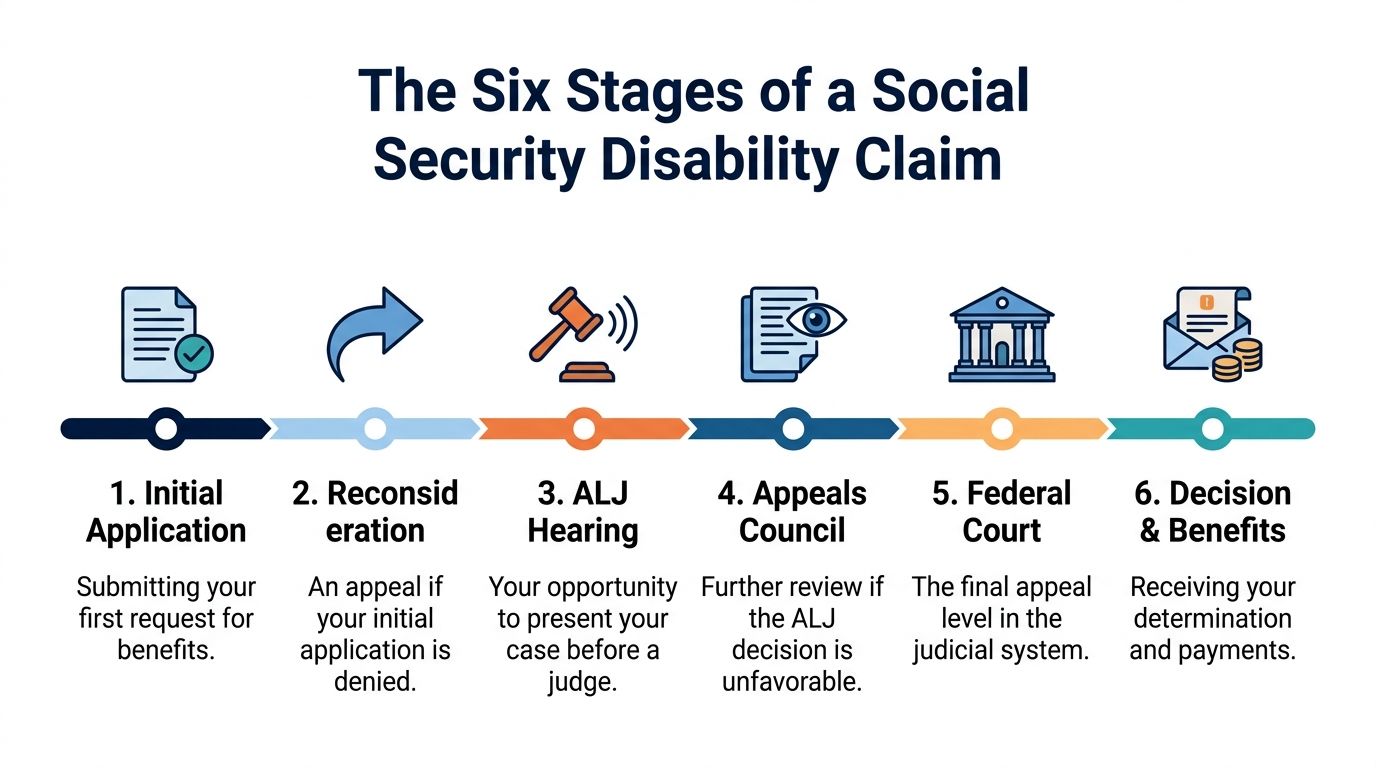
Stage one is the initial application
Applicants file the first claim for SSDI. Social Security gathers your basic information, and the state disability agency reviews your medical and vocational evidence to decide whether you meet the rules.
Stage two is reconsideration
If the initial claim is denied, reconsideration is the first appeal. A different reviewer takes another look at the file, but this is still mostly a paper review.
Stage three is the ALJ hearing
This is the first stage where many claimants feel someone is finally listening. An Administrative Law Judge reviews the claim, hears testimony, and looks at the medical and vocational picture more closely than the earlier paper stages usually allow.
Stage four is Appeals Council review
If the judge denies the claim, the Appeals Council can review whether the decision followed the law and the evidence properly. It does not function like a brand-new hearing in most cases.
Stage five is federal court
If the Appeals Council does not fix the problem, a claimant can file in federal court. At that point, the issue is usually whether Social Security applied the law correctly or failed to support its decision adequately.
Stage six is decision and payment
Winning the case is not always the same as seeing money immediately. Social Security still has to process the award, determine the payment start date, and calculate any backpay due.
Here is the process in a plain snapshot:
| Stage | What happens | What claimants should know |
|---|---|---|
| Initial application | First filing and medical review | Strong records matter early |
| Reconsideration | Mandatory first appeal | Usually another file review |
| ALJ hearing | Live testimony before a judge | Often the best chance to be heard |
| Appeals Council | Legal review of judge’s decision | Focuses on errors |
| Federal court | Judicial review outside SSA | More formal and narrower |
| Decision and benefits | Payment processing begins | Timing of cash flow can still lag |
For workers over 50 with physical conditions, the path often turns on two questions. Can you still do your past work? If not, does Social Security believe you can adjust to other work? Those questions become more favorable with age, but only if the file is prepared with care.
The First Hurdle Initial Application and Reconsideration
The first two stages are where most frustration builds. They are also where many good claims get lost because the file is incomplete, thin, or poorly framed.
The nationwide average processing time for an initial SSDI claim was about 231 days in FY2024, which is over seven months, and that was up 81% from 121 days in 2019 according to a summary of SSA and OIG data discussed by Hiller Comerford’s review of SSD wait times. That same source notes that reconsideration adds a similar wait time for people who are denied and appeal.
Why these early stages go wrong
The disability examiner is not deciding whether you are hurting. The examiner is deciding whether the records prove legal disability under Social Security’s rules.
For claimants ages 50 to 64 with physical conditions, the weak spots are often predictable:
- Diagnosis without function: “Degenerative disc disease” is common. Social Security still needs to know how long you can sit, stand, walk, lift, carry, reach, bend, or use your hands.
- Gaps in treatment: Missed appointments, long stretches without follow-up, or scattered providers can make a serious condition look less limiting than it is.
- Objective records that never make it into the file: MRI reports, operative notes, nerve studies, oncology treatment summaries, cardiac testing, and physical therapy records may exist but not reach the decision-maker in time.
- Work history described too loosely: A claimant may say “I worked in maintenance” when the job really involved heavy lifting, climbing, prolonged standing, and awkward postures.
- Pain described in general terms: “My back hurts” is honest, but it does not explain why you cannot sustain full-time work.
What works better for orthopedic and neurological cases
A strong early claim usually translates medicine into work limits. That means the file should show not only what the condition is, but what it does.
For example, a neck disorder claim gets stronger when records show reduced range of motion, radiating symptoms, weakness, numbness, failed conservative treatment, and the effect of reaching or looking down repeatedly. A knee claim gets stronger when the records show instability, reduced tolerance for standing and walking, imaging changes, use of assistive devices if prescribed, and why stairs, crouching, or uneven surfaces are a problem.
For cancer and serious heart or neurological conditions, the same rule applies. Social Security needs treatment records, prognosis details, side effects, fatigue issues, and evidence of how the condition interrupts reliability, stamina, and attendance.
Key takeaway: Early denial does not always mean the claim is weak. It often means the file did not tell the full story in the way Social Security needed to see it.
What claimants over 50 should do during this stretch
This is not the time to go passive. While the agency reviews the claim, you should keep building the medical record.
- Keep treating consistently. Regular care helps your health and creates a clearer record.
- Tell your doctors what work tasks fail. Standing, lifting, hand use, reaching overhead, sitting tolerance, and pace matter.
- Review your work history carefully. Past jobs need to be described by actual physical demands, not just job titles.
- Save every new test and specialist note. New evidence can change the picture quickly.
- Appeal on time if denied. Missing the appeal deadline can create avoidable delay and force a restart.
The hard truth is that initial review and reconsideration often feel mechanical. The upside is that these stages reward careful preparation. For many workers over 50, especially those with years of physically demanding work behind them, that groundwork pays off later when the case reaches a judge.
The ALJ Hearing Your Best Opportunity for Approval
The hearing stage is where a disability claim often becomes a real human case instead of a stack of forms. For many claimants, especially those in their 50s and early 60s with physical limitations, this is the first time the full story can be told in a way that matches everyday reality.

A hearing matters because judges can evaluate more than labels. They can see how a carpenter with lumbar disease struggles to sit through testimony, or how a former nurse with cervical radiculopathy cannot use her hands and arms consistently, or how cancer treatment leaves a claimant exhausted and unreliable. The hearing is still legal, but it allows for context.
Why age matters more at this stage
For claimants over 50, the Grid Rules can become a major advantage. These rules recognize something practical. A worker in the later part of a career does not adapt to new work the same way a younger worker might, especially after years in physically demanding jobs.
If you are over 50 and cannot return to your past work, Social Security looks closely at:
- your age category
- your education
- whether your prior work gave you transferable skills
- your residual functional capacity, meaning the most you can still do despite your condition
That is where many physical-condition claims get traction. A 57-year-old whose back, knees, and shoulders now limit lifting, standing, climbing, and bending may not fit neatly into other jobs, even if the agency once assumed he could. The same is true for a 62-year-old office worker with severe neck disease and hand numbness who can no longer manage sustained keyboarding, posture, and pace.
What makes a hearing stronger
A hearing is not won by emotion alone. It is won by matching testimony to records and vocational rules.
The strongest presentations usually include:
- A clean medical timeline. Surgeries, injections, therapy, medication changes, worsening symptoms, and failed work attempts should line up clearly.
- Specific daily limitations. Not “I have trouble walking,” but how far, how often, with what consequences.
- Careful treatment of past jobs. Judges often focus on what the work required, not what the title sounded like.
- Updated evidence. New records can change the case dramatically, especially when the condition worsens during the wait.
Practical advice: At a hearing, broad statements rarely persuade. Specific examples tied to the medical file do.
Why the wait can still be worth it
The hearing stage often takes patience. It can feel unfair to wait that long after already surviving the first two rounds. But this stage gives older claimants with serious physical limits their best chance to show why full-time competitive work is no longer realistic.
That is especially true when the claim involves real-world restrictions that paper reviewers tend to understate. A judge can better appreciate why someone with disc disease cannot alternate between sitting and standing indefinitely, why a worker with severe knee degeneration cannot safely stay on task while moving around a plant, or why heart disease makes attendance unpredictable.
Many denied claimants lose hope before the hearing. That is understandable. It is also often premature. If you are over 50, your medical record is developed, and your work history shows years of labor or specialized duties you can no longer sustain, the hearing can change the direction of the case.
Key Factors That Can Speed Up or Slow Down Your Claim
Two claims can start in the same month and finish on very different timelines. That happens because Social Security disability timing depends on several moving parts, some in your control and some not.

Location changes the pace
Where you live matters more than many expect. According to AARP’s summary of SSA timing data, Massachusetts averaged 270 days for an initial decision in 2024, while nearby Vermont averaged 123 days. That difference reflects state-level staffing and caseloads.
For claimants, the lesson is clear. National averages are useful, but they do not tell you what your local office or state agency is doing right now.
Medical evidence is the part you can influence most
The strongest driver you can control is the quality of the file. Social Security moves slowly enough on its own. Missing records, unclear doctor notes, and unsupported allegations make it slower and weaker.
For physical claims, the most helpful records usually include:
| Condition type | Helpful evidence |
|---|---|
| Back and neck disorders | Imaging, exam findings, surgery notes, pain management records, physical therapy progress |
| Knee and orthopedic problems | X-rays or MRI findings, orthopedic evaluations, gait findings, operative reports, functional restrictions |
| Neurological disease | Neurology notes, testing, progression records, medication effects, weakness or balance findings |
| Cancer | Oncology records, pathology, treatment plans, side effects, fatigue and recovery issues |
| Heart conditions | Cardiology notes, testing, medication history, exertional limits, symptoms with activity |
Fast-track programs can matter
Some cases move faster because the medical condition fits a priority track. Conditions that fall under Compassionate Allowances or TERI can be expedited when the evidence clearly supports that status.
That does not mean every serious diagnosis gets rushed automatically. It usually still takes focused documentation and a clean record. In practice, these pathways help most when the diagnosis is unmistakable and the supporting records arrive quickly.
Work activity can complicate the file
Some claimants try part-time work while waiting because they have no other choice. That can be understandable, but it can also blur the disability picture if the work suggests greater capacity than the medical evidence supports.
The issue is rarely just whether you worked at all. The issue is what the work shows about reliability, pace, attendance, physical tolerance, and whether the attempt failed because of your condition.
Representation often prevents avoidable delay
A lawyer cannot make Social Security move instantly. What counsel can do is reduce preventable problems.
That includes:
- Collecting missing records early
- Clarifying the strongest legal theory, including age-based rules for older workers
- Preparing detailed work history descriptions
- Updating the file when your condition changes
- Spotting errors before they cost months
What usually does not work: Filing quickly with sparse records and hoping Social Security will “figure it out” later.
For claimants over 50 with orthopedic, neurological, heart, or cancer-related limitations, timing and strength are linked. A better-developed file does more than improve the odds of approval. It reduces the risk that the agency spends months reviewing an incomplete picture.
Timeline Scenarios for Claimants Over 50
The best way to understand SSDI timing is to look at how different facts produce different paths. Two claimants can both be over 50 and unable to work, yet their timelines can look nothing alike.

Scenario one David and the longer path
David is 58. He spent most of his life doing construction and finish carpentry. He has severe low back pain, degenerative disc disease, knee deterioration, and numbness down one leg. He keeps thinking he should be approved because he obviously cannot go back to carrying materials, climbing, kneeling, and standing all day.
But his first application is thin. His primary doctor notes pain, but there is not much detail about function. His MRI exists, but it is not emphasized properly. His work history form understates how heavy his past jobs really were. Social Security denies the claim.
He appeals, and reconsideration does not fix it. That happens often in claims like this, especially when the issue is not whether he is sick, but whether the file proves he cannot do sustained work under SSA’s rules.
By the hearing stage, the case looks different. The file now includes orthopedic records, imaging, treatment history, and a clearer description of why he cannot sit, stand, walk, bend, or lift on a sustained basis. His age matters. His past work was demanding. Transfer to easier work is not simple. The hearing becomes the point where the whole vocational picture finally makes sense.
This is the kind of case that feels maddening while it is happening. It is also common.
Scenario two Susan and the faster path
Susan is 62 and worked for years as an office manager. She is diagnosed with a serious cancer. Her treatment begins quickly, and her oncology records are direct, organized, and current. The severity of the condition is obvious from the medical file.
Her claim moves through a priority track because the condition fits the kind of serious medical profile that can trigger faster review. She still has to apply carefully, and the records still have to support the diagnosis, but the process moves far more quickly than it does for a standard orthopedic claim.
The legal issue in Susan’s case is not the same as David’s. Her file does not depend as heavily on proving gradual vocational erosion over time. The diagnosis and treatment picture itself create urgency.
What these examples show
Both claimants are older workers. Both are legitimately unable to sustain work. But the timeline shifts based on a few key variables:
- Condition type matters. Some diagnoses qualify for faster handling.
- Evidence quality matters. A strong file early can shorten the road.
- Vocational history matters. For workers over 50, long years in physical work can become a major part of the case.
- The hearing can transform a claim. Especially when the paper file did not tell the full story at first.
If you are in your 50s or early 60s, the central question is not only how sick you are. It is whether the record proves why you cannot return to your past work and why realistic alternative work is no longer there.
How Melanson Law Group Can Help Guide You Through the Wait
The hardest part of this process is not only the delay. It is the uncertainty inside the delay. Most claimants do not know whether the agency has the right records, whether the onset date is framed correctly, or whether a denial reflects a weak case or an underdeveloped file.
That is where experienced representation changes the experience and often the result.
Building the record before small problems become big ones
At the application stage, strong representation means someone is looking at the case the way Social Security will. That includes identifying missing records, making sure your work history is described accurately, and focusing the claim on function, not just diagnosis.
For workers ages 50 to 64, this is especially important. A claim involving degenerative disc disease, serious knee damage, cervical problems, cancer, neurological illness, or heart disease often turns on how those conditions limit full-time work over time. A lawyer who understands the age rules can shape the file around the issues that matter most.
Preparing the appeal with the hearing in mind
A good disability appeal is not just a protest letter. It is a strategy. The strongest cases are built with the hearing standard already in mind, including updated medical records, better functional proof, and a tighter vocational presentation.
That matters because a former Social Security judge sees patterns that many claimants never hear about. Some files bury the best evidence. Some overstate less important symptoms and understate the restrictions that win cases. Some fail to prove the onset date in a way that maximizes backpay.
Understanding when benefits begin
Approval is not the same thing as immediate payment. There is a mandatory 5-month waiting period that runs from the Established Onset Date, and a claimant may receive up to 12 months of retroactive pay before the application date if the earlier onset can be proven, as explained by Urbina Law’s discussion of when SSDI benefits begin.
That is why onset date work matters so much. For many claimants, especially after a long appeal, the difference between a vague onset argument and a well-supported one can affect how much backpay is ultimately recovered.
Important point: The wait may be unavoidable. Unnecessary loss of evidence, timing, and backpay is not.
A law firm that handles SSDI cases closely can help claimants present the case cleanly from the start, strengthen it when Social Security gets it wrong, and frame the onset date in a way that protects the financial relief available after months of waiting.
Frequently Asked Questions About SSDI Timelines
Does being over 50 really help
Yes, it can. Social Security uses age categories in a meaningful way, especially when a claimant cannot return to past work. For people between 50 and 64, the agency is often more realistic about retraining and job adjustment. That does not create automatic approval. It does mean the legal analysis can become more favorable when the medical record and work history are presented correctly.
What should I do if my condition gets worse while I am waiting
Get treatment and make sure the new records are submitted. Worsening symptoms, new imaging, surgery, hospitalizations, medication changes, or additional specialist care can materially strengthen the claim. Do not assume Social Security will automatically gather every update on its own.
Can I work while my SSDI claim is pending
Sometimes people try because they need income. The danger is that work can be misunderstood as proof that you can sustain full-time employment. If you attempt work and it is limited, heavily accommodated, or unsuccessful because of your condition, those details matter. Get advice before assuming any work activity is harmless.
My doctor says I am disabled. Is that enough
Not by itself. Social Security does not award benefits because a doctor uses the word “disabled.” The agency looks at the medical findings, treatment history, work history, and functional limits. A supportive doctor can help a great deal, but the opinion needs to be backed by records and framed in vocationally meaningful terms.
Why do so many physical claims get denied at first
Because many files prove diagnosis but do not yet prove function. Social Security may accept that you have spinal disease, arthritis, heart problems, or cancer treatment side effects and still deny the claim if the record does not clearly show why you cannot do sustained work. That is why detailed evidence about sitting, standing, walking, lifting, reaching, use of hands, fatigue, pain, and attendance is often decisive.
If you are tired of guessing what Social Security is doing with your case, Melanson Law Group can help you evaluate where your claim stands, strengthen the medical and vocational evidence, and prepare for the stage that gives you the best chance of approval. For claimants over 50, especially those dealing with orthopedic injuries, neurological disease, cancer, or heart conditions, experienced guidance can make the process clearer and the case stronger.