The denial letter usually lands on a bad day.
You are already hurting. Maybe your back locks up after ten minutes in a chair. Maybe your knee gives out on stairs. Maybe nerve symptoms in your neck or hands make it impossible to grip, type, lift, or keep pace. If you are in your 50s or early 60s and your work has always been physical, an SSDI denial can feel less like paperwork and more like someone saying your limitations do not count.
They do count. A denial is common. It is also not the end of the case.
For many people, the appeal process is where the disability case is fully developed. That is especially true for claimants over 50 with physical conditions such as degenerative disc disease, serious knee or shoulder problems, cervical spine issues, neuropathy, heart disease, cancer, or other conditions that make past work unrealistic. Social Security often does not see the full picture on the first pass. The appeal is your chance to show it clearly.
The hard part is timing. When people ask me how long does a social security disability appeal take, they usually want one simple number. The honest answer is that it depends on which level your case reaches, how complete your medical proof is, and how quickly the record becomes decision-ready. Some delays come from the system. Some come from weak files, missing treatment notes, or doctors who describe diagnoses but not work limits.
What matters now is control. You cannot fix agency backlogs by yourself. You can protect your deadlines, strengthen your evidence, and prepare for the stage where many valid claims are finally approved. That is where this process becomes less mysterious and more manageable.
Your SSDI Claim Was Denied Now What
You open the denial letter after another bad day with your back, knees, heart, or hands, and the first reaction is usually the same. Frustration, then panic about what comes next.
Start with the deadline. File the appeal on time. Social Security generally gives you 60 days to ask for reconsideration after the denial notice. Miss that window, and you may have to start over instead of fixing the case you already filed.
For claimants in their 50s and early 60s, a denial often says more about the file than about the person. I have seen this from both sides of the system. Early denials often happen before anyone has a clear picture of what the workday looks like for someone with lumbar spine problems, failed joint replacements, neuropathy, shoulder damage, cardiac limits, or cancer treatment fatigue. The agency may have the diagnosis. The file still may not explain why a full-time job is no longer realistic.
What the denial often misses
Denial notices tend to sound final. They are often based on an incomplete record.
The missing piece is usually function. Social Security needs evidence that connects the medical condition to specific work problems. A chart that confirms degenerative disc disease is helpful. A chart that explains you can sit for only 20 minutes before changing position, walk only short distances, or miss activity after a flare-up is much more useful. The same goes for heart disease. The record should show what happens with exertion, how long recovery takes, and whether symptoms return with ordinary activity.
That detail matters even more for people over 50. Social Security applies special vocational rules in this age range, but those rules still depend on believable medical proof and a clear description of past work. Age can help. Age alone does not win the case.
A denial usually means Social Security was not persuaded by the record it had. It does not mean your limitations are minor or that an appeal is pointless.
Treat the appeal like a rebuild
The next step is not just filing forms. It is rebuilding the case so the record answers the questions that led to the denial.
In practice, that often means finding the weak spots early:
- Specialist records are missing or were never requested, especially from orthopedists, neurologists, cardiologists, pain management doctors, or oncologists.
- Office notes are too thin and list symptoms without explaining how those symptoms limit sitting, standing, lifting, reaching, using the hands, or staying on task.
- Testing is stale even though the condition has worsened.
- Past work is described too loosely, which makes it easier for Social Security to underestimate what the job required.
This is one of the significant trade-offs in an appeal. Filing fast protects the deadline. Filing fast without improving the evidence often leads to another denial. The better approach is to do both. Get the appeal filed, then spend the next stretch of time making the medical record and work history more specific.
That gives the case a fairer chance.
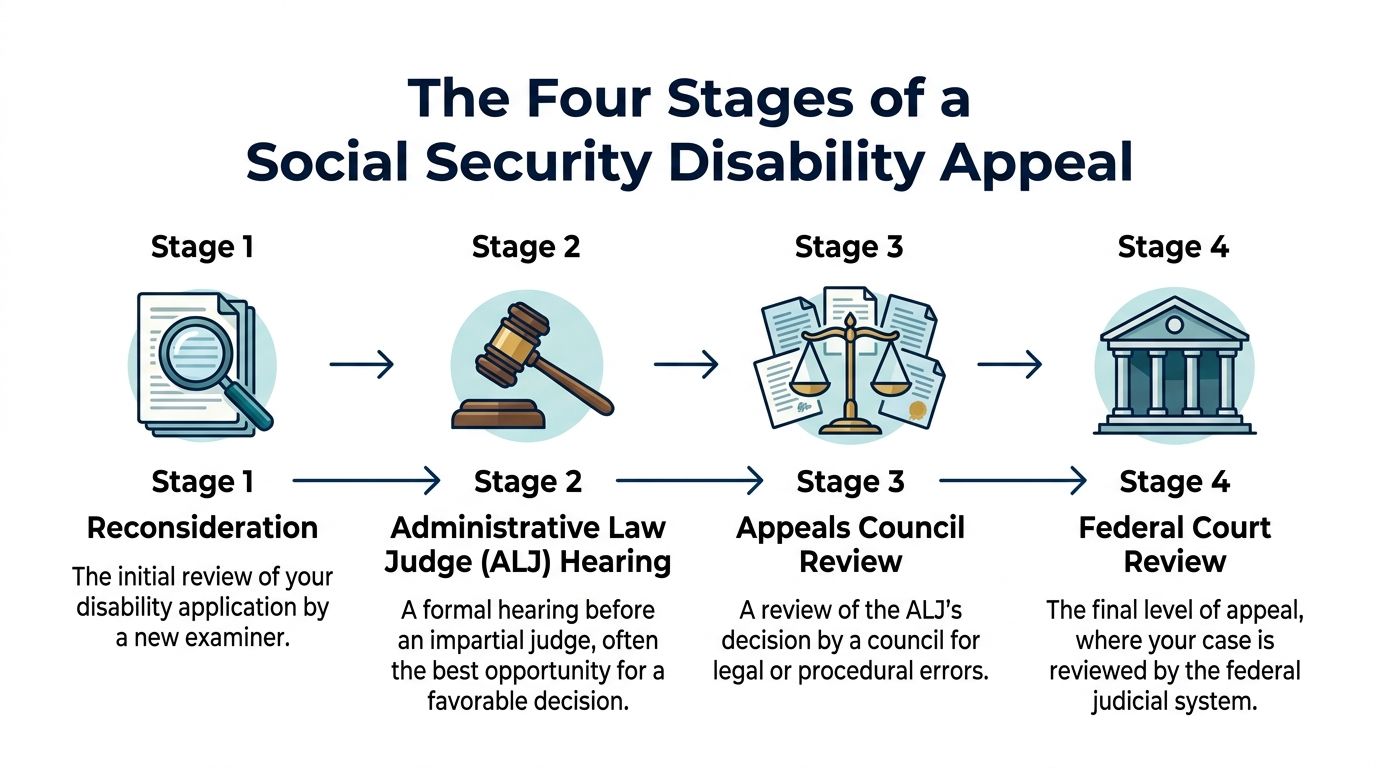
The Four Stages of a Social Security Disability Appeal
A denial letter lands in the mail. You are 58, your back or heart condition still limits you every day, and the next question is simple. What happens now, and how long is this going to take?
The appeal process moves through four levels. Each level has a different job, a different pace, and a different chance of changing the outcome. Claimants over 50 often do better when they understand that early, because the strategy should change as the case moves from paperwork review to judge review.
SSDI appeal stages at a glance
| Appeal Stage | Average Wait Time (2026 Estimates) | Purpose of Review | Key Takeaway for Claimants 50+ |
|---|---|---|---|
| Reconsideration | 2 to 6 months | A different reviewer reexamines the denial and any new evidence | File on time and add better medical proof right away |
| ALJ Hearing | 12 to 18 months | An Administrative Law Judge reviews testimony, records, and vocational issues | This is often the most important chance to win |
| Appeals Council | 6 to 12+ months | Review for legal or procedural error in the ALJ decision | This is not a fresh hearing |
| Federal District Court | 12 to 24 months | A federal judge reviews whether Social Security followed the law | This is a last-resort level and takes patience |
Reconsideration
Reconsideration is the first appeal after the initial denial. A different disability examiner reviews the file, along with any new records submitted after the first decision.
You generally have 60 days to appeal. Miss that deadline, and the case can be dismissed unless Social Security accepts a good reason for late filing.
This stage often moves faster than the later ones, but it is still a paper review. In many cases, especially for workers between 50 and 64 with orthopedic, cardiac, or other physical claims, reconsideration serves two practical purposes. It preserves the claim and gives you time to add the records that were missing or underdeveloped the first time.
As a former judge, I can tell you that many reconsideration denials are predictable. The same agency is still reviewing the file, usually without hearing from you directly. That does not make the appeal pointless. It means you should treat this level as a chance to improve the record while protecting your right to keep going.
ALJ hearing
If reconsideration is denied, the next stage is a hearing before an Administrative Law Judge, or ALJ. This is the level where many strong cases finally get real attention.
A judge reviews updated medical records, listens to testimony, studies your work history, and applies Social Security's rules to the actual limits in your life. For claimants over 50, that matters. Age categories and vocational rules can help, but only if the file shows in concrete terms why standing, walking, lifting, using your hands, or keeping pace is no longer realistic for full-time work.
Hearing waits are often the hardest part of the process. Some offices move faster than others. Some have deep backlogs. From the inside, the delay usually has more to do with staffing, scheduling, and case volume than with the strength of your claim.
Appeals Council review
If the ALJ denies the case, the next step is the Appeals Council. The Council does not hold a new hearing just because the claimant disagrees with the judge's decision.
Its role is narrower. The Council looks for legal error, procedural error, or a serious problem in how the judge evaluated the evidence. It may deny review, send the case back for another hearing, or issue a decision in limited situations.
This level frustrates many claimants because the focus changes. The argument is no longer just "the judge should have believed me." The stronger argument is often "the judge missed important evidence, applied the wrong rule, or failed to explain the decision properly."
Federal District Court
Federal court is the final stage in the usual appeal path. It is a civil action filed against the Social Security Administration in federal court.
By this point, the issue is legal review. The court does not decide disability from scratch the way a hearing judge does. It examines whether Social Security followed the law and whether the decision can be supported under the legal standard the court must apply.
That process takes time and usually requires patience, careful briefing, and a realistic view of the goal. In many cases, success in federal court means getting another hearing, not an immediate award.
The sequence matters. Reconsideration reviews the file again. The hearing gives a judge the first full chance to evaluate the claim directly. The Appeals Council examines whether the hearing decision was legally sound. Federal court reviews whether the agency stayed within the law.
The appeal system works like a staircase. Each level serves a different purpose, and the best cases are prepared with the hearing level firmly in view.
Why Appeal Timelines Vary So Much
Two claimants can file appeals in the same month and finish on very different schedules. One reaches a hearing with a complete, organized record. Another spends months waiting for missing treatment notes, delayed testing, or clarification from doctors. The timeline shifts because Social Security processes cases, not just diagnoses.

Backlogs are real, and they are not personal
Hearing offices carry different workloads. Some move more quickly. Some are backed up for long periods. A claimant often blames himself for delay when the cause is administrative volume, staffing limits, or a queue of older cases already waiting.
That does not make the wait easier, but it should change how you think about it. Delay is not proof that your claim is weak. Often it means your case has joined a crowded line.
Physical cases can look simple, but they often are not
Many people assume orthopedic or cardiac claims should be easy to evaluate. In practice, they often require detailed medical development.
A back case may involve imaging, pain management notes, surgical records, physical therapy, medication side effects, gait findings, and repeated reports of limited sitting or standing tolerance. A knee case may involve operative history, injections, instability, reduced range of motion, and failed attempts to return to work. A heart case may involve exertional limits that fluctuate but still prevent sustained work.
The agency needs a clean answer to a practical question: What can this person still do, reliably, day after day, in a work setting?
Incomplete records slow everything down
From a judge's point of view, missing records create hesitation. If key evidence is absent, the file is not ready for a confident decision.
The most common problems I saw in physical cases were not dramatic. They were ordinary gaps:
- Specialist records missing: The claimant saw an orthopedist or cardiologist, but the records never made it into the file.
- Treatment notes too vague: The doctor documented pain or fatigue without tying it to lifting, standing, walking, or using the hands.
- Work history poorly described: Social Security cannot properly compare current limits to past work if the job duties are fuzzy.
- Condition progression not documented: Neurological disease, cancer recovery, and degenerative conditions often worsen over time, but the file may freeze the story too early.
A thick file is not always a strong file. Judges look for records that answer functional questions clearly.
Some delay comes from what claimants can control
Not every slowdown is systemic. Sometimes claimants unintentionally make the process longer.
A few examples:
- Missing appointments. Gaps in treatment can raise questions and leave the file stale.
- Changing doctors without follow-through. A new provider may not yet know the history well enough to describe work limits.
- Assuming Social Security has everything. It may not.
- Waiting to gather evidence until a hearing notice arrives. By then, valuable time is already lost.
For claimants ages 50 to 64, another issue often appears. They describe why they cannot do their old physically demanding job, but they do not explain why they also cannot manage lighter, more sustained work. Social Security is focused on capacity, not sympathy. The stronger file shows not just pain, but why pain prevents regular work activity.
Why older claimants should think in functional terms
If you are over 50, your vocational profile can matter. But that profile only helps if the medical evidence supports meaningful limits. For example, the difference between being able to stand occasionally and stand frequently can matter. So can limits on bending, overhead reaching, climbing, handling, or maintaining pace because of pain or fatigue.
That is why timelines vary. Some cases arrive with those details already documented. Others take months to develop into a file the agency can decide.
The ALJ Hearing Where Most Cases Are Won
For many claimants, the hearing is the first time someone in authority looks at the entire case instead of a stack of forms. That is one reason this level matters so much. It is also the stage where preparation changes outcomes.
The wait is significant. The ALJ hearing stage is the biggest bottleneck, with average waits from 12 to 18 months, and represented claimants can see 20% to 30% shorter waits because evidence is submitted proactively and some cases are positioned for an on-the-record decision. The same source reports that representation increases fully favorable hearing decisions to around 45% to 50%, compared with 15% for unrepresented claimants in hearing cases, as explained in this discussion of SSA appeal timeframes.
What a judge decides
At the hearing level, the question is not whether you are a good person, worked hard, or are seriously hurt. Claimants are typically sincere. The legal question is whether the evidence proves limitations severe enough to prevent substantial work under Social Security's rules.
For claimants over 50 with physical conditions, judges often focus on a few practical points:
- Can you still do your past work as it was performed or generally performed?
- If not, do your age, work background, and restrictions leave any realistic other work?
- Are your limitations supported by treatment records, exams, imaging, testing, and consistent reports over time?
A former judge's perspective helps here. Judges do not need a dramatic story. They need a reliable one. The strongest testimony usually sounds specific and ordinary. It explains how long you can stand before shifting, what happens when you sit too long, whether you elevate a leg, how often symptoms interrupt concentration, and why even simple routine tasks leave you exhausted.
Why age matters more at this level
For people in the 50 to 64 range, the hearing is often where vocational rules come into sharper focus. Many older workers spent years in physically demanding jobs and do not have easily transferable skills to a seated office role. That can matter under Social Security's framework.
But age is never enough by itself. A judge still needs a medically supported residual functional capacity, often called an RFC, that fits the rule. If the evidence suggests you can still perform a broad range of work, age may not carry the claim. If the evidence shows credible limits on lifting, standing, walking, using the hands, postural movement, or stamina, the picture changes.
What works at hearing
Some hearing files arrive ready to decide. Others arrive with obvious holes. The difference often comes down to whether the record answers the judge's key questions.
What usually helps:
- Longitudinal treatment records: Judges want to see the condition over time, not one isolated visit.
- Specialist support: Orthopedists, neurologists, cardiologists, and oncologists often provide context that primary care notes alone do not.
- Functional detail: Good records describe limits in sitting, standing, walking, lifting, reaching, handling, or maintaining pace.
- Consistent testimony: Your hearing testimony should match the medical story. Not perfectly word for word, but candidly and clearly.
What usually hurts:
- Overstatement: If testimony sounds exaggerated compared with the records, credibility suffers.
- Underexplained gaps: Missed treatment or sparse follow-up without explanation can weaken the case.
- Job descriptions that are too vague: A judge cannot properly compare your current limitations to past work without understanding what the work required.
The hearing is not won by saying you are in pain. It is won by showing how the pain limits work functions in a way the record supports.
The overlooked path of an on-the-record decision
Some cases do not need a full hearing if the written record is strong enough. A representative can ask for an on-the-record, or OTR, decision. That means the judge reviews the evidence and can approve the claim without taking live testimony.
Not every case is a candidate. OTR requests tend to work best when the medical record is complete, the vocational issues are clear, and the severity of the limitations is already well documented. For older claimants with strong orthopedic, neurological, cardiac, or cancer-related proof, this can be an important strategy because it may avoid part of the long hearing wait.
Proactive Steps to Potentially Shorten Your Wait
You cannot force Social Security to move faster. You can make your case easier to decide.
That distinction matters. The fastest file is usually the file that answers the right questions early and leaves less room for guesswork. If you are asking how long does a social security disability appeal take, this is the part that offers some influence.
Build a decision-ready medical record
Think less about volume and more about usefulness. A judge or examiner does not need every page ever created. They need the pages that explain your diagnosis, treatment, and work-related limits.
Focus on gathering:
- Recent treatment notes: Especially from specialists treating your main disabling conditions.
- Objective testing: Imaging, cardiac testing, neurological studies, operative reports, pathology, or other relevant records.
- Medication history: Including side effects that affect stamina, concentration, balance, or attendance.
- Physical findings over time: Reduced range of motion, abnormal gait, weakness, numbness, swelling, reduced grip, shortness of breath, or exertional intolerance.
Ask doctors for the right kind of support
Many claimants ask a doctor for a letter that says, "my patient is disabled." That usually carries less weight than people expect.
More useful support explains function. A strong medical opinion addresses what you can still do and what you cannot sustain. For example:
- Sitting and standing tolerance
- Walking distance or endurance
- Lifting and carrying limits
- Use of hands, arms, or shoulders
- Need to elevate a leg, recline, or take unscheduled breaks
- Expected absences from work because of treatment or symptoms
For a claimant over 50 with a history of medium or heavy work, these details can be more important than a broad statement of disability.
Prepare your work history carefully
Physical cases often turn on the comparison between old job demands and current limits. If your past work involved more lifting, climbing, reaching, stooping, kneeling, or standing than your file shows, say so clearly.
Do not rely on a job title alone. "Maintenance worker," "driver," "warehouse associate," or "nurse assistant" can mean very different things in practice. A good work history describes what you did.
Stay in treatment if you can
Judges understand that treatment is not perfect. Insurance problems, side effects, transportation issues, and specialist waitlists are real. But long unexplained gaps can make a file harder to trust.
If care is interrupted, document why. If treatment has plateaued, that should also be in the records. A stable but severe condition can still support disability.
Consider whether your case is suitable for an OTR request
An on-the-record request can sometimes move a strong case more efficiently. This is usually worth considering when:
- The medical evidence is complete and current
- Your age and work history fit the vocational picture well
- The record already supports serious functional limits
- There is little factual dispute about what your past work required
Not every case qualifies. But when it does, asking for OTR review can be a smart way to avoid waiting for a full hearing date.
The best way to shorten the process is not to rush. It is to submit a file that is ready for a reasoned decision.
The Final Appeal Stages Appeals Council and Federal Court
A common call to my office goes like this. Someone in their late 50s with a bad back, worn-out knees, or heart problems has just read the ALJ denial and asks whether the next appeal will finally let someone "look at it again."
At this point, the process changes. The Appeals Council and federal court focus on whether the judge or the agency made a legal mistake, missed important evidence, or handled the case improperly. They usually do not give you a fresh hearing on the facts.

Appeals Council review is about error
The Appeals Council does not take new live testimony. It reviews the ALJ's written decision and the record to decide whether the result can stand.
That review usually centers on questions such as:
- Did the judge apply the right legal rule?
- Did the decision ignore or misread important medical or vocational evidence?
- Did the hearing process leave out something that could have affected the outcome?
The Council often denies review. Sometimes it sends the case back for another hearing, which can help if the ALJ made a clear legal or factual mistake. In a smaller group of cases, it issues its own decision.
For claimants over 50, I pay close attention to errors involving past work demands, transferable skills, and the medical-vocational rules. Those issues matter a great deal in cases involving orthopedic conditions, cardiac limits, or other physical impairments that make a return to heavy or medium work unrealistic.
Federal court is formal and narrow
If the Appeals Council does not correct the problem, the next step is a lawsuit in federal court. That sounds dramatic, and it is more formal, slower, and more expensive in terms of time and effort.
Federal judges usually are not deciding whether they would have approved the claim themselves. They review whether Social Security followed the law and whether the agency's decision is supported under the legal standard the court must apply. From a former judge's perspective, that distinction matters. A weak hearing record is hard to rescue later, even when the claimant's limitations are very real.
The practical lesson
These stages can still be the right move. I have seen Appeals Council remands and federal court remands open the door to benefits that should have been granted earlier.
Still, the trade-off is clear. The later the appeal, the less room there is to shape the factual record and explain the day-to-day limits that keep a 55-year-old former driver, warehouse worker, nurse assistant, or maintenance worker from sustaining full-time work.
That is why I treat Appeals Council and federal court review as targeted legal review, while putting the heaviest effort into building the strongest possible case before the ALJ decision becomes final.
FAQs for Claimants Over 50 and Their Caregivers
Does being over 50 help my SSDI appeal
It can. Social Security applies vocational rules that may be more favorable to older workers, especially those whose past jobs were physical and whose medical limits now prevent similar work. But age does not replace proof. Your records still need to show specific, credible restrictions.
I have degenerative disc disease and knee problems. Is that enough to win
The diagnosis alone is not enough. What matters is how those conditions limit standing, walking, sitting, lifting, bending, climbing, kneeling, reaching, and keeping a regular work pace. Claims are stronger when the records show those limits consistently over time.
My doctor supports me. Why was I still denied
Because support and documentation are not the same thing. A doctor's note saying you cannot work may help, but Social Security usually looks for treatment records, exam findings, testing, and functional opinions that explain why full-time work is not realistic.
If I used to do heavy work, does that matter
Yes. It can matter a great deal for people in their 50s and early 60s. A claimant who spent years in physically demanding jobs may have a stronger vocational argument than someone whose prior work was already sedentary. The record should clearly describe what the old job required.
What should a caregiver do to help
A caregiver can be very helpful without taking over the case.
Useful support includes:
- Tracking appointments: Keep a list of doctors, clinics, and treatment dates.
- Organizing records: Save imaging reports, discharge paperwork, and medication lists.
- Documenting daily limits: Note practical problems such as walking distance, falls, fatigue, or trouble using hands.
- Helping with forms: Many claimants underreport their struggles because they are used to pushing through pain.
Should I keep working while I appeal
That depends on the type and level of work, and it should be discussed carefully with a lawyer because work activity can affect how Social Security evaluates the claim. The main point is to be cautious. Trying to survive financially is understandable, but the details matter.
What is the biggest mistake after a denial
Waiting. Waiting to appeal, waiting to collect records, waiting to talk to your doctors about work limits, and waiting to prepare for the hearing level. Delay inside the file often becomes delay in the case.
If you were recently denied and need guidance from a team that focuses on these cases every day, Melanson Law Group helps SSDI claimants build stronger appeals, prepare for hearings, and present the medical evidence Social Security needs to see. Their Cambridge-based team includes a retired Social Security judge and offers hands-on representation with no upfront fee.