

Applying for SSDI online after 50 often starts the same way. Your back has gotten worse, your knee won’t hold up through a shift, your heart condition leaves you exhausted, or cancer treatment has changed what your body can handle. You know you’re not working the way you used to. What’s harder is turning that reality into an application the Social Security Administration will accept as legally sufficient.
That gap is where many people get stuck. The SSDI online application looks simple on the screen, but the decision doesn’t turn on how neatly you fill in boxes. It turns on whether your medical records, work history, and functional limits show that you meet Social Security’s rules. That is especially important for people between 50 and 64, because age, job history, and physical restrictions can change how a claim should be presented.
The online system is still the right place to begin. Social Security’s own data show the agency handles claims at enormous volume, with 1,937,000 applications and 629,900 awards in 2024, a 32.5% awards-to-applications ratio, after 1,904,600 applications and 561,600 awards in 2023, a 29.5% ratio, and 1,789,600 applications and 543,400 awards in 2022, a 30.4% ratio, according to SSA disabled-worker application and award data. The online portal matters because it helps people file, but filing online doesn’t lower the legal standard.
If you’re older, dealing with degenerative disc disease, knee damage, neck problems, neurological disease, heart trouble, orthopedic injuries, or cancer, you need more than a login and a password. You need a plan from the first form through the likely pressure points that follow. That includes medical records, doctor support, DDS review, denial response, and hearing preparation if your case gets that far.
This guide gives you that practical roadmap.
Step 1: Use the Official SSA Online Application Portal (iClaim)
Start with the official Social Security filing system, not a third-party form site. The online application is the cleanest way to open your claim, and it lets you save your progress, return later, and monitor what happens after submission through your Social Security account.
A denial is not the end of your claim.
Talk to a disability attorney now. Free consultation. No fees unless you win.
Call (617) 683-1983For many people ages 50 to 64, the benefit of the portal is convenience, not strategy. The strategy comes from what you enter into it.

What to have ready before you log in
If you’re applying because of degenerative disc disease, severe knee arthritis, a failed joint replacement, cervical spine problems, neuropathy, heart disease, or cancer-related limitations, gather your details first. Don’t rely on memory while the application is open.
- Medical provider list: Write down every doctor, clinic, hospital, physical therapist, imaging center, and specialist with addresses, phone numbers, and treatment dates.
- Work history details: List the jobs you held in roughly the last 15 years, what you did, how much lifting, walking, standing, climbing, reaching, and paperwork the job required.
- Medication and testing history: Include injections, surgeries, MRIs, CT scans, cardiac testing, chemotherapy, radiation, rehab, and pain management.
- Function limits: Be ready to describe what happens if you sit too long, stand too long, bend, lift, turn your neck, grip tools, climb stairs, or try to keep pace.
Practical rule: The online form is a filing tool. Your words should describe work-related limits, not just diagnoses.
What older applicants often get wrong
People in their 50s and early 60s often understate their limitations because they’re used to working through pain. That hurts claims. Social Security needs a realistic picture of what your body can and cannot do on a sustained basis.
You also need to understand whether you should even use a new online application. The online disability application is for adults who have not been denied disability benefits in the last 60 days — people recently denied for medical reasons are directed to the Internet Appeal instructions instead of filing a new claim.
Create a my Social Security account if you don’t already have one, save your re-entry number immediately, and keep a copy of everything you submit.
Before spending hours on forms, check the two things that control whether an SSDI claim can even move forward. First, you need enough work history under Social Security. Second, you need a medical condition that keeps you from performing substantial full-time work.
A useful way to think about the threshold:
Not sure if you qualify?
Get a free case review from a New England disability team. You only pay if we win.
Call (617) 683-1983| Question | What to look for |
|---|---|
| Have you worked enough under Social Security? | Review your earnings and disability coverage in your Social Security account |
| Did your condition force you out of work? | Match your stop-work date to medical visits, testing, and work records |
| Is there medical proof? | Records should show diagnoses, treatment, objective findings, and ongoing symptoms |
| Can you still do full-time work reliably? | Focus on sitting, standing, walking, lifting, reaching, and attendance |
Step 2: Complete a Pre-Application Case Assessment and Document Compilation
A rushed application usually turns into a weak application. Before you hit submit, step back and look at your case the way Social Security will. The question isn’t whether you hurt. The question is whether your records prove you can’t sustain work under SSA rules.
That distinction is where a pre-application review can help, especially for workers between 50 and 64 whose cases often hinge on detailed physical limitations and past job demands.

Match the records to the real work problem
A 58-year-old with degenerative disc disease may have years of treatment records but no clear statement from an orthopedist about sitting tolerance, lifting limits, or the need to alternate positions. A 62-year-old undergoing cancer treatment may have excellent oncology notes but little written about fatigue, nausea, neuropathy, or inability to maintain attendance. A former construction worker with knee damage may have surgical records but nothing tying his pain and instability to an inability to perform even lighter jobs consistently.
Those are not small gaps. They are often the difference between “serious medical condition” and “legally persuasive disability file.”
What a useful pre-application review looks for
A good review focuses on missing proof, not just paper volume.
- Treatment continuity: Are there long gaps in care that need explanation?
- Condition-specific support: Do your records show range-of-motion loss, gait problems, reduced strength, imaging findings, post-surgical restrictions, or treatment side effects?
- Work connection: Is there evidence showing why your condition stops your past work and other realistic work?
- Doctor cooperation: Which physicians are likely to provide practical functional opinions, and which ones only chart symptoms?
If you speak with a lawyer or representative before filing, bring everything you have. Old records can matter if they show progression. So can failed work attempts, especially when someone tried to return after surgery, cardiac treatment, or cancer treatment and couldn’t keep going.
People often think they should wait until after a denial to get help. In many cases, the better move is to build the record before the first filing.
For older applicants with physical claims, honesty matters more than optimism. Don’t minimize how often you lie down, how far you can walk, whether you need help with chores, or whether driving has become limited because of pain, dizziness, numbness, or medication side effects. SSDI cases are rarely won by sounding tough. They’re won by sounding accurate.
Step 3: Understand the Rules with SSA’s Disability Benefits Guide
A 58-year-old warehouse worker with a bad back often starts the online application thinking the case will turn on MRI results and surgery notes alone. Social Security looks at more than diagnosis. It applies a set of legal rules to decide whether your medical limits keep you from doing your past work or any other work the agency believes you could still perform.
Worried a misstep could cost you benefits?
A short, free consultation now can prevent an expensive mistake later. No upfront fees.
Call (617) 683-1983That is why applicants ages 50 to 64 should read SSA’s disability guidance before submitting the form. For this age group, especially people with physical conditions and long work histories in demanding jobs, the rules about age, job skills, and exertional limits can change how a case is evaluated.
Why the rules matter more after 50
Age does not guarantee approval. It does affect how Social Security reviews whether a person can adjust to other work.
That distinction matters for someone who spent 25 years doing construction, nursing aide work, machine operation, delivery driving, or maintenance. If that worker now has serious limits with lifting, standing, walking, climbing, reaching, or using the hands, SSA does not look only at the diagnosis. It also looks at the demands of past jobs, whether any skills carry over, and whether lighter work is realistic given the person’s limitations and age.
Read SSA’s guide with these questions in mind
The guide is more useful if you read it like a checklist for your own claim.
- What does SSA mean by disability? The agency uses a legal definition. The question is not whether work has become painful or difficult. The question is whether your condition prevents substantial work activity under SSA’s rules.
- What were your past jobs really like? Job titles are often too vague. The useful description includes how much you lifted, how long you stood, whether you climbed, stooped, crouched, reached overhead, used tools, or worked at a fast pace.
- What can you still do, reliably? SSA focuses on function. How long can you sit, stand, or walk? How much can you lift? How often do pain, numbness, shortness of breath, or fatigue interrupt a normal workday?
- How long will the limits last? Temporary restrictions usually do not qualify. The file needs to show a condition expected to last long enough under SSA’s standard.
For older applicants with physical claims, I often see the same problem. They explain the diagnosis well but do not explain the work limits well. A person with cervical radiculopathy, shoulder loss of motion, and hand numbness may say, “I can’t do my old job.” SSA still has to decide why. The stronger application spells out limits with reaching, handling, turning the head, lifting, driving, keyboarding, and maintaining attendance.
If you are over 50, age helps only when the medical record and the work history fit the rule Social Security is applying.
Use this step to learn the agency’s vocabulary. Terms such as severe impairment, past relevant work, residual functional capacity, and other work show up throughout the claim. Once you understand those concepts, the online application gets easier to answer accurately, and a later denial makes more sense if one comes. That helps you make a better decision about whether to keep handling the case yourself or bring in a representative before the hearing stage.
Step 4: Organize Your Evidence with a Document Checklist
The strongest SSDI files are usually the easiest to follow. For people ages 50 to 64 with physical conditions, a document checklist can stop the most common problem in online filings: missing records from the right provider at the right time.
Want a straight answer about your claim?
Free consultation with an experienced SSDI team. No fees unless you win.
Call (617) 683-1983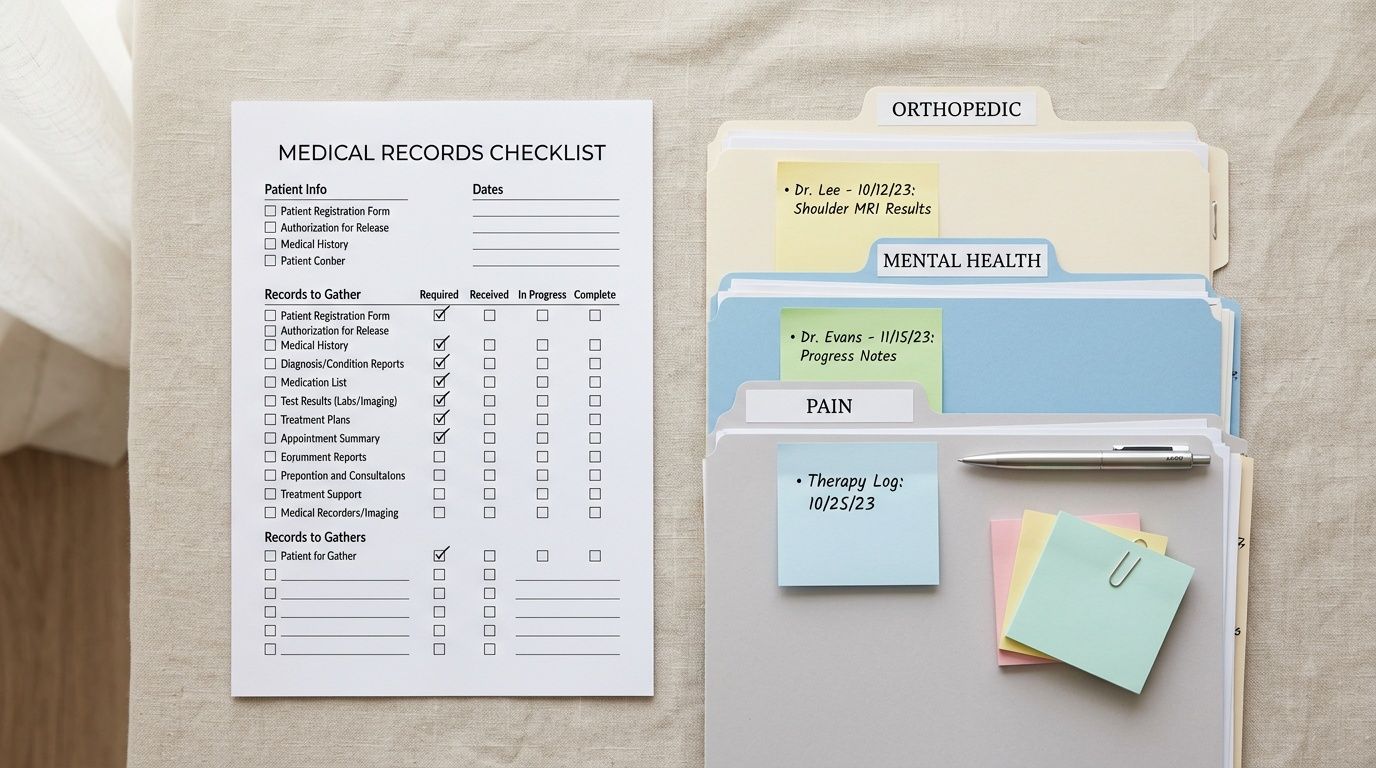
Try grouping your records into simple categories before you upload or submit anything: core diagnosis records, ongoing treatment records, function evidence, and work history support.
| Document Category | Specific Items to Collect |
|---|---|
| Medical treatment records | Primary care notes, orthopedic records, neurology notes, cardiology records, oncology records, pain management records, hospital records |
| Imaging and testing | MRI reports, X-rays, CT scans, EMG or nerve studies, cardiac testing, pathology reports, surgical reports |
| Medication evidence | Current medication list, side effects, dosage changes, reasons medications were stopped |
| Procedure history | Injection records, physical therapy records, surgery notes, post-operative restrictions, rehabilitation records |
| Doctor opinion evidence | RFC forms, narrative letters, clinician-signed MSR, work restrictions, return-to-work notes |
| Symptom documentation | Pain logs, reports of numbness, weakness, balance problems, fatigue, shortness of breath, treatment response |
| Work history proof | Detailed job descriptions, union records if available, employer statements, dates worked, physical demands of each job |
| Personal support evidence | Statements from spouses, adult children, friends, or caregivers describing daily limitations |
A better way to ask doctors for help
Many doctors are willing to help but do not know what Social Security needs. A general request for a disability letter often produces something too vague to matter. A focused request works better:
- Bring a one-page summary: list your diagnoses, your past jobs, and the tasks you can no longer do
- Ask for function-based restrictions: sitting, standing, walking, lifting, reaching, hand use, attendance, and the need to change positions
- Match the dates: the opinion should cover the period you are claiming
- Ask the doctor to tie limits to findings: exams, imaging, surgery history, treatment response, and observed symptoms
- Make sure the limits are realistic: overstated opinions can hurt credibility if they don’t match the chart
A short Medical Summary Report, or MSR, can be useful if the regular records are scattered or thin on functional detail. As noted in the SOAR guide to the SOAR process for SSDI and SSI applications, a clinician-signed narrative that connects symptoms, treatment, and functional limits can help DDS review the case more clearly. It does not replace the treatment notes — it makes them easier to understand.
Step 5: Track Your Application Status via the DDS System
Once you submit the SSDI online application, your case stops feeling visible. That’s normal. The file moves into review, and much of the important work happens behind the scenes at Disability Determination Services, often called DDS.
Your claim generally moves through a few predictable stages:
| Stage | What Happens |
|---|---|
| Non-medical review | Social Security checks technical issues such as earnings and insured status |
| Medical review at DDS | DDS reviews records, may request more evidence, and may schedule an exam if the file is incomplete |
| Initial decision | You receive a written determination by mail |

During this period, your job is to stay responsive. Open every letter. Return forms on time. Tell Social Security when you start new treatment, have surgery, get new imaging, or receive major test results.
What to do while the claim is pending
Check your status regularly through your my Social Security account, but don’t let status-checking replace case management. If DDS asks for forms, answer quickly and completely. If the agency schedules a consultative examination, attend it.
Watch for the common weak points
- Missed mail: Open everything from SSA and DDS the day it arrives.
- Incomplete forms: Don’t leave activity limitations vague.
- Outdated treatment records: Keep submitting newer records if your condition is evolving.
- Consultative exam mistakes: Be honest, cooperative, and consistent.
Step 6: Know When to Seek Legal Aid or Pro Bono Help
Not every claimant can hire private counsel right away, and some people need help before they’ve even filed.
When outside help is worth pursuing
If you have trouble reading forms, tracking deadlines, getting records, or explaining your work history, assistance can make a real difference.
Questions to ask before you rely on a program
- Scope of help: Will they assist with the initial filing only, or also reconsideration and hearing?
- Condition experience: Have they handled claims involving your type of condition?
- Record gathering: Will they request records and review them, or only give general advice?
- Communication: Who will return calls and track deadlines?
Step 7: Prepare for an Appeal and Hearing with an Expert
After an initial denial, some people file a brand-new claim because it feels simpler than appealing. In many cases, that creates avoidable problems — you can lose time and break the continuity of the record.
Appeal first, if you are still within the deadline. If the denial is recent, review the appeal deadline immediately.
What changes at the hearing level
A hearing gives you a chance to present the case with more precision. The judge is looking at medical treatment, work history, symptom consistency, and whether your limitations fit the rules for disability.
What an expert should help you prepare
- Update the record with recent treatment notes, imaging, and specialist evaluations
- Focus on function — how limitations affect sitting, standing, walking, lifting, reaching, handling, and attendance
- Define past work correctly
- Prepare specific, consistent testimony
- Address weak spots — gaps in treatment, unsuccessful work attempts, inconsistent notes
7-Step SSDI Online Application Comparison
| Step / Service | Implementation Complexity | Resource Requirements & Speed | Expected Effectiveness / Quality | Expected Outcomes / Impact | Ideal Use Cases & Key Advantages |
|---|---|---|---|---|---|
| Step 1: Use the Official SSA Online Application Portal (iClaim) | Low–Moderate: straightforward form but strict documentation rules | Low monetary cost; faster than paper but requires time to gather records | Moderate–Low: many first-time denials (≈30–35% approvals) | Official submission, immediate confirmation, quicker processing vs. paper | Best for self-filers with complete records; secure official submission with status tracking |
| Step 2: Pre-Application Case Assessment & Document Compilation | Moderate–High: legal review and strategy planning required | Higher resources (expert time); up-front time investment can speed later stages | High: improves chances of favorable initial decision | Stronger, better-framed application; fewer avoidable denials and delays | Ideal for borderline or complex cases; leverages retired-judge insight to anticipate adjudicator needs |
| Step 3: Understand the Rules with SSA’s “Disability Benefits” Guide | Low: reading and comprehension of procedural rules | Minimal cost (free); time-consuming to interpret bureaucracy | Moderate: authoritative but not case-specific | Better procedural knowledge; reduces documentation mistakes but doesn’t add evidence | Good for applicants who want to learn SSA criteria and Grid Rules before acting |
| Step 4: Organize Your Evidence with a Document Checklist | Low: template-based organization | Low cost; efficient time-saver for assembling records | Moderate: improves presentation and completeness of file | More complete and organized submissions; fewer missing-document delays | Useful for applicants and lawyers to quickly identify gaps; condition-specific templates aid relevance |
| Step 5: Track Your Application Status via the DDS System | Low–Moderate: navigation and monitoring through DDS stages | Low cost; provides near-real-time updates but can lag | Moderate: increases transparency but does not affect determinations | Confirms receipt of evidence, flags requests, helps timely responses | Essential for ongoing case management; representatives can act quickly on DDS requests |
| Step 6: Know When to Seek Legal Aid or Pro Bono Help | Moderate: eligibility screening and intake procedures | Low monetary cost for client; potential long wait times and limited resources | Variable: can be high if experienced counsel available | Provides access to counsel and possible representation through appeals | Best for low-income applicants who cannot afford private counsel; quality varies by program |
| Step 7: Prepare for an Appeal & Hearing with an Expert | High: intensive legal preparation, expert coordination, hearing advocacy | High resources (attorney, experts); time-consuming (often 1+ year) | High: represented applicants have substantially better hearing outcomes | Highest chance of approval at hearing; potential for significant backpay | Critical for denied or complex cases; seasoned hearing attorneys offer strategic advantage |
Frequently Asked Questions
Can I file for SSDI online if I’m over 50?
Yes. Age doesn’t block online filing. The bigger issue is whether your account setup, work history, and medical records are ready.
Do the grid rules mean I’ll automatically be approved after 50?
No. They can help, but only if the medical evidence and work history support the right vocational picture.
Can I apply if I’m still working part time?
Maybe. The question is whether your earnings and activity rise to the level of substantial gainful activity.
What if I was recently denied?
Don’t start a brand-new online application. If the denial is recent, the appeal route is usually the correct next step.

