

You may be in your 50s or early 60s, with a work history you built over decades, and a body that no longer lets you do what your job requires. A back that locks up after standing. A knee that gives out on stairs. Numbness down an arm from a neck problem. Shortness of breath from heart disease. Fatigue after cancer treatment that doesn't lift just because the workday starts.
Wondering what your claim could be worth? Try our free SSDI benefits calculator.
Then the denial arrives. Social Security says you can't do your old job, but you can do “other work.”
That sentence frustrates people for good reason. It sounds abstract, almost careless, when your real life feels anything but abstract. You know what your body can no longer do. The agency is talking about categories, rules, and job adjustment.
For many claimants over 50, that fight turns on a set of rules called the Social Security disability grids. They confuse people because they sound mechanical, and in one sense they are. But they are not random. If you understand how they work, they can become a pathway to approval, especially for workers whose careers were built in physically demanding jobs and who now face serious orthopedic, neurological, cardiac, or cancer-related limitations.
The Over-50 Worker's Dilemma
A common case looks like this. A worker in his late 50s spent years in construction, warehousing, delivery, maintenance, or machine operation. He develops degenerative disc disease, knee damage, cervical radiculopathy, neuropathy, or a heart condition. His doctor tells him to avoid prolonged standing, heavier lifting, repeated bending, or constant walking. He stops working because the job has become unsafe or impossible.
Social Security reviews the file and agrees on one point. He can't return to past work.
But the claim is still denied because the agency believes he can adjust to other jobs.
A denial is not the end of your claim.
Talk to a disability attorney now. Free consultation. No fees unless you win.
Call (617) 683-1983That is where many people get lost. They think the case is now only about diagnosis. It isn't. At that stage, the case becomes a vocational case as much as a medical one. The question changes from “What disease do you have?” to “Given your limitations, age, education, and work background, can you realistically adjust to other work?”
Most denied claimants over 50 are not losing because their condition sounds minor. They are losing because the record doesn't translate the condition into the work limits that the rules actually use.
That matters most for people between 50 and 64, because Social Security's framework recognizes a practical truth. The older you are, the harder it can be to shift into a new line of work, especially if your past work was physical and your skills do not transfer neatly into seated, less demanding jobs.
If you've been told you can do “other work,” don't treat that as the final word. Treat it as the point where the grid rules, your residual functional capacity, and your hearing strategy start to matter.
What Are the Social Security Disability Grids
Once a case reaches step 5, Social Security stops asking whether you can return to your old job and starts asking a narrower vocational question: given your limits, could you adjust to other work? The grids are the chart the agency uses to answer that question. Formally, they are the Medical-Vocational Guidelines in Appendix 2 to Subpart P of Part 404 under the SSA's Medical-Vocational Guidelines.

A judge does not pull one rule out of thin air. The rule comes from four facts in the file, and small changes in any one of them can change the outcome.
The four inputs that drive the chart
- Age. The rules treat a 50-year-old differently from a 49-year-old, and a 55-year-old differently from a 54-year-old.
- Education. Social Security looks at how much schooling you completed and, in some cases, whether that education still helps you move into other work.
- Work experience. The agency looks at your past jobs and whether the skills from those jobs transfer to easier work.
- Residual functional capacity, or RFC. This is the work level Social Security says you can still perform despite your medical problems.
In hearings, RFC is often where cases are won or lost. A file that supports sedentary work can point to one grid rule. A file that drifts into light or medium work can point to a very different result.
What RFC means in practice
RFC is Social Security's shorthand for work capacity. In grid cases, the main exertional categories are sedentary, light, medium, heavy, and very heavy work. Those labels are less technical than they sound. They are really about how much lifting, standing, walking, carrying, and physical effort a person can sustain over a full workday.
Here is the practical picture:
| RFC level | Practical picture |
|---|---|
| Sedentary | Mostly seated work, with only limited standing and walking |
| Light | A job that requires more standing or walking and some modest lifting |
| Medium | Noticeably greater physical demands, often too much for older workers with serious back, joint, lung, or heart limits |
A warehouse worker with lumbar disc disease, knee arthritis, and numbness in the legs may belong in the sedentary category if the record shows sitting is possible but standing and walking are sharply limited. A delivery driver with heart disease who can still be on his feet part of the day may be found capable of light work. Medium work usually makes a grid case much harder, which is why the exact RFC language matters so much.
Practical rule: Your diagnosis gets you into the system. Your RFC, age, education, and job history decide which grid rule applies.
The grids help because they turn a messy vocational question into a rule-based decision. They also leave room for error if the record paints with too broad a brush. From the bench, I saw many cases where the primary dispute was not whether the claimant was sick. It was whether the medical evidence supported the lower RFC category that matched the claimant's age and work history. For workers over 50, that distinction can decide the case.
How the Grids Create an Advantage After Age 50
The strongest feature of the Social Security disability grids for older workers is simple. Age changes the outcome. The rules become more favorable as you move deeper into your 50s and early 60s, especially when your RFC is limited to sedentary or light work and your past skills don't transfer well.
That is not a loophole. It is the design of the system. The grid framework is most favorable at sedentary and light exertional levels and becomes much less favorable at medium or heavier work, with older age groups, especially 50+ and 55+, receiving progressively more favorable treatment under the SSA grid rule overview discussed here.

Not sure if you qualify?
Get a free case review from a New England disability team. You only pay if we win.
Call (617) 683-1983Why age matters so much
In hearings, this is the point many claimants miss. Social Security is not saying older workers are less valuable. It is recognizing that vocational adjustment gets harder with age. A worker who spent decades in physically demanding jobs does not always move easily into a new seated job just because someone in an office labels it “unskilled” or “simple.”
That is particularly true when the worker also has limited tolerance for sitting, standing, walking, reaching, or using the hands.
The legal framework reflects everyday reality:
- A worker just past 50 may get the benefit of rules that would not help a younger claimant with the same medical record.
- A worker past 55 often stands in a much better position if the file shows reduced physical capacity and little transferable skill.
- A worker in the early 60s may have an even stronger vocational argument, especially after a lifetime of labor-heavy work.
The age cliff at a hearing
At hearing level, birthdays matter more than people think. I have seen cases where the difference between a denial and an approval was not a dramatic medical change, but a careful argument about age category, exertional level, and transferability of skills.
That is why timing and framing matter. If a claimant is near a more favorable age category, the hearing strategy should reflect that reality. Counsel should know the claimant's exact age on the relevant dates, the date last insured if SSDI is involved, and whether the medical record supports a sedentary or light RFC before and after that date.
A useful way to think about it is this:
| Age range | Practical grid impact |
|---|---|
| 50 to 54 | The rules start helping, but the RFC and skill issue still need careful development |
| 55 to 59 | The advantage usually becomes stronger |
| 60 to 64 | Adjustment to new work is often harder to argue for, especially with physical limitations |
A denial that says “you can do other work” may be legally fragile if the agency ignored how age, reduced physical capacity, and nontransferable work history fit together.
What helps older claimants most
For workers over 50, the most effective cases usually share a few features:
- A lower exertional RFC. Sedentary or light is where the grids tend to matter most.
- A work history rooted in physical jobs. Factory, trades, driving, warehouse, maintenance, and similar work can create strong arguments against skill transfer.
- A clear medical record. Imaging, treatment notes, specialist records, and function-based doctor opinions help define what work you can't sustain.
- Consistent testimony. Hearing testimony should match the treatment record and job history, not exaggerate and not minimize.
Claimants often focus only on proving they can't do the old job. For people over 50, that is only half the battle. The true advantage comes from proving they also cannot reasonably adjust to a new one under the grid framework.
Defining Your RFC to Fit a Favorable Grid Rule
If the grids are the lock, RFC is the key. Without it, many otherwise strong cases fail. The medical chart may clearly show degenerative disc disease, severe knee arthritis, cervical stenosis, neuropathy, coronary disease, or ongoing effects from cancer treatment. But unless the record translates those diagnoses into work limits, the case stays vague.
The agency does not decide claims by diagnosis name alone. It decides them by function.
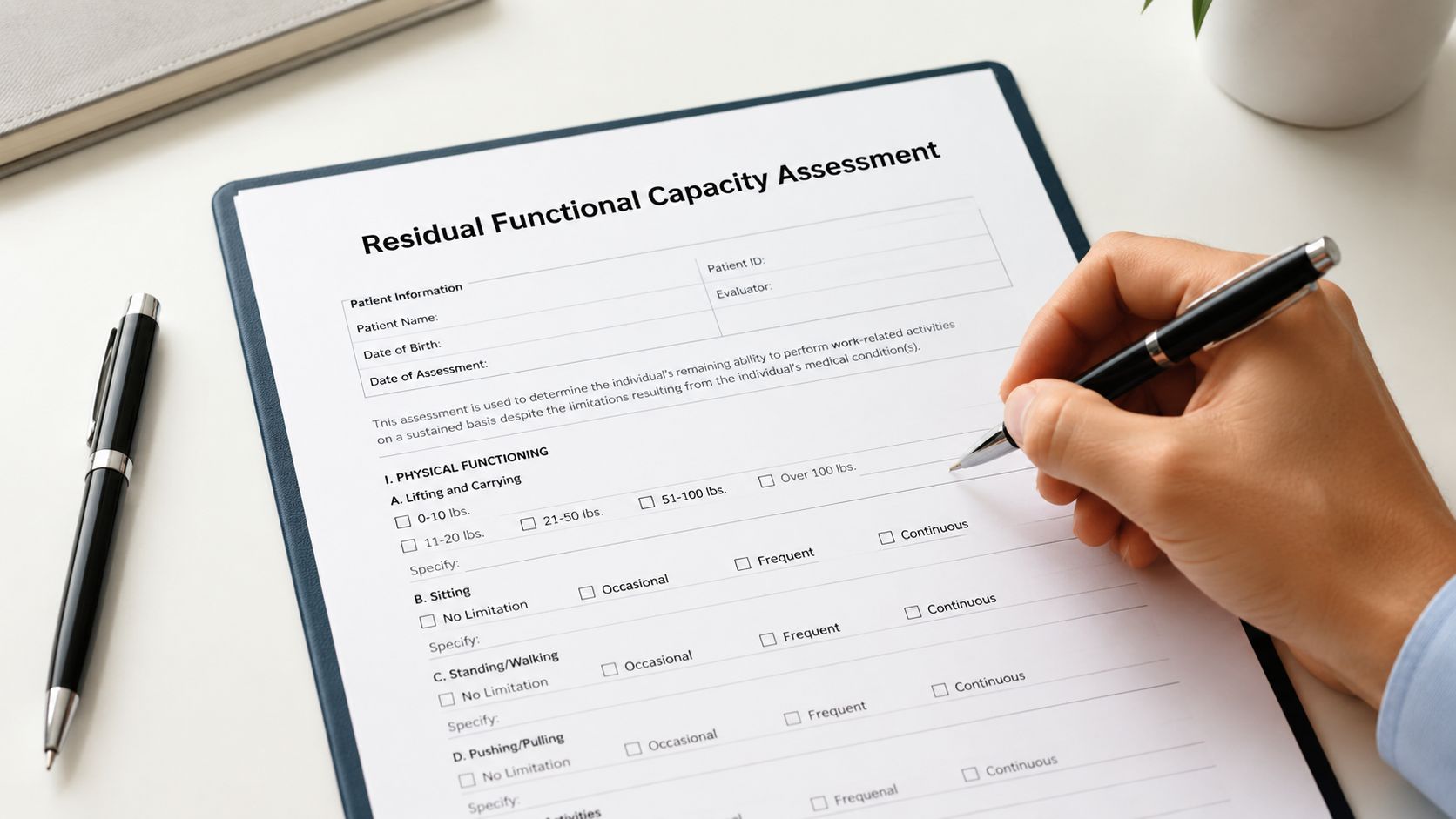
Turn symptoms into work restrictions
A useful hearing record says more than “my back is bad” or “I have heart trouble.” It connects symptoms to sustained work ability.
Here is what that translation often looks like:
- Degenerative disc disease or neck disease becomes limits on lifting, carrying, standing, walking, bending, reaching, or turning the head repeatedly.
- Knee or hip problems become reduced standing and walking tolerance, trouble climbing, and inability to crouch or kneel regularly.
- Neuropathy becomes poor balance, numbness, reduced hand use, or difficulty with fine manipulation.
- Heart disease becomes reduced endurance, shortness of breath, need for slower pace, or inability to tolerate prolonged standing or exertion.
- Cancer and treatment effects become fatigue, weakness, and difficulty sustaining a full work schedule.
What wins cases is specificity. “Pain” is real, but “can sit only briefly before changing position,” “can't stand long enough for production work,” or “can't use hands continuously” is what judges and vocational experts can evaluate.
What to ask your doctor for
Many doctors support their patients but don't know the language Social Security uses. A short letter that says “my patient is disabled” usually carries little weight by itself. A detailed functional opinion carries much more value because it speaks to the actual legal test.
Worried a misstep could cost you benefits?
A short, free consultation now can prevent an expensive mistake later. No upfront fees.
Call (617) 683-1983Ask for an opinion that addresses:
- Lifting and carrying ability
- How long you can sit
- How long you can stand or walk
- Need to alternate positions
- Use of hands for handling and fingering
- Postural limits, such as bending, stooping, crouching, kneeling, or climbing
- Fatigue and pace limits
- Whether symptoms would interfere with a regular work schedule
The strongest medical opinions don't argue the law. They describe what the body can and cannot do over the course of a normal workday.
What doesn't work
Some approaches hurt more than they help.
- Overstating your limits can damage credibility if the treatment notes don't support it.
- Relying on diagnosis labels without function-based restrictions leaves the decision-maker guessing.
- Ignoring old job demands misses the chance to show why your past skills don't transfer.
- Submitting records without a theory forces the judge to assemble your case for you, and judges rarely do that the way an advocate would.
When a claimant over 50 has a record that supports sedentary or limited light work, the RFC should be built carefully and deliberately. That is how you move from “serious condition” to “favorable grid rule.”
When the Grids Do Not Apply Non-Exertional Limits
A common hearing problem looks like this. The claimant is 54, has a bad back and knee damage, and the file points to sedentary work. If that were the whole story, the grid analysis would be fairly neat. But then the record also shows numb fingers, medication drowsiness, and pain that breaks concentration. At that point, the chart alone will not decide the case.
That matters because many over-50 claimants are close to a favorable outcome, but not there on strength limits alone. In my experience, these cases are often won by proving that the person cannot do the full range of sedentary or light work on a regular, sustained basis.
The grids are built mainly for exertional limits. Those are limits on lifting, carrying, standing, walking, and sometimes sitting. Once the case includes non-exertional restrictions, the grid may stop directing the result and start serving as a framework. Social Security then has to look more closely at the full RFC and, in many cases, rely on vocational testimony rather than the chart by itself. Nolo gives a useful overview of that process in its explanation of how Social Security uses the grid rules.

What counts as a non-exertional limit
For claimants over 50, the non-exertional limits that change cases most often are the ones that interfere with ordinary job reliability and production, such as:
- Hand-use problems from neuropathy, cervical radiculopathy, or arthritis that reduce handling, fingering, or grip
- Pain-related concentration loss that affects pace and persistence
- Medication side effects such as sleepiness, slowed thinking, dizziness, or blurred focus
- A need to raise the legs during the day because of swelling or vascular problems
- Extra breaks caused by fatigue, shortness of breath, pain flares, or treatment effects
- Difficulty staying seated long enough to meet the demands of sedentary work
- Mental limits that reduce the ability to follow instructions, stay on task, or deal with ordinary work stress
These are not side issues. For many older workers, they are the reason a seemingly manageable desk job is not workable.
Why non-exertional limits often help claimants over 50
Sedentary work sounds easier than it is. It usually requires frequent hand use, steady attention, regular attendance, and the ability to stay at a workstation for most of the day.
That is why non-exertional limits can change the direction of a case. A claimant may be able to lift only small amounts and still fail at sedentary work because his hands go numb after repeated use. Another may meet the lifting rule for light work but need unscheduled breaks from pain and fatigue. A person with chronic pain may physically get through parts of the day but fall off task often enough that competitive work disappears.
From the bench, I saw this mistake repeatedly. The agency would classify the person at sedentary work, and everyone would focus on the lifting limit. The better question was whether the claimant could do sedentary work eight hours a day, five days a week, with ordinary productivity and attendance. Many could not.
For an over-50 claimant, that is not a technical point. It is often the path to approval when the grid does not hand you a clean win.
How to prove these limits
Judges do not give much weight to vague statements like "pain is severe" or "medication makes me tired." The record needs detail. Good proof answers practical work questions:
- How long can the person use both hands before symptoms interfere?
- How often would attention drop during a normal workday?
- How many extra breaks are likely?
- How long can the person remain seated before needing to stand, recline, or move around?
- Would symptoms likely cause missed work or reduced pace?
The strongest cases tie these limits to treatment notes, specialist findings, medication history, and a doctor opinion that describes function in work terms.
Want a straight answer about your claim?
Free consultation with an experienced SSDI team. No fees unless you win.
Call (617) 683-1983A weak file says the claimant has pain and anxiety. A strong file shows that pain slows pace, medication causes drowsiness by afternoon, and numbness limits fingering to an occasional basis. That kind of detail gives a judge something usable.
The practical lesson
Claimants sometimes worry that adding non-exertional limits will make the case look less organized. The actual problem is not complexity. The actual problem is unsupported allegations.
Supported non-exertional limits can turn an unfavorable exertional finding into a winnable hearing. They narrow the jobs a vocational expert can name. They also expose a point many older workers understand from experience. A job is not available in any meaningful sense if you cannot keep up, stay present, use your hands, or remain at the station long enough to do it.
For claimants over 50, the best strategy is usually to do both at once. Aim for the most favorable exertional RFC the medical record supports, then prove the added non-exertional limits with enough detail that the judge has to confront the actual workplace effect. That is how many close cases move from chart-driven analysis to a credible finding that no substantial work remains.
Hearing Strategies and Grid Rule Examples
A lot of over-50 claimants walk into a hearing thinking the only question is, “Am I sick enough?” That is not usually the question that decides a grid case. Instead, the question is whether the record proves a work limit that fits a favorable rule, or proves enough added limits that the vocational expert cannot identify realistic jobs.
Hearings are often where older-worker cases turn. By that stage, the file usually already shows the diagnoses. What wins is a clear vocational theory that the judge can apply to the rules.
Three issues usually control the hearing:
- The correct RFC
- Whether past skills transfer
- Whether the claimant can make a realistic vocational adjustment at this age

Example one with a direct grid path
Take a 56-year-old former factory worker with a high school education. He spent years lifting, carrying, bending, and moving materials on his feet. Now he has serious knee damage and lumbar spine problems, and the medical record supports a sedentary RFC. His prior work may have been skilled or semi-skilled in some respects, but the skills do not transfer neatly to seated jobs done at a desk.
That is the kind of case a representative should map to a grid rule before the hearing starts. A rule such as Rule 201.14 can direct a finding of disabled if the facts are developed correctly. At that point, the hearing is not about making a broad plea for sympathy. It is about lining up each required fact so the judge can apply the rule without guesswork.
Good hearing preparation in that case usually does four things:
- It pins down the actual physical demands of the past factory job, not the cleaned-up version in a job title.
- It ties the sedentary limit to exam findings, imaging, treatment history, and doctor opinions.
- It shows why any past skills do not transfer to sedentary work with very little adjustment.
- It gives the judge a short, rule-based path to approval.
From the bench, I saw many older workers lose cases they could have won because no one pinned down the transferability issue. A claimant can have the right age and the right RFC and still miss the rule if the past work is described too vaguely.
Example two with a broken-grid strategy
Now take a 52-year-old bookkeeper with a heart condition. The agency says she can do light work. On paper, that may look unfavorable. Her past work also creates a second problem, because Social Security may argue that bookkeeping skills transfer to other jobs.
The hearing strategy in that case is different. Counsel should test whether the light RFC is overstated, and whether the agency's transferability argument survives close inspection. Bookkeeping in practice can involve far more than simple clerical tasks, but transferable skills still must match other jobs closely enough to matter.
Suppose the record shows fatigue, shortness of breath, chest symptoms, medication side effects, and a need for unscheduled breaks. Suppose the treating records also support reduced pace or time off task beyond normal employer tolerance. Then the hearing stops being a simple lifting-and-carrying dispute. It becomes a credibility and work-sustainability case, and that often matters more than the label "light work."
That is where good cross-examination of the vocational expert can change the result. If the expert agrees that extra breaks, off-task time, or poor attendance would eliminate competitive work, the judge has a concrete reason not to rely on the grids alone.
What judges usually look for in over-50 grid cases
The strongest hearings usually share the same traits:
| Effective hearing tactic | Why it matters |
|---|---|
| Accurate past-work testimony | It shows whether the prior job was actually medium, light, skilled, or unskilled |
| Function-based medical proof | It gives the judge work limits, not just diagnoses |
| Clear transferability analysis | It addresses one of the most disputed issues in older-worker cases |
| Targeted vocational testimony | It shows whether any jobs remain once the real limits are added |
Vagueness hurts. Specifics help.
A claimant who says, “I hurt all the time,” may be telling the truth, but that statement does not resolve the legal issue. A claimant who says, “After 20 minutes sitting, I have to stand. After 10 minutes standing, I need to sit again. My hands go numb when I button a shirt or handle small objects,” gives the judge facts that can be matched to work demands.
For claimants over 50, the hearing should also address a point the grids implicitly recognize. Age narrows the range of realistic job changes. Social Security may talk about adjustment to other work as if a 55-year-old laborer can shift into a new seated job with little difficulty. In actual hearings, that assumption often breaks down once the past job is described accurately and the medical limits are stated in work terms.
Preparation matters here. Review old jobs carefully before testifying. Get treating-source opinions that describe sitting, standing, walking, lifting, hand use, pace, attendance, and the need for breaks. If a firm such as Melanson Law Group is involved, the value is usually in case framing, medical evidence review, hearing preparation, and identifying the vocational points that fit the grid rules.
Turning a Denial into an Approval with the Grids
For claimants over 50, the Social Security disability grids are not just technical paperwork. They are often the roadmap to approval. But they only help when the case is built the right way.
That means proving more than a diagnosis. It means showing the correct RFC, the actual demands of your past work, whether your skills transfer, and whether added non-exertional limits make the grid framework incomplete. For workers with back injuries, knee problems, neck conditions, neuropathy, heart disease, or cancer-related fatigue, those distinctions can decide the case.
A denial after age 50 doesn't mean Social Security was right. It often means the claim was not yet framed in the language the system uses.
The hearing level is where that can change. A well-prepared case can turn “you can do other work” into a much harder question, and in the right case, into an approval.
If you're over 50, have been denied SSDI, and your condition keeps you from returning to the work you've done for years, it's worth having your case reviewed through the lens of the grid rules and your actual RFC. Melanson Law Group represents claimants in SSDI applications, hearings, and appeals, and can evaluate whether your age, work history, and medical limits support a stronger argument for benefits.

