
If you're in your 50s or early 60s, still trying to hold life together while schizophrenia affects your focus, sleep, judgment, or ability to be around people, you're probably carrying more than one problem at once. A lot of people in this age group aren't dealing with schizophrenia alone. They're also dealing with back pain, bad knees, neck problems, neuropathy, heart symptoms, cancer treatment, or the lingering wear of decades of physical work.
That combination matters.
People often assume Social Security will approve a claim because schizophrenia is a serious diagnosis. That's not how the system works. Social Security wants proof of how your condition limits work function, and for people between 50 and 64, the strongest claims often show the combined effect of mental and physical impairments. A person who can't reliably handle concentration, pace, and social interaction because of schizophrenia, and also can't stand, lift, walk, or sit consistently because of orthopedic or cardiac problems, may have a much stronger case than someone who submits only a diagnosis and a medication list.
The Reality of Applying for Disability with Schizophrenia
A common situation looks like this. Someone in their late 50s spent years working through symptoms because they had to. They managed with treatment for a while, but work got harder. Then the body started giving out too. The low back pain became constant. The knee started buckling. Standing all day wasn't realistic anymore. Neither was remembering instructions, staying on task, or handling the stress of coworkers and supervisors.
By the time that person files for disability, they're exhausted. They're often behind on bills, embarrassed about needing help, and scared that Social Security won't understand what daily life looks like.
That fear isn't irrational. Schizophrenia claims can be hard to win. An SSA-related analysis of 2019 claims reported only a 1.8% approval rate for people with schizophrenic and other psychotic disorders, compared with 5.2% for mental health disorders overall, according to this SSA-related claims analysis.
Why diagnosis alone usually isn't enough
Social Security doesn't award benefits just because a psychiatrist wrote "schizophrenia" in the chart. The agency looks for medical proof and work-related limitations. It wants to see how symptoms affect your ability to:
- Follow instructions: not just understand them once, but carry them through consistently
- Stay focused: especially when tasks are repetitive, time-sensitive, or stressful
- Interact appropriately: with supervisors, coworkers, and the public
- Adapt to change: including schedule changes, criticism, production pressure, or unexpected events
For older workers, there's another layer. Social Security also looks at what kind of work you've done in the past and whether your current limits leave you with any realistic work options.
Practical rule: A first denial doesn't always mean the claim is weak. It often means the file didn't yet show the full picture.
What tends to go wrong early
Early applications often fail for practical reasons:
| Common problem | Why it hurts the case |
|---|---|
| The records focus only on symptoms | Social Security still needs evidence of work-related limits |
| Physical conditions are left out | The agency may miss how combined impairments reduce job options |
| Treatment notes are sparse or inconsistent | Gaps make it harder to show persistent limitation |
| The claimant minimizes symptoms | The file starts to read better than daily life actually is |
For claimants ages 50 to 64, the goal isn't to tell Social Security that life is hard. It's to show, with records and specific examples, why sustained full-time work isn't realistic anymore.
Understanding What Schizophrenia Disability Benefits Are
When people talk about schizophrenia disability benefits, they usually mean one of two Social Security programs.
SSDI is the earned-benefits program. It functions as an insurance system tied to your work history. If you've worked and paid into Social Security long enough, SSDI is usually the first program to examine.
SSI is different. It's a needs-based program for people with limited income and resources. Some people apply for both, depending on their work record and financial situation.
The benefits question isn't really about diagnosis
The central issue is whether you can perform substantial gainful activity, which is Social Security's way of asking whether you can sustain competitive work. The agency doesn't just ask whether you have schizophrenia. It asks whether your medical conditions keep you from maintaining work on a regular basis.
That distinction matters for people over 50. Many have long work histories and physically demanding jobs. If schizophrenia now affects concentration, reliability, judgment, and adaptation, and physical conditions reduce standing, walking, lifting, reaching, or sitting tolerance, the work analysis changes a lot.
A diagnosis opens the door. Functional evidence gets you through it.
This isn't a rare category in disability practice
Schizophrenia isn't a fringe issue in Social Security disability work. The SSA's Annual Statistical Report for 2023 recorded 8,654 disabled-worker beneficiaries whose primary diagnosis was schizophrenia spectrum and other psychotic disorders, representing 2.7% of disabled-worker awards in the diagnosis breakdown, as discussed in this review of schizophrenia-related disability benefits data.
Which program are you likely dealing with
A quick way to think about it:
- You worked steadily for years: SSDI is usually the main focus
- Your work history is limited or interrupted: SSI may be important
- You're not sure: that's normal. Many people don't know which program fits until their file is reviewed closely
If you're between 50 and 64, don't assume the case is only about mental health. Your work history and your physical decline often shape the outcome just as much as the psychiatric diagnosis.
For many older claimants, the strongest strategy isn't "prove schizophrenia exists." It's "prove why this person, with this work background and these combined limitations, can't keep doing competitive work."
Meeting the SSA Medical Criteria for Schizophrenia
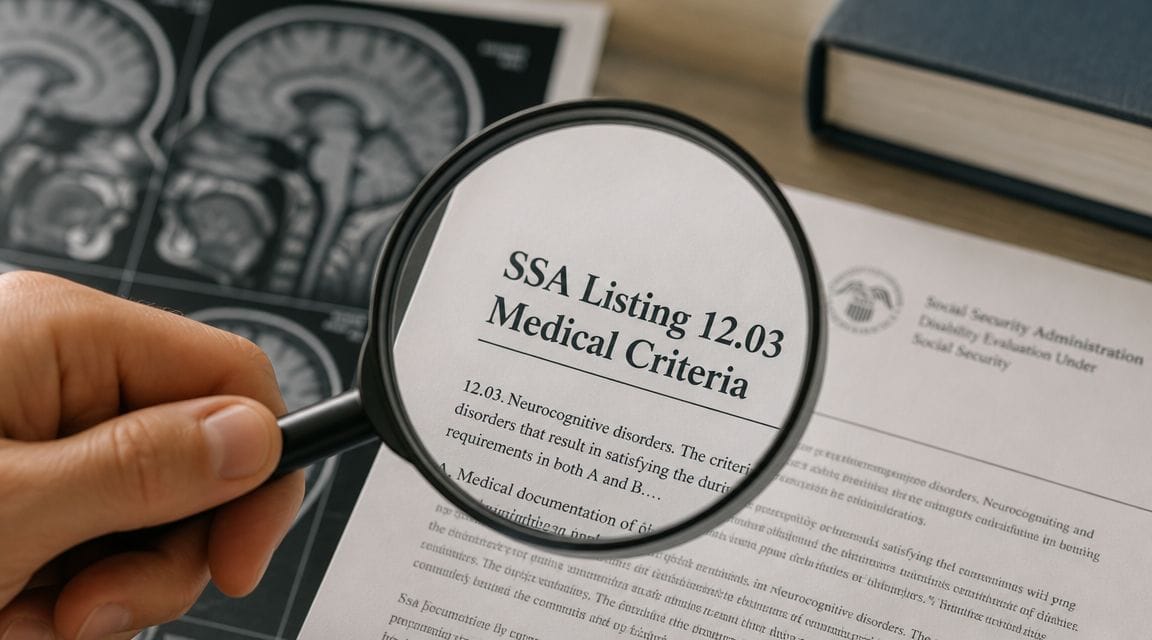
Social Security evaluates schizophrenia under Listing 12.03. The legal wording is technical, but the practical idea is straightforward. The agency wants evidence of psychotic symptoms and evidence of serious limitation in how you function.

Under the SSA's adult mental-disorders rules, schizophrenia can be approved at the listing level if the record shows psychotic symptoms plus either an extreme limitation in one functional domain or marked limitations in two domains, according to SSA Listing 12.03 in the Blue Book.
What Social Security is looking for
The medical side usually starts with documented symptoms such as delusions, hallucinations, disorganized thinking, or grossly disorganized behavior. But symptoms by themselves don't finish the case. Social Security then measures how those symptoms affect four functional areas:
| Functional area | Real-world examples of trouble |
|---|---|
| Understanding or applying information | forgetting instructions, getting lost in steps, poor decision-making |
| Interacting with others | conflict, withdrawal, paranoia, inability to handle supervision |
| Concentrating, persisting, or maintaining pace | losing track of tasks, stopping mid-task, poor follow-through |
| Adapting or managing oneself | poor hygiene, inability to manage appointments, reacting badly to ordinary change |
Marked versus extreme
A marked limitation doesn't mean you can never function in that area. It means the problem is serious enough that ordinary work demands break down reliably.
An extreme limitation is more severe. That usually means functioning in that area is very limited, even outside a work setting.
The records should make that distinction visible. Treatment notes that say "stable today" don't necessarily defeat a case, but they need context. Stable in a quiet exam room isn't the same thing as able to maintain attendance, pace, and appropriate behavior in a job.
The serious and persistent path
Some claimants don't fit neatly into a one-time snapshot. Their records show a longer pattern. Social Security also has a pathway for a serious and persistent disorder when the claimant has a long documented history, ongoing treatment, reduced symptoms because of treatment, and only minimal ability to adapt to changes.
That part of the rule is especially important for people who seem "better" only because they've built a narrow routine with support, medication, and reduced demands.
A strong schizophrenia claim doesn't just say, "My symptoms are severe." It shows how those symptoms keep disrupting ordinary work function despite treatment.
If you're trying to understand what a thorough psychiatric workup should cover, it may help to explore psychiatric evaluations in Florida. A careful evaluation can help identify the functional problems that often get missed in brief medication visits.
The Over 50 Advantage Your Physical Conditions Add
For claimants between 50 and 64, age can change the disability analysis in a useful way. Social Security doesn't look at older workers the same way it looks at younger claimants. The agency recognizes that retraining, job transition, and adaptation become harder with age, especially after years in physically demanding work.
That matters a lot when schizophrenia exists alongside physical illness.

Denied? You have only 60 days to appeal.
Talk to a disability attorney now. Free consultation. No fees unless you win.
Call (617) 683-1983Why combined impairments are often the real case
A schizophrenia claim can be difficult if the file suggests the person can still do simple, low-stress work. A physical claim can also be difficult if the records suggest the person can still do seated or light work. But when both are true at the same time, the remaining job base may shrink dramatically.
Consider how these combinations play out:
- Schizophrenia plus degenerative disc disease: trouble with concentration, stress tolerance, and social functioning, plus limited sitting, standing, bending, and lifting
- Schizophrenia plus knee damage: reduced reliability and pace, plus difficulty walking, climbing, kneeling, or staying on your feet
- Schizophrenia plus heart disease: mental limits on persistence and adaptation, plus reduced stamina and poor tolerance for exertion
- Schizophrenia plus neuropathy or neurological disease: cognitive and psychiatric symptoms layered onto balance problems, numbness, weakness, or slowed movement
An older worker with that profile may not fit back into past work. They may also struggle to transition into new work, especially if the past job was physical and the mental symptoms interfere with retraining.
How the grid rules help older workers
The so-called grid rules are part of Social Security's vocational framework. They matter most when a claimant can't perform past relevant work and has limited capacity for other work. Age, education, work background, and residual functional capacity all start interacting.
The practical takeaway is simple. At 50 and older, certain vocational assumptions become more favorable than they are for younger applicants. If your past work was physical, your transferable skills are limited, and your current mental and physical restrictions leave you below the demands of full-time competitive work, the case can become much stronger.
Older claimants shouldn't separate their impairments into neat boxes. Social Security must consider the whole person.
What works and what doesn't
A useful case theory often looks like this:
| What strengthens the claim | What weakens the claim |
|---|---|
| Showing how schizophrenia limits pace, judgment, and interaction | Filing only psychiatric diagnoses without function details |
| Adding orthopedic, cardiac, neurological, or cancer-related limits | Treating physical pain as a side issue |
| Tying limits back to past job demands | Assuming Social Security will connect the dots on its own |
| Explaining why retraining isn't realistic | Claiming "I can't work" without examples |
For older claimants, the smartest approach is often not to ask whether schizophrenia alone wins the case. It's to ask whether schizophrenia, combined with the rest of the medical record, rules out both past work and any realistic new work.
How to Build an Unmistakable Medical Record
Social Security cases are often won or lost on the file before anyone speaks at a hearing. A strong file doesn't just contain a lot of pages. It tells one consistent story across psychiatry, primary care, therapy, hospital records, and specialists treating physical conditions.
What should be in the record
For schizophrenia disability benefits, the psychiatric evidence should show more than diagnosis codes.
Include records that reflect:
- Psychiatric treatment notes: especially notes describing hallucinations, delusions, disorganized thinking, paranoia, poor insight, poor judgment, or cognitive slowing
- Medication history: what you've taken, whether it helped, and any side effects such as sedation, tremor, fogginess, or slowed thinking
- Therapy or counseling notes: if they describe social withdrawal, inability to cope with stress, or poor day-to-day functioning
- Hospital or crisis records: when symptoms escalated or safety became a concern
- Third-party observations: function reports from a spouse, adult child, sibling, or close friend who sees what daily life really looks like
The physical side needs the same level of detail. If you have degenerative disc disease, knee pathology, neck issues, cardiac limitations, cancer treatment effects, or neurological symptoms, the file should contain the actual treatment trail. Orthopedists, cardiologists, neurologists, oncologists, pain specialists, and physical therapy records all help show the full work picture.
What quality looks like
The best records answer practical work questions.
A psychiatrist's note is more persuasive when it doesn't stop at "patient reports anxiety and hallucinations." It becomes more useful when it explains that the patient can't maintain attention, misreads others' intentions, forgets tasks, avoids leaving home, or decompensates under minor stress.
A spine specialist's note is more useful when it doesn't just list diagnoses. It should describe sitting limits, standing tolerance, gait changes, reduced range of motion, weakness, pain with activity, or why repeated bending and lifting aren't realistic.
Good records don't just prove treatment. They prove function.
A checklist claimants can use
Bring these points to your appointments and keep them in mind when reviewing your own records:
- Describe bad days accurately: not only how you feel at the appointment
- Connect symptoms to tasks: driving, shopping, appointments, personal care, cooking, bills, following instructions
- Track side effects: if medication makes you sleepy, slowed down, shaky, or mentally foggy, say so
- Keep both tracks active: mental health treatment and treatment for physical conditions should both appear in the file
- Watch for contradictions: don't tell one doctor you're doing fine if you tell another you can barely function
If you're trying to organize a large chart before appeal review, tools like a medical record analysis AI agent can help summarize records and spot gaps. It won't replace legal judgment, but it can make a dense file easier to review.
Navigating the Application Reconsideration and Hearing
Applicants typically don't experience the disability process as a clean legal sequence. They experience it as waiting, paperwork, confusion, and another denial when they already feel depleted.
That's especially true in schizophrenia cases, where the symptoms themselves can make forms, deadlines, and treatment follow-through hard to manage.

What each stage usually feels like
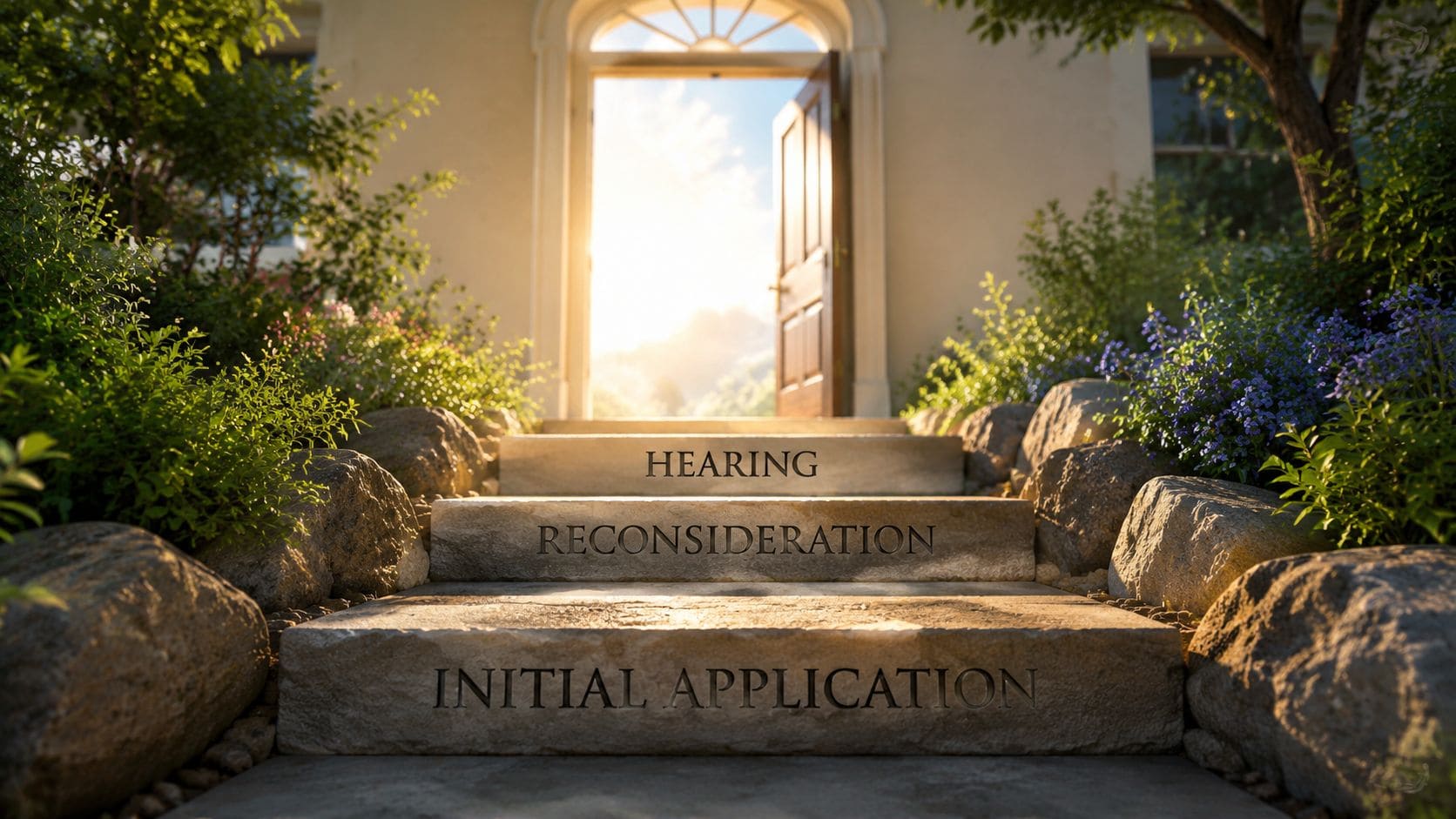
At the initial application, many claimants assume Social Security will gather everything important and understand the diagnosis. Often, that doesn't happen. The agency may receive incomplete records, and the forms may understate how symptoms affect attendance, pace, supervision, and adaptation.
At reconsideration, people often submit the same story again and hope for a different outcome. Sometimes the file is stronger by then, but many cases still haven't fully developed the interaction between psychiatric and physical limitations.
The hearing is different. It's usually the first real chance to explain the full work story to an Administrative Law Judge. Here, details are paramount. Why did the last job end? What happened when stress increased? Why didn't part-time work last? Why doesn't a "good day" translate into reliable full-time work?
Work attempts can help or hurt
The SSA's framework is explicit that disability requires inability to engage in substantial gainful activity for at least 12 months, and common guidance also recognizes that people with schizophrenia may fluctuate, with periods of relative stability followed by decline under work stress, medication side effects, or cognitive overload, as described in this discussion of schizophrenia claims and work capacity.
That means short work attempts aren't automatically fatal. But they have to be explained well.
A judge may see a brief return to work in two very different ways:
| If poorly documented | If well documented |
|---|---|
| "The claimant could work." | "The claimant tried, then failed because symptoms and limits resurfaced." |
| "Symptoms must have improved." | "Temporary stability didn't hold under actual job demands." |
| "Part-time work proves capacity." | "Marginal or supported work wasn't sustainable." |
The hearing story has to be specific
The strongest testimony usually avoids extremes. Saying "I can never do anything" often isn't credible. Saying "I'm fine most of the time" can also sink the case.
A better answer sounds like real life. You can explain that you may have moments of stability, but can't sustain pace, attendance, focus, social interaction, or physical endurance across a normal workweek.
Tell the truth in work terms. Explain what happens when a supervisor corrects you, when a task changes, when pain flares, or when medication slows you down.
For lawyers and claimants preparing a clear timeline from scattered medical records, even a resource built as a guide for personal injury attorneys can be useful. A clean chronology helps show when symptoms worsened, when treatment changed, and why work attempts failed.
When an Experienced Lawyer Makes the Difference
Schizophrenia disability benefits cases are rarely simple, and they become more technical when the claimant is over 50 and also has significant physical conditions. A lawyer's job isn't just to file forms. It's to identify the strongest legal path, develop the missing evidence, and present the case in a way Social Security can approve.
That can mean framing the case under Listing 12.03 when the psychiatric record is strong enough. It can mean developing the vocational argument for an older worker whose schizophrenia combines with degenerative disc disease, knee damage, heart disease, neuropathy, or cancer treatment effects. It can also mean preparing the claimant for the hearing so their testimony matches the medical record instead of accidentally minimizing the case.
A lawyer also sees problems that claimants often miss. Missing specialist records. Notes that sound better than daily life. Work attempts that need context. Gaps in treatment that require explanation. Those issues can often be addressed, but usually not by hoping the judge fills in the blanks.
The right representation is especially valuable when the firm understands how judges evaluate credibility, medical opinions, vocational evidence, and older-worker claims. That kind of experience can make a meaningful difference in how the case is built from the start of the appeal through the hearing.
If schizophrenia and physical conditions have pushed you out of work, Melanson Law Group can help you build a stronger SSDI case. The firm focuses on Social Security disability claims, including appeals and hearings, and offers hands-on guidance with no upfront fees. You only pay if you win.