
A lot of people in their 50s arrive at this problem from the same direction. They worked for decades, pushed through back pain, knee damage, neck problems, heart symptoms, neuropathy, or the aftereffects of cancer treatment, and then hit the point where work stopped being realistic. What starts as an SSDI question quickly becomes a family question. How do we replace income, keep the household stable, and make sure the children who depend on us aren't left behind?
That last part is where many families miss benefits they may already have a path to claim. Social Security isn't only about the disabled worker's monthly check. In the right situation, a parent's disability claim can also open separate benefits for a minor child, for an adult child whose disability began young, or, in a different program, for a child who qualifies for SSI based on disability and household financial need.
How Your Disability Claim Can Help Your Children
When a worker in their late 50s calls after a degenerative disc disease diagnosis, a failed knee replacement, worsening cervical pain, or a serious heart condition, the first fear is usually immediate. They can't keep up with the job. They may already be missing workdays. Savings are under pressure. If there's a child at home, or an adult son or daughter with long-term disabilities, the stress multiplies.
The overlooked piece is that a strong Social Security disability case can do more than replace part of the worker's own income. It can create a doorway to social security childhood disability benefits in more than one form.
The three family pathways people confuse
Families often lump these programs together, but the rules are different:
- Benefits for minor children on a parent's Social Security record. If a parent is approved for SSDI, a child may qualify for monthly dependent benefits based on that parent's work record.
- Disabled Adult Child benefits. An adult child can sometimes receive benefits on a parent's record if the disability began before age 22 and other rules are met.
- SSI for a child. This is a separate, needs-based program for children with severe impairments. It doesn't depend on the parent's work history.
That distinction matters. A parent can lose time and money by applying under the wrong theory, or by assuming one denial means every route is closed.
Social Security child benefits are not rare or fringe. The Social Security Administration found that approximately 3.4% of all children under age 18 received a Social Security child benefit in the 2018 to 2020 period, and beneficiaries included 53% non-Hispanic White, 20% non-Hispanic Black, and 18% Hispanic children, showing these programs reach a broad range of families across the country, as described in the SSA child beneficiaries population profile.
Many parents think, "My claim is about me." In practice, one approved claim can affect the whole household.
For clients in the 50 to 64 age group, this is often the right way to frame the case. Your SSDI claim is still the foundation. But it may also be the event that enables support for your children, especially if you have a minor child at home or an adult child with a lifelong condition who has relied on family care for years.
Securing Your Own SSDI Benefits in Your 50s and 60s
Before any child can draw on your record, your own disability case has to be built correctly. That's especially important for workers in their 50s and early 60s, because this age range often has legal advantages if the evidence is organized the right way.

Why age matters in an SSDI case
Social Security doesn't award benefits just because you've been diagnosed with degenerative disc disease, severe knee arthritis, spinal stenosis, neuropathy, coronary disease, or cancer. The agency looks at how your medical problems limit work activity.
For people between 50 and 64, that analysis often turns on residual functional capacity, usually shortened to RFC. RFC is the most Social Security believes you can still do in a work setting despite your medical problems.
For this age group, the practical fight is often about whether you can sustain:
- Standing and walking enough for light work
- Sitting long enough for sedentary work
- Frequent use of hands, arms, or neck movement
- Regular attendance without excessive absences
- Safe performance despite pain medication, fatigue, dizziness, or cardiac symptoms
A person with lumbar disc disease may not be disabled because an MRI looks bad. That same person may become disabled under Social Security's rules if the records show limited sitting, the need to change positions, reduced lifting, failed treatment, and a work history in jobs that don't transfer well to less demanding work.
What makes evidence persuasive
The strongest claims usually tell a consistent story across medical records, work history, and day-to-day limitations.
Helpful evidence often includes:
- Specialist treatment notes from orthopedists, neurologists, cardiologists, oncologists, or pain physicians
- Imaging and testing that supports the diagnosis
- A treatment timeline showing injections, physical therapy, surgeries, medication changes, or ongoing symptoms despite care
- Detailed function reports describing what happens when you sit, stand, walk, bend, reach, lift, or concentrate over a full workday
Practical rule: Don't focus only on diagnosis names. Focus on work consequences. Social Security decides cases based on functional limits, not sympathy.
Common mistakes in the 50 to 64 age range
People lose winnable claims when they understate their restrictions or describe their past jobs too loosely. "Manager" can sound sedentary on paper even if the actual job involved climbing stairs, stocking, lifting files, walking a plant floor, or driving between sites. The same problem comes up with nursing, warehouse, maintenance, construction, machine operation, and delivery work.
A few things usually help:
- Describe your past jobs as you performed them. Not how they looked in a title.
- Track position changes and rest periods. If you need to alternate sitting and standing, that matters.
- Explain failed attempts to keep working. Reduced hours, missed days, and task changes can support credibility.
If your own claim isn't won, child benefits tied to your record usually don't move forward. That's why the worker's case has to be treated as the anchor, not as a separate issue from the family.
Unlocking Monthly Benefits for Your Minor Children
Once a parent is approved for SSDI, the next question is often simple. Does my child get anything too? In many households, the answer is yes.

When a child may qualify
If you're receiving SSDI, your unmarried minor child may also qualify for a monthly benefit on your record. In many cases, that includes a child under 18, and it can also continue a bit longer for a child who is still in high school.
This isn't SSI. It isn't based on the child's own medical condition. It's a dependent benefit that flows from the parent's Social Security entitlement.
The most important practical point is cause and effect. No approved parent claim, no dependent child benefit on that record.
How families should think about the amount
The payment for a child on a parent's record is tied to the parent's benefit, but families shouldn't assume the amount will match what they heard from a friend or saw online. Social Security also applies a family maximum, which can affect how much is payable when more than one dependent is drawing on the same record.
That means two things are true at once:
- A child benefit can be a meaningful source of monthly support.
- The exact amount needs to be confirmed with Social Security after the parent's claim is approved.
Families often wait to ask about dependent benefits until months after approval. That's usually a mistake. Ask early and make sure every potentially eligible child is identified.
Practical steps after approval
After the parent's SSDI claim is allowed, gather the basics right away:
- Birth certificate information for each child
- School status details if an older teenager is still in high school
- Relationship documents if the family structure is blended or otherwise nonstandard
This is one area where delay can create avoidable confusion. The worker is often exhausted from the main disability case and assumes Social Security will automatically sort out the children's side. Sometimes it does. Sometimes it doesn't. It's safer to treat child benefits as a separate follow-up task that deserves direct attention.
Understanding Disabled Adult Child Benefits
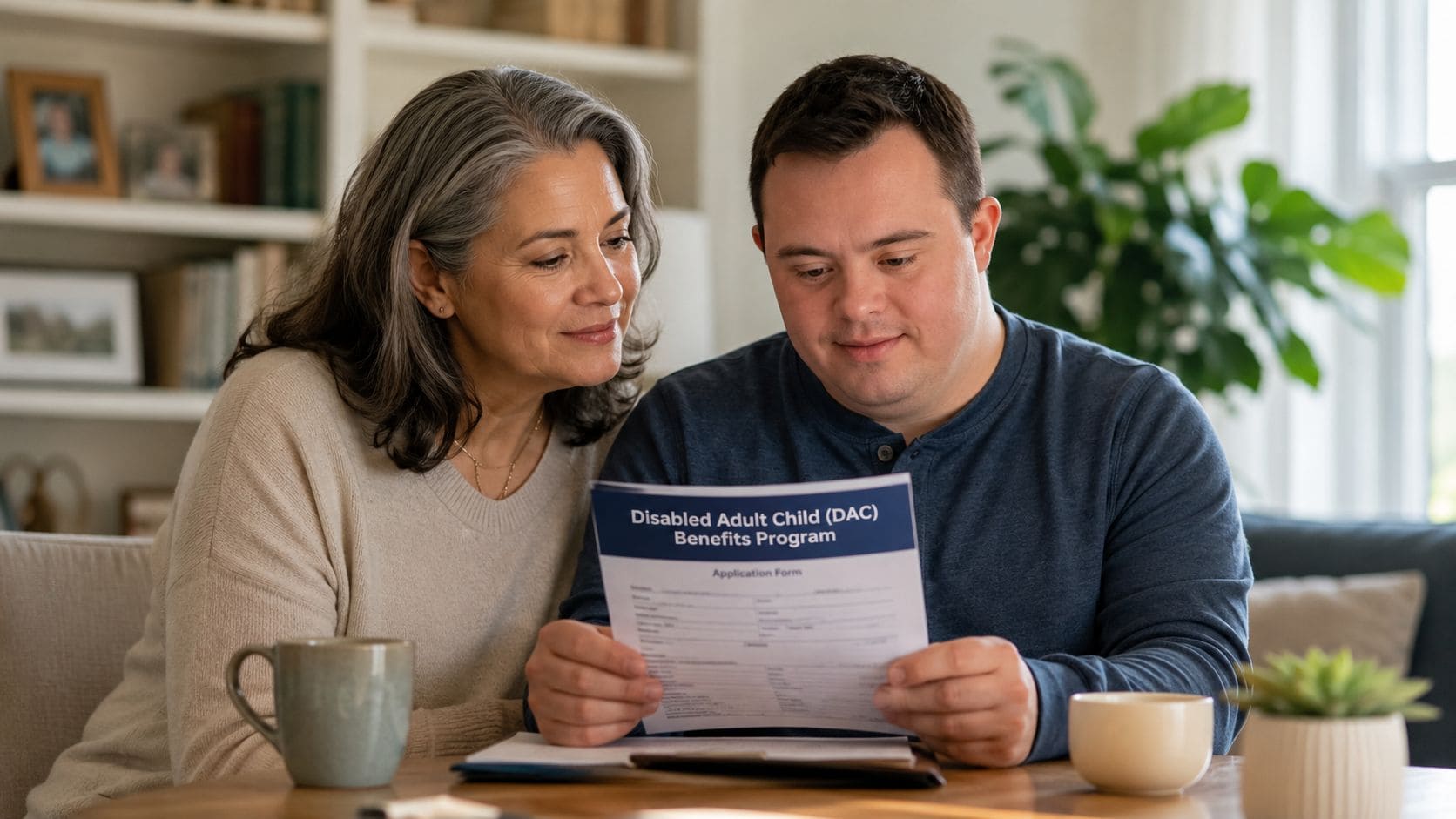
For many families, the most valuable and least understood benefit is the Disabled Adult Child benefit, often shortened to DAC. This is the program that matters when a parent in their 50s or 60s has an adult son or daughter with a long-term disability that began young.
The timeline that controls the case
DAC cases make more sense if you think in terms of a timeline.
First, the adult child must have become disabled before age 22. Second, the parent must later reach a triggering event in Social Security, usually retirement, disability entitlement, or death. When those pieces line up, the adult child may be able to draw on the parent's record.
The benefit is not SSI. It is a Title II dependent benefit, and eligibility requires disability onset before age 22 and a parent entitled to Social Security. The payment is typically 50% of the parent's full retirement or disability benefit amount, as explained in this overview of the Disabled Adult Child benefit under Title II.
The core requirements
A DAC claim usually turns on a short list of questions:
| Requirement | What it means in practice |
|---|---|
| Adult child status | The claimant is now 18 or older |
| Early disability onset | The disability began before age 22 |
| Parent trigger | A parent is receiving Social Security retirement or disability benefits, or is deceased |
| Marital status | Marriage can affect eligibility, so this needs careful review |
The difficult requirement is often not current disability. It's proving the start date.
Denied? You have only 60 days to appeal.
Talk to a disability attorney now. Free consultation. No fees unless you win.
Call (617) 683-1983An adult may clearly be disabled now because of cerebral palsy, an intellectual disability, epilepsy, an early neurological disorder, or another long-standing condition. But Social Security still wants evidence tying the disability back to the period before age 22.
Where families get stuck
Parents sometimes assume that because they have cared for an adult child for years, DAC should be automatic once they win SSDI or start retirement. It isn't. Social Security still wants documentation.
The best DAC cases usually have a paper trail that includes some combination of:
- Older medical records
- Special education records
- Neuropsychological testing
- Statements showing long-term functional dependence
- Treatment records that connect youth limitations to current adult disability
A DAC claim is often won or lost on old records. If the disability began early, don't wait to track down pediatric files, school evaluations, and prior specialist notes.
For a parent who has spent years as a caregiver, this benefit can change the long-term plan for the whole family. It shifts support away from pure parental income and toward an independent Social Security entitlement for the adult child on the parent's earnings record.
Qualifying for Supplemental Security Income for a Child
SSI for a child is a different lane entirely. It matters most when a child has severe impairments and the household has limited income and resources, especially if the parent doesn't have enough work credits for SSDI or the child isn't claiming on a parent's record.
A child can qualify for SSI from birth if the impairment is medically determinable, causes marked and severe functional limitations, and has lasted or is expected to last at least 12 months or result in death. Unlike adult SSDI, there is no five-month waiting period for SSI payments, as stated in Social Security's SSI rules for children with disabilities.
How SSI differs from dependent benefits
This is the point families need to keep straight:
- Minor child benefits on a parent's SSDI record depend on the parent's entitlement.
- DAC benefits depend on disability before 22 plus a qualifying parent's Social Security status.
- SSI for a child depends on the child's disability and the household's financial picture.
So if a parent in their late 50s has a pending SSDI case but weak work history, a child may still have an SSI route. On the other hand, a family with stronger Social Security earnings may find that a dependent or DAC path fits better.
What Social Security looks for in child SSI cases
For a minor child, Social Security asks a different medical question than it asks in an adult worker's case. It looks at how the child's condition affects functioning in daily life, development, learning, communication, behavior, and age-appropriate independence.
Conditions can be physical, neurological, developmental, or a combination. What matters is not the label alone, but the degree of limitation and how well the records show it.
A child SSI claim usually works best when parents can show both:
- Consistent treatment evidence
- Clear examples of how the child functions compared with other children the same age
Families often assume a serious diagnosis is enough. It usually isn't. SSI for children depends heavily on functional detail, school information, and treatment records that show what the child cannot do reliably.
The Medical Evidence Needed to Prove a Child's Disability
Families often know their child is struggling, but Social Security cases are won with records, timelines, and function evidence. The exact proof depends on whether the claim is for a minor child's SSI case or a Disabled Adult Child case.
The standards are different
For a young child on SSI, Social Security focuses on whether the condition creates severe functional problems in childhood settings. For DAC, Social Security uses the adult disability standard for the claimant now, while also requiring proof that the disability began before age 22.
That creates two different evidence strategies.
| Factor | SSI for a Minor Child | Disabled Adult Child (DAC) Benefits |
|---|---|---|
| Main disability question | Does the child have marked and severe functional limitations? | Is the adult child currently disabled under adult rules? |
| Key time focus | Current childhood functioning | Current adult disability plus onset before age 22 |
| Most useful records | Pediatric treatment notes, therapy records, school reports, teacher observations | Adult medical records, older medical files, school records, developmental history |
| Common weak point | Records describe diagnosis but not daily impact | Missing proof that limitations existed before age 22 |
| Best supporting statements | Parent, teacher, therapist, specialist | Parent, long-term treating doctors, school personnel, prior evaluators |
What helps in a minor child SSI case
In child SSI cases, some of the best evidence doesn't come only from a doctor. It often comes from the adults who see the child trying to function every day.
Strong evidence may include:
- Teacher questionnaires describing attention, pace, classroom behavior, mobility, or fine motor problems
- Speech, occupational, or physical therapy notes showing persistent limitations
- Specialist opinions that explain why the child's impairment affects age-appropriate functioning
- Parent observations that are specific rather than general
A weak statement says, "He struggles a lot."
A stronger statement says, "He can sit for only short periods, needs repeated redirection, melts down when routines change, and still can't complete tasks other children his age handle independently."
What helps in a DAC case
DAC claims usually require a split-screen approach. You need evidence for the present and evidence from the past.
Current proof may look familiar to anyone handling an adult disability case: specialist care, testing, hospital records, medication history, and function opinions. The older proof is where families run into trouble.
Look for records such as:
- School evaluations and IEP files
- Pediatric or adolescent neurology, psychiatry, or developmental records
- Testing done around high school years
- Documents showing inability to work or live independently early on
The most persuasive DAC files tell one continuous story from youth into adulthood. Gaps can be explained, but they shouldn't be ignored.
If older records are missing, don't give up. Families can still build the timeline with whatever reliable evidence remains. But they need to do it deliberately. Social Security won't fill in those blanks for you.
What to Do After a Denial and How a Lawyer Can Help
A denial letter feels personal, especially when the case involves a child. Parents read it as Social Security saying the child isn't really disabled, or the family doesn't need help badly enough. That's not the right way to read it.
Many denials happen because the record was incomplete, the forms didn't describe limitations well, or the agency didn't get the full picture about onset, function, or work history. That is frustrating, but it is fixable.

Why child-related claims are often denied
In my experience, the most common problems are practical ones:
- Missing function evidence. The records show diagnoses but don't show daily limits clearly.
- Weak onset proof in DAC cases. The adult child is disabled now, but the file doesn't prove disability began before 22.
- Incomplete parent claim development. If the worker's SSDI case isn't established, dependent benefits tied to that record may stall.
- Poorly framed activities. Families often minimize struggles because they're used to adapting.
Some claims should have been approved earlier but weren't. That's one reason the appeal process matters.
What happens after the first denial
Most families move through at least two possible review stages after an initial denial:
- Reconsideration
- A hearing before an Administrative Law Judge
The hearing level is often where cases improve because the judge can hear testimony, review updated records, and look at the timeline more carefully. That matters in orthopedic claims, chronic pain cases, neurological conditions, and DAC onset disputes.
A broader historical point also explains why these family benefits matter so much. The share of child beneficiaries receiving benefits because a parent was disabled rose from 29% in 1980 to a peak of 43% during the Great Recession, and Social Security paid about $3 billion to children of retired, disabled, or deceased workers and some adults disabled before age 22, according to this review of child-benefit trends in Social Security.
What a lawyer can actually do
A good disability lawyer doesn't just file forms. The work is more specific than that.
A strong representative can:
- Identify the right benefit theory. Minor child benefit, DAC, child SSI, or more than one.
- Build the record. That includes medical records, school files, treatment notes, and missing historical evidence.
- Prepare testimony. Parents and adult children often know the facts but need help presenting them in a way Social Security understands.
- Spot technical issues early. Onset dates, relationship proof, school status, and work history details can make or break a case.
A denial usually means the evidence wasn't enough for that reviewer on that record. It doesn't mean the claim can't win.
Families should treat an appeal as a new chance to present the case properly, not as a paperwork sequel to the first filing.
If you're dealing with your own SSDI claim and trying to understand how it could also protect your children, Melanson Law Group can help you evaluate the full picture. The firm represents disabled workers and families through applications, appeals, and hearings, with practical guidance on worker claims, dependent benefits, and the evidence needed to build a stronger case.