
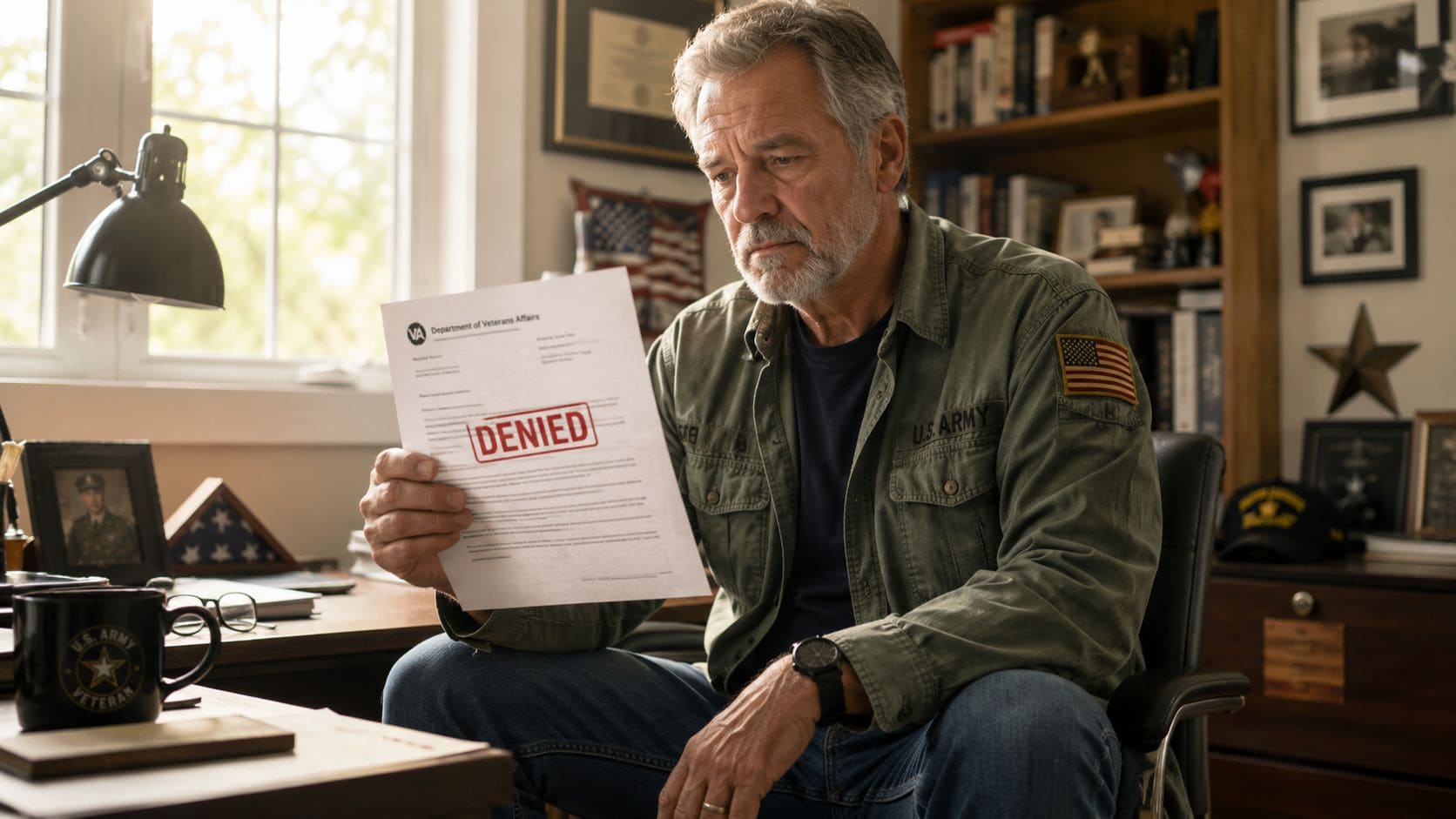
You wake up already stiff. Your back takes a few minutes to loosen up. Your knee doesn't trust stairs anymore. Your hands may still work, but not all day, and not without pain shooting into your neck, shoulders, or legs. You did the job for years anyway. Then you filed for disability, expecting your medical records and VA history to speak for themselves.
Instead, you got a denial.
For veterans between 50 and 64, that denial often lands at the worst possible time. Retirement isn't here yet. Full-time work may be unrealistic. Savings may already be under pressure. If you have degenerative disc disease, bad knees, cervical problems, neuropathy, heart disease, cancer, or another serious physical condition, the legal problem isn't only whether you're hurting. It's whether the agency reviewing your claim understands how your condition keeps you from sustaining work on a regular basis.
That's where a skilled veteran disability attorney becomes useful, especially when your case touches both VA disability and Social Security Disability Insurance (SSDI). Those systems overlap in evidence, but they don't use the same rules. If you treat them as identical, you can weaken both claims. If you align them correctly, your records can work together instead of against you.
Your Body Says Stop But the System Says No
A veteran in his late fifties comes in with a familiar story. He spent years pushing through back pain from lumbar disc problems, then added knee degeneration, then numbness down one leg. He has a VA rating. His doctors know he's struggling. But the denial letter still says he can do some form of work.
That's the part that feels insulting. Veterans over 50 often aren't claiming they can't lift a feather or move at all. They're saying something more realistic. They can't do it reliably, repeatedly, and for a full work schedule without pain, fatigue, swelling, shortness of breath, or the need to stop and recover.
Why this problem is getting bigger
More veterans are living with service-connected disability than in earlier years. The share of Post-9/11 veterans with a service-connected disability rose from about 18% in 2008 to 31% in 2022, and one source notes the claims process can average around 5 months for an initial decision, which helps explain why many veterans struggle to manage it alone, especially when health and income are both under strain (After Service on veteran disability claims).
That trend matters for older veterans because physical wear doesn't stay frozen in time. A service-connected back injury from decades ago may now involve stenosis, nerve symptoms, falls, sleep disruption, medication side effects, and reduced endurance. A knee injury may become a gait problem that affects hips and spine. A heart condition may leave you able to do small tasks, but not enough to keep a job.
Practical rule: A denial usually doesn't mean your condition isn't serious. It often means the file doesn't yet connect your diagnosis to specific work limitations in the way the decision-maker expects.
What usually goes wrong
Many denied claims have one of these problems:
- The records list diagnoses but not limits. "Degenerative disc disease" is not the same as "can't sit longer than brief periods without changing position."
- The story is medically true but legally incomplete. Doctors treat symptoms. Disability claims require proof of function.
- The veteran tried to be tough. That habit helps in life. It can hurt in a disability file if the records understate what a normal week looks like.
For many people, the denial isn't the end of the case. It's the point where strategy starts.
Understanding Your Two Disability Claims VA vs SSDI
A lot of veterans assume a strong VA rating should carry the day with Social Security. It doesn't work that way. The two systems ask different questions, and that difference is where many cases get lost.
One of the biggest gaps in online guidance is the crossover issue. Many resources don't explain how to align VA records and a VA rating with the separate legal standards of SSDI, which can lead to inconsistent statements and weaker cases across both systems (CCK on veterans lawyers and SSDI crossover issues).
The side by side comparison that matters
| Attribute | VA Disability Compensation | Social Security Disability (SSDI) |
|---|---|---|
| Who runs it | Department of Veterans Affairs | Social Security Administration |
| Main purpose | Compensation for service-connected medical conditions | Income replacement when a person can no longer perform substantial work because of disability |
| Core question | Is the condition connected to military service, and how severe is it? | Does the condition keep you from sustaining competitive work under Social Security's rules? |
| How disability is measured | By ratings for service-connected conditions | By whether you are disabled from work under SSA's standard |
| Service connection required | Yes | No |
| Can you receive benefits while still working | In some circumstances, depending on the VA issue and rating picture | SSDI focuses on inability to sustain qualifying work under SSA rules |
| Why records matter | To prove service connection, severity, and functional effects | To prove medically supported work limitations, including sitting, standing, walking, lifting, using hands, pace, attendance, and stamina |
| What a VA rating means to the other system | It helps within VA | It can support an SSDI claim, but it does not guarantee approval |
What a veteran disability attorney should actually do
A good attorney does more than send your VA file to Social Security and hope for the best. The job is to translate the evidence.
For example, a VA record may strongly support chronic back pain, knee instability, radiculopathy, or cardiac symptoms. But SSDI often turns on practical questions:
- How long can you sit before pain forces a position change?
- Do you need to raise a leg?
- How often do you miss activity because of flares, treatment, or fatigue?
- Can you stoop, crouch, reach, handle, or walk safely and consistently?
- Would you stay on task through a normal workday?
Your VA evidence is useful. It just has to be organized around Social Security's rules instead of VA rating language.
Where veterans hurt their own cases
The most common mistake is inconsistency. A veteran tells the VA, truthfully, "I push through and still do some things." Then the SSDI file says, "I can't maintain full-time work." Those statements may both be true, but if they aren't framed carefully, the file can look contradictory.
Another problem is overreliance on labels. A diagnosis like degenerative disc disease, coronary artery disease, neuropathy, or cancer history matters. It doesn't answer the legal question by itself. The winning file usually shows how the condition affects attendance, posture, pace, lifting, balance, or endurance across a normal week.
When You Should Hire a Disability Attorney
The most important time to hire counsel is often right after a denial. That's when the file stops being an application and becomes an appeal strategy.
For VA disability appeals, representation is associated with materially better results. In 2018, the approval rate was 44.61% for veterans with an attorney versus 27.22% without one, an absolute difference of more than 17 percentage points (Sean Kendall Law on VA appeal success rates). That statistic comes from the VA appeal context, but the larger lesson carries over. Appeals are legal records. They usually improve when someone is actively shaping the evidence.

Why the denial stage changes the case
At the denial stage, most veterans need three things quickly.
- A theory of the case. Not a pile of records. A clear explanation of why your conditions prevent sustained work.
- Medical development. The right treatment notes, imaging, specialist records, and functional statements matter more than volume.
- Preparation for the next decision-maker. The record should be built with the next level of review in mind, not the last one.
Veterans over 50 have an additional reason to get help. Social Security cases often turn on vocational issues tied to age, prior work, transferable skills, and physical limitations. That legal analysis can be favorable when it's argued correctly, but it rarely argues itself.
When waiting becomes expensive
Some people wait because they're worried about cost or they think another filing will fix things. Sometimes it does. Often it only burns time.
Watch for these signs that you shouldn't handle it alone:
- You have multiple physical conditions. Back, knees, neck, nerve pain, heart disease, and fatigue can combine into a much stronger case than any one diagnosis alone.
- Your records are scattered. VA treatment, private orthopedics, cardiology, oncology, pain management, and physical therapy don't gather themselves into one coherent story.
- Your denial says you can do lighter work. That's usually where legal and vocational arguments matter most.
- You don't know how your VA records fit your SSDI claim. That crossover issue is exactly where many veterans lose ground.
A good attorney isn't there to add paperwork. The job is to decide what evidence matters, what doesn't, and how to present your limits in a way a judge can use.
The fee issue
Most disability representation is handled on a contingency basis. That means you don't pay upfront and the lawyer gets paid only if the case succeeds, subject to the governing fee rules in that system. For many veterans, that makes the decision easier. You're not paying for hope. You're hiring someone to improve the odds and reduce avoidable mistakes.
How to Find and Vet the Right Attorney
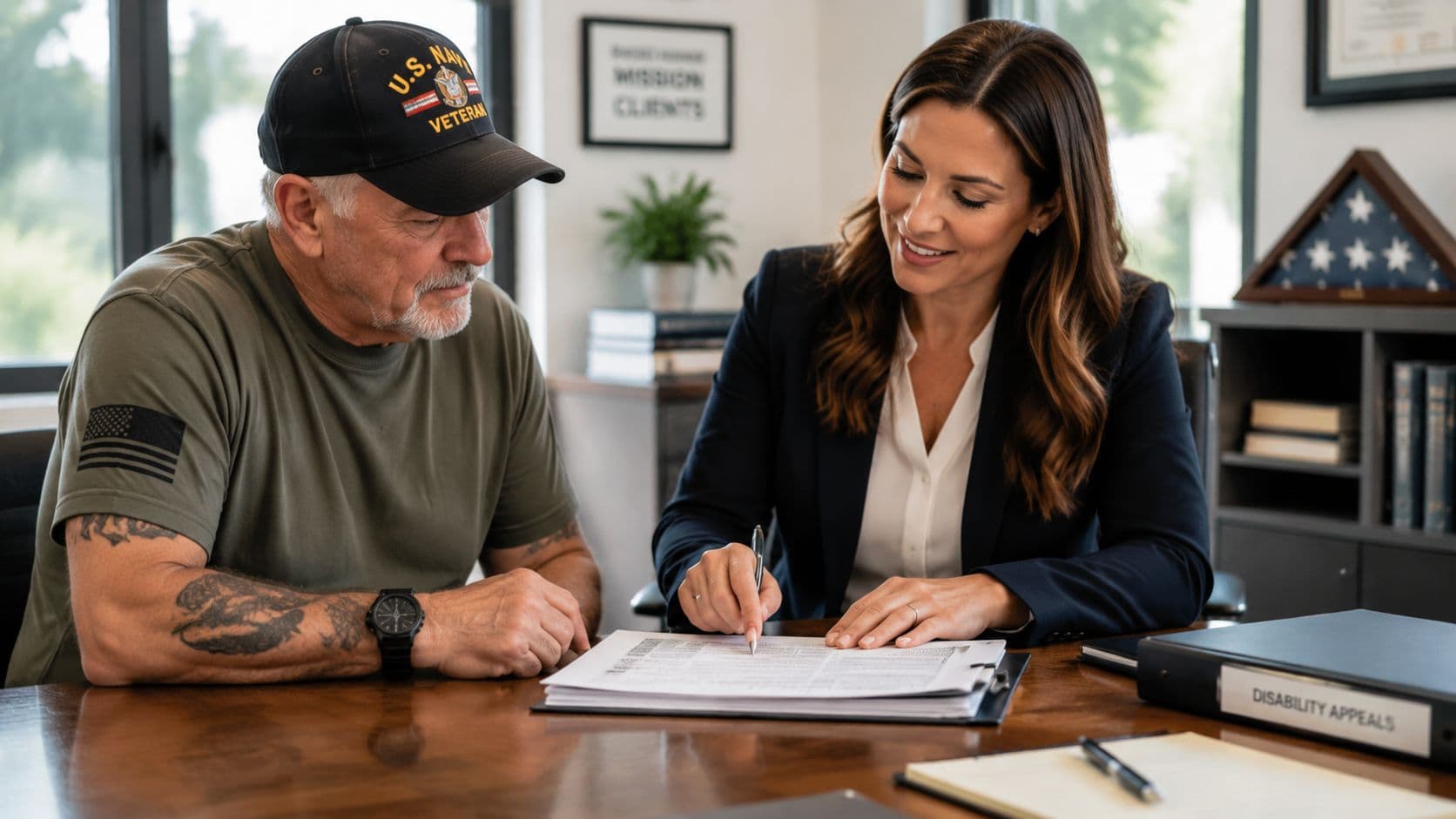
A lot of veterans call after they have already had one bad consultation. The lawyer talked about the VA rating, promised to "take care of it," and never explained how Social Security will judge a 58-year-old mechanic with a bad back, shortness of breath, and a work history built on physical labor. That is the wrong fit.
You need a lawyer who can look at your case through the Social Security rules while still knowing how to use your VA file the right way. For veterans over 50, that often means a close look at whether your medical records show the limits that stop full-time work: how long you can sit, stand, walk, lift, bend, reach, concentrate, and stay on task. A diagnosis alone does not answer those questions.

What to look for first
Start with fit, not branding.
A strong veteran disability attorney for an SSDI case should be able to talk about function in plain English. If you say your degenerative disc disease lets you sit only 20 minutes before you have to shift positions, or your heart condition leaves you wiped out after a short walk, the lawyer should immediately understand why that matters. They should also tell you what is still missing from the file.
Denied? You have only 60 days to appeal.
Talk to a disability attorney now. Free consultation. No fees unless you win.
Call (617) 683-1983Focus on these points:
- SSDI hearing work: Ask whether the attorney personally handles administrative hearings and prepares clients for testimony about pain, fatigue, limited range of motion, and reduced stamina.
- Experience with claimants over 50: Age can change how Social Security looks at transferable skills and available work. A lawyer who understands that can make better use of your work history.
- Ability to read medical records for work limits: MRIs, nerve studies, cardiology notes, oncology treatment records, and medication side effects matter only if someone ties them to job function.
- A plan for record development: "We will request the records" is not enough. Ask what records they want first, whether they seek treating source opinions, and how they deal with gaps between VA findings and SSDI standards.
- Clarity about who handles the case: Some offices run intake well and case preparation poorly. Ask who reviews records, who calls you before key deadlines, and who appears at the hearing.
Questions worth asking in the first call
Good questions save time. They also tell you whether the lawyer sees the weak spots in your claim.
How do you use VA evidence without treating it like automatic proof for SSDI?
The answer should be specific. VA ratings can support the case, but Social Security still needs evidence about work-related limits.What would you do if my records show chronic pain or heart symptoms, but do not say much about sitting, standing, lifting, or attendance?
A useful answer includes steps, not slogans.Have you handled cases involving degenerative disc disease, spinal stenosis, knee degeneration, neuropathy, coronary disease, arrhythmia, or treatment-related fatigue?
These conditions often look different on paper than they do in real life. The lawyer should know that.What concerns do you see in my work history?
Veterans over 50 often have long careers in skilled or semi-skilled work. Sometimes that helps. Sometimes Social Security argues those skills transfer to lighter jobs. A good lawyer should spot that issue early.Who will represent me if the case goes to hearing?
Get a direct answer.How do you prepare veterans who tend to understate symptoms?
That matters more than many people realize. Judges need accurate limits, not stoicism.
Warning signs that should slow you down
Some answers tell you to keep looking.
- The lawyer treats your VA rating as the whole case. That misses the central SSDI question, whether you can still sustain substantial work.
- The office has no clear strategy for older workers with physical jobs. Veterans over 50 often win or lose on vocational details, not on diagnosis labels.
- Nobody asks about side effects, postural limits, or missed workdays. Those facts can be as important as imaging results.
- The firm cannot tell you who will appear at the hearing. Unclear staffing often leads to poor preparation.
- You hear broad reassurance but no case analysis. You should leave the call with a better sense of what needs to be proved.
The right lawyer can explain your claim in work terms a judge can use. How far you walk. How long you sit. How often you need to lie down. How pain, fatigue, and medication affect a full workday.
One practical option to compare
If you are comparing firms in New England, Melanson Law Group handles SSDI claims for disabled workers, including veterans, and focuses on record development and hearing preparation. Whether you speak with that office or another one, use the same test. Ask how they will separate the VA issues from the SSDI issues, how they will prove function instead of diagnosis, and how they will build a case for a veteran over 50 whose body no longer matches the job history on paper.
Preparing Your Case The Process and What to Expect
Most veterans feel better once they understand the path ahead. The process is still slow, but it becomes more manageable when you know what your lawyer needs from you and what happens next.
The first rule is simple. Don't wait until the hearing notice arrives to get organized. Start pulling together the backbone of the file as soon as the denial comes in.
What to gather early
Your attorney's office will usually obtain records, but you can speed things up by identifying the key sources.
Bring together:
- Service and VA basics: DD-214, VA rating decisions, denial notices, appeal paperwork, and any prior favorable findings.
- Medical provider list: VA clinics, private orthopedists, neurology, cardiology, oncology, pain management, primary care, physical therapy, and imaging centers.
- Medication history: Not just the names. Also note side effects such as drowsiness, dizziness, or slowed concentration.
- Work history: Job titles, dates, duties, lifting demands, walking demands, time on your feet, driving, climbing, use of tools, and any accommodations that stopped working.
- Daily limitation notes: Brief examples help. How long you can sit, stand, walk, bend, or use your hands before symptoms spike matters more than broad statements like "I hurt all the time."
What your attorney is trying to prove
A serious disability case usually needs more than proof that you're under treatment. The file should show that your condition prevents reliable work activity on a sustained basis.
For physical cases, the strongest records often address questions like these:
| Issue | Why it matters |
|---|---|
| Sitting and standing tolerance | Many denials assume a person can do seated or light work |
| Walking and balance | Knee degeneration, neuropathy, and spinal problems often affect safety and stamina |
| Use of arms and hands | Neck issues and neurological problems can limit reaching, handling, or fingering |
| Attendance and persistence | Pain flares, medical appointments, treatment, and fatigue can disrupt a normal work schedule |
| Cardiac or cancer-related endurance | Reduced stamina may block even modest work demands |
What the appeal path teaches us about delay
Even outside Social Security, appeal-lane selection matters. In Board of Veterans' Appeals data summarized by Berry Law, FY2021 legacy appeals were approved at 32% and AMA appeals at 38.1%, while average decision times were 2,015 days for legacy appeals, 300 days for direct review, 338 days for evidence submission, and 547 days for hearing docket AMA appeals (Berry Law summary of VA appeal lanes and timing). The lesson for veterans is straightforward. Choosing the wrong path can cost years.
That same principle applies to SSDI strategy. The lawyer's role isn't only to file the next form. It's to decide what development should happen before the next decision, what records must be updated, and whether the case is being built for reconsideration or for an administrative law judge.
If your case is headed to hearing, preparation should start months before the hearing, not the night before.
What the hearing stage usually turns on
By the hearing stage, the question is rarely whether you've been diagnosed. The main issue is whether the judge can see how those diagnoses affect your ability to work day after day.
For veterans over 50, hearing preparation often focuses on three areas:
- Past work reality: What the job required, not what the title sounds like on paper.
- Consistency: Making sure your testimony, treatment records, and written forms tell the same story.
- Specific limitations: Clear examples beat labels. "I need to alternate position throughout the day" is stronger than "I have back pain."
A good hearing prep session should also address the habits that hurt veterans. Many people answer questions too briefly, minimize pain, or talk about their best day instead of their normal week. None of that helps a judge understand why work has become impossible to sustain.
What you can do while the case is pending
Use the waiting time well.
- Keep treating when you can. Gaps in care can create avoidable questions, even when there are understandable reasons for them.
- Report symptoms accurately. Don't tough it out in the medical record.
- Tell your lawyer about changes quickly. Surgery, new imaging, falls, cardiac events, cancer recurrence, medication changes, and new specialists can all matter.
- Save written notices. Deadlines matter, and missing one can create a completely separate problem.
The process can be slow. A well-prepared file still gives you a better chance than a rushed one.
How Melanson Law Group Fights for Veterans
Veterans over 50 usually don't need a motivational speech. They need a firm that understands how judges evaluate disability claims, how physical conditions affect work, and how to prepare a case that holds together under scrutiny.
Melanson Law Group's model fits that need in a practical way. The firm focuses on SSDI representation and handles cases from application through reconsideration and administrative hearing. For veterans, that matters because the hardest part of the case is often translating years of VA and civilian medical evidence into a Social Security record that is clear, consistent, and work-focused.
What that means in an actual case
The firm's background gives it two useful angles.
- Judge-level perspective: Jack Melanson is a retired Social Security judge who has decided more than 6,000 disability claims. That kind of experience helps a legal team spot the difference between records that are merely sympathetic and records that are persuasive.
- Litigation discipline: Ned Melanson's background as a former corporate litigator supports the other half of the job, which is building a coherent evidentiary theory instead of submitting disconnected records.
That combination matters for veterans with conditions like degenerative disc disease, joint deterioration, cervical spine problems, neurological disease, heart conditions, or cancer-related limitations. These cases often don't fail because the veteran lacks treatment. They fail because the file doesn't clearly connect medical proof to work limits, attendance problems, positional changes, reduced endurance, or unsafe movement.
The hands on part matters too
A good disability practice doesn't treat hearing prep as an afterthought. It should help the client understand what the judge is likely to care about, where the weak spots are, and how to explain limitations without understatement or overstatement.
For many veterans, that's the first time someone has framed the case correctly. Not "Are you hurting?" but "What can you still do, how long can you do it, what happens when you try, and can you repeat it five days a week?"
If you're a veteran trying to hold together a VA claim and an SSDI case at the same time, that kind of disciplined preparation can make the difference between a messy file and a persuasive one.
If you're dealing with a denial and need help aligning your VA evidence with an SSDI claim, Melanson Law Group can review the case, explain the next step, and represent you with no upfront fee.