
You may be in your late 50s, living somewhere in Massachusetts, Maine, New Hampshire, Vermont, Connecticut, or Rhode Island, and trying to make sense of a life that no longer feels familiar. Maybe it started with a fall on ice, a car crash on Route 1, a work accident, or a strike to the head that seemed manageable at first. Months later, the underlying issue isn't just headaches. It's forgetting what you were doing, losing your place in conversations, snapping at people you love, and realizing you can't keep up with the job you did for years.
For many people in this age group, traumatic brain injury disability is not one clean diagnosis with one neat file of records. It's a brain injury layered on top of a bad back, worn-out knees, neck pain, heart problems, neuropathy, cancer treatment, or another condition that already made work harder. That combination matters. It often explains why someone who looked employable on paper can no longer sustain work in practice.
If Social Security has already denied your claim, that doesn't mean they think you're fine. It often means the file didn't yet tell the right story in the right way.
Table of Contents
- Your Life After a TBI and Why You Cannot Work
- How the SSA Defines Traumatic Brain Injury Disability
- Meeting the SSA Disability Listings for TBI
- Your TBI Combined with Other Conditions The Over 50 Advantage
- Building the Medical Evidence to Prove Your TBI Claim
- Navigating the SSDI Application and Hearing Process
- When to Partner with an Experienced Disability Lawyer
Your Life After a TBI and Why You Cannot Work
A common New England disability case looks like this. A woman in her late 50s slips, hits her head, and goes to the hospital. She goes home expecting improvement. Instead, she develops memory lapses, brain fog, irritability, slowed thinking, and fatigue. She also already has degenerative disc disease, chronic neck pain, or knee problems that make standing, walking, and commuting harder than they used to be.

At that point, work doesn't usually end because of one dramatic symptom. It ends because too many small failures pile up. You forget instructions. You miss appointments. You can't stay on task. You make mistakes with paperwork, inventory, customer interactions, driving routes, or safety procedures. Then pain and poor sleep make the cognitive problems worse.
That experience is far from rare. Among U.S. adults age 40 and older with a history of head injury involving loss of consciousness, 47.4% were living with disability in at least one area of functioning, affecting about 11.4 million people, according to a nationally representative study discussed in the National Library of Medicine article on head injury and disability burden. The same source notes that people age 75 and older account for about 32% of TBI-related hospitalizations.
TBI often becomes a work disability case not because the injury is visible, but because the person can no longer reliably function through a full workday, five days a week.
What older workers often notice first
- Memory changes: You start relying on notes for tasks you once did from habit.
- Mental slowing: Multi-step work becomes confusing, especially under pressure.
- Behavior changes: Irritability, anxiety, or poor frustration tolerance cause problems with supervisors and coworkers.
- Physical overlap: Back pain, knee instability, shoulder problems, or neck pain reduce your margin for error even more.
For workers in their 50s and early 60s, this mix of cognitive and physical limits often explains the whole case better than the brain injury diagnosis alone.
How the SSA Defines Traumatic Brain Injury Disability
Social Security does not award benefits because a doctor diagnosed a traumatic brain injury. The agency asks a different question. Can you still perform substantial gainful activity? In plain English, can you sustain competitive work on a regular and continuing basis?
That distinction trips people up. A claimant will say, truthfully, “I have a TBI.” Social Security may still deny the claim if the medical record does not clearly show what the TBI prevents the person from doing in a work setting.
Diagnosis is the start, not the finish
A diagnosis tells the SSA what happened medically. A disability finding requires proof of functional loss. That means evidence about things like:
- Attention and pace: Can you stay focused long enough to complete ordinary tasks?
- Memory and follow-through: Can you remember instructions without repeated reminders?
- Judgment and adaptation: Can you handle schedule changes, supervision, and ordinary workplace stress?
- Physical stamina: Can you sit, stand, walk, lift, reach, or use your hands consistently enough for a real job?
A strong claim translates symptoms into work consequences. “I get overwhelmed in noisy environments” is better than “I have headaches.” “I miss medication doses unless my spouse reminds me” is better than “I have memory issues.”
What the SSA wants to see
The agency usually evaluates the full file, not one dramatic record. It looks for a pattern over time. Consistency matters. If emergency records, neurology notes, physical therapy notes, mental health treatment, and family statements all point in the same direction, the case gets stronger.
Practical rule: Never assume the judge will connect the dots for you. Your records should connect the injury to the daily limitations, and the daily limitations to the inability to work.
For claimants in New England, this matters even more when they have a long work history in physically demanding jobs, skilled trades, health care, transportation, clerical work, or retail management. The SSA will compare your present abilities to the demands of your past work. Then it will ask whether any other work remains.
The best frame is simple. Don't present your case as “I had a TBI.” Present it as “Because of the TBI, plus my other medical conditions, I can't reliably meet the mental and physical demands of full-time work.”
Meeting the SSA Disability Listings for TBI
Some claimants qualify because their condition meets a Social Security listing. Many do not. That does not mean they should lose. It means the case must be built another way. Still, it helps to understand the listings because they show what kinds of limitations Social Security considers most serious.
What Listing 11.18 looks for
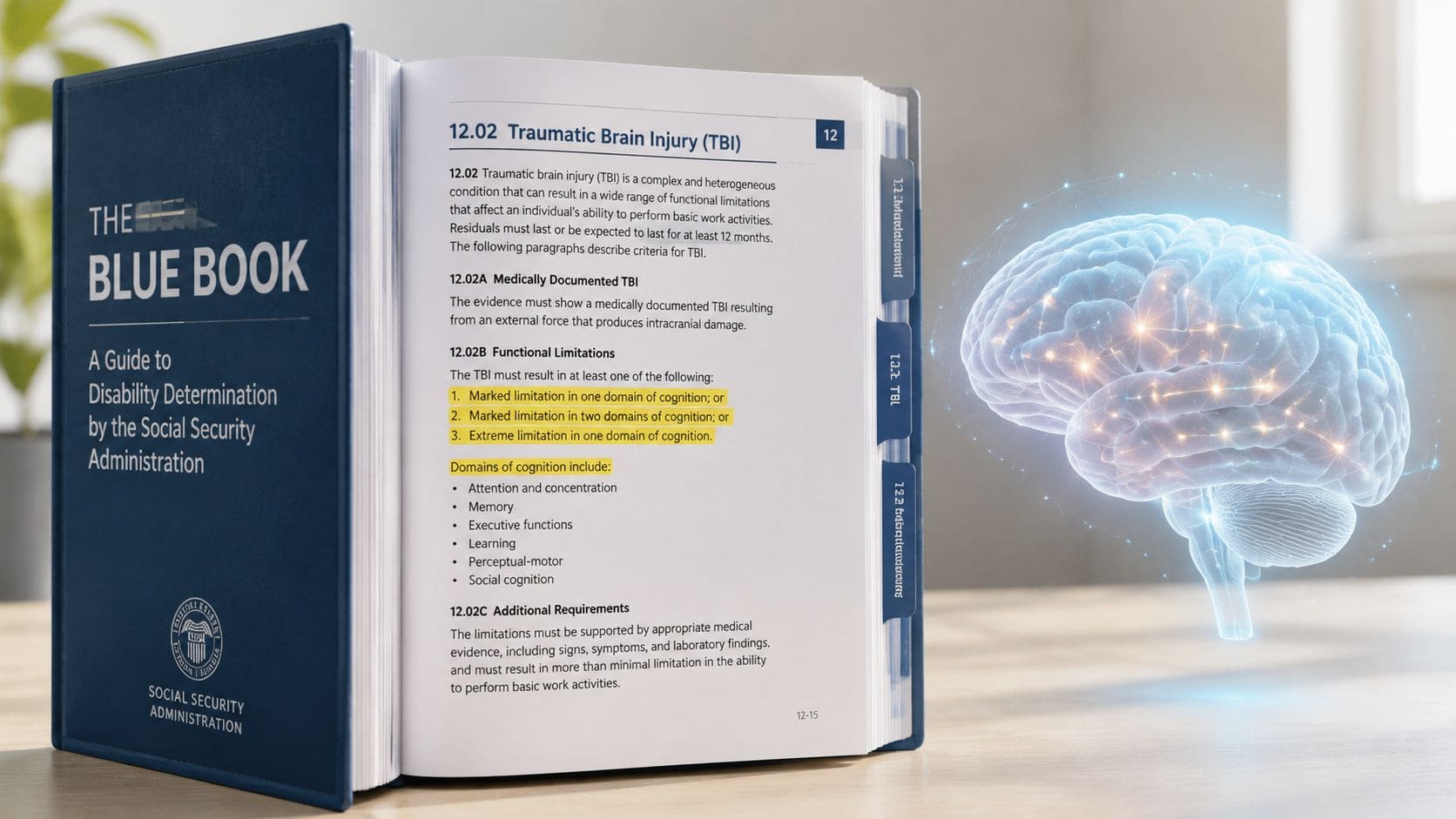
Listing 11.18 addresses traumatic brain injury. In practice, it often focuses on severe physical consequences or severe mental limitations after the injury. Some people think of TBI as only a thinking problem. Social Security does not. It may consider balance problems, use of the arms or hands, and other motor deficits alongside cognitive symptoms.
For a person in their 50s, that can matter a lot. If your TBI left you with dizziness, poor balance, slowed processing, and neck pain after a fall, that may present very differently from a younger person with a single concussion who returned to school or work quickly.
Why Listing 12.02 matters in many TBI cases
Many TBI claims are evaluated through Listing 12.02 for neurocognitive disorders, especially when the biggest problems are memory, executive function, concentration, social judgment, or self-management.
The hard part is that many of these symptoms are invisible. They do not always show up on a simple scan. The National Academies discussion of TBI as an invisible disability captures the central challenge well: cognitive and behavioral changes often require proof through daily functional limits, caregiver observations, and neuropsychological testing, not just imaging. The same source notes that survivors of moderate or severe TBI may need physical therapy and mental health services, which reinforces that the disability can extend well beyond obvious motor loss.
Here is how I explain the mental-function criteria in plain language:
- Understanding, remembering, or applying information: You can't reliably learn new tasks, follow steps, or retain instructions.
- Interacting with others: You become withdrawn, irritable, impulsive, or easily overwhelmed by routine contact.
- Concentrating, persisting, or maintaining pace: You start tasks and lose track, work too slowly, or need extra breaks.
- Adapting or managing oneself: You struggle with appointments, medications, finances, hygiene, or changes in routine.
A “marked” limitation is more than inconvenience. It means the problem seriously interferes with functioning. An “extreme” limitation is even more severe. In real life, that might look like someone who can microwave a meal but can't manage a workday, stay on pace, respond appropriately to criticism, and remember basic instructions without repeated prompting.
If your scans are normal but your life is not, your case is not weak. It just has to be documented differently.
Many people with traumatic brain injury disability don't meet a listing exactly. They still win because the evidence shows they cannot sustain work when all limitations are considered together.
Your TBI Combined with Other Conditions The Over 50 Advantage
If you are between 50 and 64, this may be the most important part of your case. Social Security does not have to find that the TBI alone disables you. It must decide whether all of your medically supported limitations keep you from performing your past work or adjusting to other work.
For older claimants, that combined analysis can be far more favorable than people realize.
Denied? You have only 60 days to appeal.
Talk to a disability attorney now. Free consultation. No fees unless you win.
Call (617) 683-1983Why combined impairments win cases
A brain injury rarely lives alone in the file of a worker in this age range. Many claimants also have degenerative disc disease, lumbar radiculopathy, spinal stenosis, severe knee arthritis, shoulder injuries, cervical problems, heart disease, neuropathy, cancer treatment side effects, or chronic pain. Each condition may look manageable by itself. Together, they can eliminate even simple work.
A person might be physically able to sit for part of the day, but not long enough without pain. Or mentally able to do simple tasks, but not at a steady pace. Or capable of attending work some days, but not reliably because fatigue, headaches, dizziness, and pain flare together.
The analysis of TBI outcomes and social factors in PubMed Central makes an important point: why some TBI survivors work and others do not often depends on more than the initial injury. Access to rehabilitation, family support, depression, anxiety, and other comorbid conditions can shape long-term function. In disability terms, that means your claim gets stronger when the file shows the whole picture, not just the head injury in isolation.
How the SSA Grid Rules View Claimants Over 50
The Medical-Vocational Guidelines, often called the Grid Rules, can help older workers. They recognize a basic truth. It is harder for a person in their 50s or early 60s, with health limits and a long work history in one kind of job, to switch into new work than it is for a much younger person.
Below is the practical lens the SSA often applies.
How the SSA Grid Rules View Claimants Over 50
| Age Group | Education Level | Past Work Type | Functional Limit Example | Likely Grid Rule Outcome |
|---|---|---|---|---|
| 50 to 54 | Limited or high school education | Heavy or medium physical work | Reduced to sedentary or less, with added cognitive limits | Often more favorable than for younger claimants |
| 55 to 59 | High school or less, or education not leading to easy job transfer | Skilled or semi-skilled work without transferable skills | Reduced to light or sedentary work, plus memory or pace problems | Frequently strong for approval analysis |
| 60 to 64 | Long work history in physically demanding or specialized work | Skills tied to prior field | Limited physical range, slower processing, poor adaptation | Especially favorable when transferable skills are weak |
This table is not a promise of approval. It shows the direction of the analysis. Age, education, past work, transferable skills, and residual functional capacity all matter.
For many New England claimants, the winning argument is not “my TBI is catastrophic.” It is “I am over 50, my work history is in jobs I can no longer do, my other conditions already narrowed my options, and my TBI-related cognitive deficits remove the few jobs that might otherwise remain.”
Building the Medical Evidence to Prove Your TBI Claim
A strong traumatic brain injury disability case is built with detail. Not volume alone. Detail. The file must show what happened at the time of injury, what symptoms persisted, how treatment unfolded, and what you still cannot do now.

The records that carry real weight
Start with the early records. The objective backbone of the case often comes from documentation of the initial injury. According to the Physiopedia explanation of the Glasgow Coma Scale, the key records include the Glasgow Coma Scale (GCS) score, the duration of loss of consciousness (LOC), and the period of post-traumatic amnesia (PTA). That source also notes that LOC greater than 6 hours is strongly correlated with severe, permanent impairment.
Those details matter because they create the medical bridge between the accident and the long-term deficits.
After that, the most persuasive evidence usually includes:
- Neuropsychological testing: This is often the clearest way to document problems with memory, attention, processing speed, executive function, and mental stamina.
- Neurology and rehabilitation records: These help show the clinical course over time.
- Mental health treatment notes: If you developed depression, anxiety, irritability, or emotional dysregulation after the injury, those records matter.
- Physical treatment records: Spine care, orthopedic evaluations, physical therapy, pain management, and cardiac treatment can show why your overall work capacity is further reduced.
- Function-focused opinions from treating providers: The useful question is not “Is my patient disabled?” It is “What can this person still do, and for how long, in a work setting?”
What does not prove enough on its own
Many claimants think a normal MRI ruins the case. It doesn't. A scan can be relevant, but it is not the whole case. The problem in many denied claims is not lack of diagnosis. It is lack of function evidence.
What usually falls short by itself:
- A diagnosis list without limitations
- Short office notes that only say “stable”
- Generic letters saying you cannot work
- Your testimony without supporting treatment records
- One-time emergency records without follow-up documentation
Bring your doctors concrete examples. “I forget appointments unless my spouse reminds me.” “I lose track after ten minutes.” “I can't sit through a task because neck pain and headaches build.” Doctors write better notes when they understand the day-to-day failures.
Third-party statements can also help. A spouse, adult child, close friend, or former coworker may be the best witness to the change after the injury. They can describe how you handled bills before and after, whether you get lost while driving, whether you need reminders, whether your temper changed, and why returning to work failed or never became realistic.
Navigating the SSDI Application and Hearing Process
The SSDI process is usually won by building the record in layers. The initial application creates the foundation. Reconsideration gives you a chance to repair obvious weaknesses. The hearing is where many traumatic brain injury disability cases finally make sense to the decision-maker.

What happens at each stage
At the initial application, Social Security reviews forms, medical records, work history, and your statements about daily life. Many people are too brief here. They list diagnoses but don't explain why they can't sustain work.
At reconsideration, the agency reviews the case again. This stage often feels discouraging because the result may be another denial. Still, it gives you a chance to submit better records, correct inaccurate work descriptions, and sharpen the theory of the case.
Then comes the Administrative Law Judge hearing. This is usually the most important stage because a judge can look at the entire file, hear your testimony, and evaluate the combined effect of your conditions in a fuller way than the earlier paper review.
Why the hearing is often the turning point
At hearing, the judge is not just reading codes and clinic notes. The judge hears how your symptoms affect ordinary work functions. That includes staying on task, following instructions, dealing with supervisors, showing up consistently, and handling changes.
The European TBI burden study available through PubMed Central is often cited for the point that TBI contributed to over 1.3 million years of potential life lost in Europe, which reflects the condition's profound impact on functioning and work life. In Social Security cases, the practical takeaway is narrower: adjudicators need evidence linking the initial injury markers, including GCS and post-traumatic amnesia, to persistent functional deficits. That is exactly where a well-prepared hearing presentation matters.
A Vocational Expert often testifies. The judge asks that expert whether a hypothetical person with certain limitations could perform past work or other jobs. Details are critical in this assessment. If the hypothetical leaves out slowed pace, off-task behavior, missed days, the need for reminders, or the combined effect of pain and cognitive fatigue, the testimony can sound far worse for the claimant than it should.
A denial is not the end of the case. In many TBI claims, the real case does not appear clearly until the hearing record is fully developed.
The hearing is also your chance to explain failed work attempts, why symptoms fluctuate, and why “simple work” is not simple for someone with memory deficits, pain, fatigue, and reduced tolerance for ordinary stress.
When to Partner with an Experienced Disability Lawyer
TBI claims are hard because the symptoms that end careers are often the least visible on paper. Add age, a long work history, and other physical conditions, and the case becomes legally technical fast. That is when an experienced disability lawyer can make a real difference.
A good attorney does more than file forms. They identify the theory of the case. They determine whether the best path is a listing argument, a residual functional capacity argument, a Grid Rules argument, or some combination. They know what records are missing, what your doctors need to address, and how to prepare you to testify clearly without minimizing your symptoms.
They also handle deadlines, evidence submission, hearing preparation, and cross-examination of vocational testimony. For many claimants, that alone lowers the stress enough to make the process manageable.
Most disability representatives work on a contingency fee basis, which means you don't pay an attorney fee unless you win. If you have already been denied, that is often the point when getting help makes the most sense. A denial can be the start of a better, stronger case.
If you're in Massachusetts or elsewhere in New England and you're struggling to prove a traumatic brain injury disability claim, Melanson Law Group can help you build the kind of detailed SSDI case Social Security judges need to see. Their team handles applications, denials, and hearings with a hands-on approach, and you pay nothing upfront. You only pay if you win.

