
The approval notice finally shows up after months of forms, medical records, consultative exams, and waiting. For many people in their 50s across Massachusetts, Maine, New Hampshire, Vermont, Connecticut, and Rhode Island, that moment brings relief and a second wave of stress right behind it. Relief because Social Security said yes. Stress because the bills didn't stop while you were waiting.
If you're dealing with degenerative disc disease, a serious knee problem, neck pain that keeps you from turning or lifting, a neurological disease, cancer treatment, or a heart condition, your question is usually immediate and practical. When will I receive my SSI back pay? You may need it for rent, utilities, overdue car repairs, or basic household stability.
The short answer is that SSI back pay usually doesn't arrive as one big check the way many people expect. It often comes in stages, and timing depends on whether Social Security has everything it needs to release the payment. That sounds bureaucratic because it is. But the process is manageable once you know the rules.
Your Approval Letter Arrived Now What
A common New England scenario looks like this. A worker in their late 50s from Massachusetts or Rhode Island has spent years doing physical work, then a severe knee issue, orthopedic injury, or worsening back condition makes standing, walking, kneeling, or lifting unrealistic. The case takes time. Savings thin out. Family helps where they can. Then the approval letter arrives.
The first reaction is often, “Good. Now when does the money hit my account?”
That's the right question. SSI approval doesn't always mean immediate payment, and it doesn't always mean one payment. The approval notice tells you the claim was granted, but Social Security still has to process the financial side of the case. That includes confirming payment details and calculating what is owed for the past months.
For claimants ages 50 to 64, especially those with physical conditions that have already drained income and energy, the waiting after approval can feel almost as hard as the claim itself. You may already have a list in your head: catch up on rent, replace bald tires before winter, pay for prescriptions, cover heating costs, or finally deal with the credit card balance that built up while you couldn't work.
Denied? You have only 60 days to appeal.
Talk to a disability attorney now. Free consultation. No fees unless you win.
Call (617) 683-1983Practical rule: Treat the approval letter as the start of the payment phase, not the end of the case.
Two things help right away:
- Read every page carefully. Look for whether the approval is for SSI, SSDI, or both.
- Check your payment information. If your bank account, mailing address, or living arrangement changed during the case, Social Security needs current information.
That distinction between SSI and SSDI matters more than is commonly understood. It changes when back pay starts, how it's calculated, and how it's paid out.
SSI vs SSDI Back Pay A Critical Distinction
If you remember only one point, remember this one. SSI back pay and SSDI back pay follow different rules. Many people use the terms interchangeably, and that creates confusion the minute the approval comes in.
Why the payment structure is different
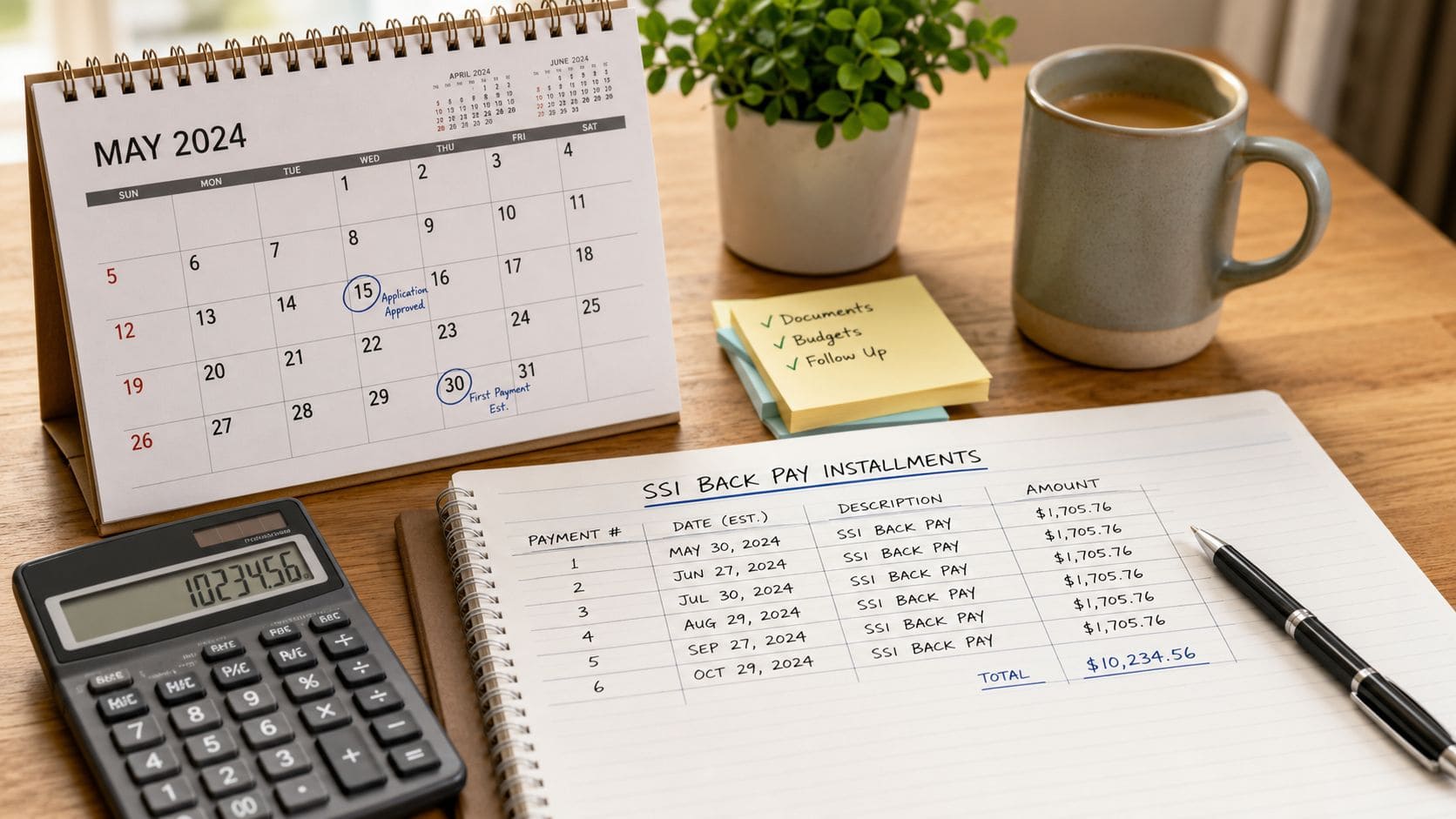
Think of SSDI more like a single payout for past-due benefits, and SSI more like a structured release of funds. According to Berger and Green's explanation of SSI back pay, SSI back pay is distributed in three installments rather than as a lump sum: one-third is paid soon after approval, the second third after six months, and the final third after another six months. This installment structure is designed to prevent recipients from exceeding income limits. In contrast, SSDI back pay is typically issued as a single lump sum payment within one to two months after approval.
That distinction matters a lot for someone who has gone a long time with little or no income. If you're in Connecticut or Vermont and counting on one large check to solve every overdue bill at once, SSI may not work that way.
A side by side comparison
| Program | How back pay usually arrives | What usually drives the rule |
|---|---|---|
| SSI | Usually in installments | Financial eligibility and resource rules |
| SSDI | Usually as one lump sum | Work history benefit rules |
SSI is a needs-based program. Social Security is trying to pay past-due benefits without creating a new eligibility problem for the person receiving them. That's why the installment structure exists.
What this means in real life
For a claimant in their 50s with cancer, heart disease, or a spinal condition, the trade-off is frustrating but important:
- A lump sum feels easier. You can clear several problems at once.
- Installments can protect eligibility. They reduce the risk that one payment disrupts ongoing monthly SSI.
- Planning becomes essential. You may need to prioritize housing, utilities, medical costs, and transportation first.
SSI back pay isn't being delayed just to be difficult. The program is built around strict financial rules, and the payment schedule reflects that.
This is also why people who have friends on SSDI often hear advice that doesn't fit their own case. If your claim is SSI, don't assume your back pay timeline will look like your neighbor's SSDI case in Maine or New Hampshire. The structure is different from the start.
Calculating Your SSI Back Pay and Payment Timeline
A lot of people in their 50s call my office after approval and ask the same question: “I was out of work for a long time before I filed. Will Social Security pay me for all of that time?” For SSI, the answer is usually no. The start date for SSI back pay is tied to the application month, not the month your back, neck, nerve, or heart condition first stopped you from working.

When SSI back pay starts
For SSI, the first possible payable month is usually the month after you file. If you filed in June, July is generally the earliest month Social Security will count for SSI back pay. A claimant in Rhode Island with severe arthritis may have been unable to work for a year before applying. A claimant in Maine with neuropathy may have struggled even longer. SSI still usually starts with the filing month rule.
That point frustrates many people, especially those between 50 and 64 who waited to apply because they hoped surgery, injections, physical therapy, or a lighter job would keep them going. SSI does not reward that delay. Filing earlier often protects more payable months.
A practical example
Take a claimant in New Hampshire who is 58 and has degenerative disc disease with radiating leg pain. She files for SSI in January 2025 and receives an approval in December 2025.
Her timeline would usually look like this:
Filing month
January 2025.Not sure if you qualify?
Get a free case review from a New England disability team. You only pay if we win.
Call (617) 683-1983First possible SSI back pay month
February 2025.Approval month
December 2025.Back pay calculation period
Social Security reviews the months between the first payable month and the approval period, then applies the SSI rate and any reductions based on income, living arrangements, or other financial factors in the file.
The key point is simple. The medical onset date may help prove disability, but it usually does not control SSI back pay the way people expect.
When the money usually arrives
As mentioned earlier, the first installment often arrives within about 60 days after approval. The regular monthly SSI check may start on a different track and show up separately. If the back pay is large enough to require installments, later payments are often spaced about six months apart.
That installment schedule catches people off guard. Someone in Massachusetts who expected one large payment may instead receive the funds over time. It is frustrating, but the practical response is to budget for the first release only until the later payments reach the account.
Why your estimate may differ from Social Security's number
SSI back pay is rarely just “monthly benefit amount times number of months.” Social Security often reviews details that change the number, including:
- Whether anyone helped pay your rent, food, or utilities
- Changes in where you lived during the claim
- Any work income or other income during the back pay period
- Direct deposit or bank information that needs updating
- Whether part of the back pay must be paid in installments
For claimants in New England, I also tell people to pay close attention to resource rules once the money arrives. The 9-month resource exclusion for SSI back pay is one of the least understood parts of the system, and it can protect eligibility if handled correctly. Back pay that is excluded for a limited period still needs to be tracked carefully. Keep the award letter, bank statements, and records showing what was spent and when.
A realistic SSI back pay estimate starts with the month after filing, then adjusts for the financial details Social Security reviews before release.
That approach gives you a better planning number and helps you avoid a second problem after approval: getting the money, then accidentally creating a resource issue that threatens future SSI.
Common Reasons Your SSI Back Pay Is Delayed
Applicants understandably focus on the approval date. Social Security focuses on whether the payment file is complete enough to release funds. Those aren't always the same thing.
According to Social Security Disability's discussion of back pay timing, most recipients of Social Security benefits receive their back pay within 60 days of their official approval date. However, delays can occur due to SSA backlogs, missing information, or administrative processing issues. The first regular monthly benefit payment is often issued separately, around 30 to 45 days post-approval.
Delays on Social Security's side
Some delays come from the agency, not from anything you did wrong.
- Payment center backlog. A file can sit waiting for final action even after the medical decision is done.
- Administrative processing issues. The benefit is approved, but the release of funds still requires internal review.
- Separate timing for monthly benefits and back pay. People sometimes receive one and assume the other is about to arrive immediately. It may not.
Delays on the claimant's side
Other delays happen because a detail in the file needs to be updated or confirmed. These are the ones worth checking closely.
Banking information changed
If you switched accounts during the case, the payment can stall until the record is corrected.Worried a misstep could cost you benefits?
A short, free consultation now can prevent an expensive mistake later. No upfront fees.
Call (617) 683-1983Mailing address is outdated
This matters more than people think. If Social Security mails a notice and doesn't get a response, processing can slow down.Income or living arrangement needs verification
SSI is means-tested. If Social Security sees a question about support from family, shared housing, or other income, it may pause to verify that issue.
A quick checklist for New England claimants
If you live in Maine, Vermont, Massachusetts, Connecticut, Rhode Island, or New Hampshire, confirm these before assuming the delay is mysterious:
| Item to confirm | Why it matters |
|---|---|
| Direct deposit details | Wrong account information can stop payment release |
| Address on file | Social Security may send follow-up notices |
| Household and support information | SSI payment decisions depend on financial facts |
What doesn't work is calling repeatedly without your records in front of you. What does work is checking the practical details first, then contacting Social Security with specific questions tied to your approval date and payment status.
Protecting Your Back Pay and Future Benefits
Getting the first SSI installment can feel like finally coming up for air. It can also create a new fear. Many people worry that once the money lands, Social Security will say they now have too much and cut off future SSI.
That concern is understandable. It's also where one of the most misunderstood SSI rules becomes extremely important.

The nine month rule that many people miss
According to WithPurple's explanation of protecting SSI back pay, the SSA's "9-Month Resource Exclusion Rule" explicitly excludes back pay from resource limits for nine months after receipt, allowing recipients a grace period to spend down funds without immediate penalty. Many new SSI applicants are unaware of this rule and fear that receiving back pay will instantly push them over the $2,000 resource limit, risking benefit suspension.
That rule matters a lot if you're in your 50s and managing a serious physical condition. You may need the funds for basic life repair, not luxuries. A safer car. Dental work you postponed. A mattress that doesn't worsen your back pain. Replacing a failing appliance. Catching up on housing costs.
How to use the grace period wisely
The strongest approach is practical, not fancy.
Keep the back pay identifiable
Don't make it hard to trace. Preserve statements and deposit records so you can show what came in and when.Spend with purpose
Focus on necessary expenses that support stability, health, and daily function.Keep receipts and notes
If Social Security later asks questions, paperwork matters. A folder, binder, or scanned PDF set can save a lot of aggravation.
Back pay protection isn't just about following a rule. It's about avoiding a preventable interruption in the monthly SSI you still need.
Smart uses of SSI back pay
For clients with cancer, chronic pain, severe knee arthritis, neck problems, or neurological disease, the most useful spending usually falls into a few categories:
- Housing stability. Rent arrears, a security-related repair, or basic household items that make the home livable.
- Transportation. A repair that keeps a reliable vehicle on the road for treatment visits or daily necessities.
- Medical support. Out-of-pocket costs, equipment, or related needs that improve function and reduce risk.
- Debt cleanup. Paying off pressing obligations that are making the rest of life harder.
For some families, planning goes beyond immediate spending. If you're trying to preserve assets carefully for a disabled loved one or think part of the funds may need longer-term protection, it may help to read about setting up a trust before you move money around casually.
Want a straight answer about your claim?
Free consultation with an experienced SSDI team. No fees unless you win.
Call (617) 683-1983What tends to go wrong
The biggest mistakes are usually simple:
- Leaving no paper trail.
- Mixing funds in a confusing way.
- Waiting too long to plan.
- Assuming every purchase is harmless without thinking about how Social Security may view the remaining balance later.
You don't need a perfect spreadsheet. You do need organized records and a clear reason for how the money is used.
What to Do If Your Back Pay Is Overdue
At a certain point, patience stops being useful and follow-up becomes necessary. The hard part is knowing when you've reached that point.

According to Dr. Disability Law on SSI and SSDI back pay timing, while the SSA aims to issue back pay within 60 days of approval, complex cases can take 90 days or more. If a claimant has not received back pay within 90 days of their approval notice, it is reasonable to inquire with the SSA about the payment status, as this timeframe accounts for normal processing variations and potential bottlenecks.
Start with a clean follow up
If you're past that point, contact Social Security with your documents in front of you. Have these ready:
- Approval notice
- Social Security number
- Current direct deposit information
- Current mailing address
- Any recent letters about SSI financial review or payment processing
Ask direct questions. Has the back pay been released? Is the file waiting on a payment center action? Is any financial information missing? Is there a notice they sent that requires a response?
Keep a paper trail
After each call or office visit, write down:
| What to record | Why it helps |
|---|---|
| Date of contact | Establishes a timeline |
| Who you spoke with | Helps if you need to follow up |
| What they said | Clarifies whether the issue is delay, missing info, or review |
A short notebook entry is enough. You're creating a usable record in case the delay drags on.
If the payment is late, don't make the call vague. Ask what specific item is holding release of the back pay.
When legal help makes sense
Post-approval problems are still legal problems when the system stalls. If you've waited, followed up, and still aren't getting a clear answer, an experienced disability attorney can often identify where the file is stuck and what needs to happen next.
That's especially helpful for claimants in their 50s with serious physical limitations. If you're managing a heart condition, recovering from cancer treatment, or living with worsening orthopedic pain, chasing payment centers and administrative staff may not be realistic. A lawyer can step in, press for clarity, and help make sure the approved benefit gets paid.
If you're waiting on SSI or SSDI benefits and need clear guidance from a team that knows how Social Security cases work from the inside, Melanson Law Group is a strong place to start. Their Cambridge-based team helps disability claimants across the process, from initial filings to hearings and post-approval issues, with practical, hands-on representation.