

The envelope is open. The denial letter from Social Security Administration is on the table. You may have read the first page three times and still feel like it did not answer the core question, which is simple: if your back, knees, neck, heart, or neurological condition keeps you from working, how can Social Security say no?
That reaction is normal.
For many people between 50 and 64, the denial lands at the worst possible time. Work has become harder or impossible. Savings are pressured. Doctors are involved, but the paperwork does not reflect what daily life looks like. If you worked for years in physical jobs, the letter can feel insulting because it treats your claim as if a diagnosis and a work history are abstract file entries instead of the story of your body wearing down over time.
A denial is serious. It is not harmless paperwork. But it is not the end of your claim. In many cases, it is the start of the appeal phase, where the file can be corrected, strengthened, and presented in a way that matches Social Security’s rules.
You Are Not Alone Most SSDI Claims Are Denied First
If you received a denial, the first thing to understand is that this happens to most applicants.
Initial SSDI applications are denied at high rates. 65 to 70 percent of applicants receive a denial at the first stage, and in Fiscal Year 2024 only 38 percent of claims were approved initially, according to recent SSDI denial trend data.

That number matters because it changes how you should read the letter. A first denial does not mean Social Security decided your condition is minor. It means the agency did not have the right evidence in the right form, or it believes you can still do some kind of work under its rules.
For people in the 50 to 64 age range, this distinction is important. You may know you cannot go back to heavy or medium work because of degenerative disc disease, knee damage, shoulder problems, neuropathy, heart symptoms, cancer treatment side effects, or chronic pain after orthopedic injury. Social Security is not asking only whether you are sick. It is asking whether the file proves, in a specific legal way, that you cannot do your past work or adjust to other work.
What the denial usually means
A denial letter reflects one of two problems:
- A technical problem: Social Security says you do not meet a non-medical rule.
- An evidence problem: Social Security says the records do not prove enough about your limitations.
Both can be fixed, but not by frustration alone.
Key point: A denial letter is a decision about the file Social Security reviewed, not a final verdict on your worth, honesty, or effort.
What helps right away
Useful first steps are practical:
- Save the envelope and notice: The date matters for appeal timing.
- Read the explanation pages carefully: The key language is buried in the standard form.
- Start a file immediately: Keep the denial letter, doctor names, medication lists, imaging reports, discharge instructions, and work history details together.
- Think in work limitations, not diagnoses: Social Security wants to know what you can no longer do reliably.
People lose time trying to “argue” with the denial emotionally. A better approach is to treat the letter as a roadmap. It tells you where Social Security thinks your case is weak. That gives you something concrete to answer.
Decoding Your Denial Letter What It Really Means
Most denial letters use language that sounds official but vague. The wording can make it seem as if Social Security understood your condition and still rejected it. That is not what happened.
The first step is to identify whether you received a technical denial or a medical denial.
Technical denials
A technical denial means Social Security says you failed a non-medical requirement. According to this explanation of SSDI denial codes, technical denials make up nearly 50% of SSDI initial applications. Common issues include work credits and earnings over the Substantial Gainful Activity threshold.
For claimants in their fifties or early sixties, this issue comes up when they are trying to hold onto part-time work, light duty, or inconsistent earnings while their health declines. The intention is understandable. The problem is that Social Security may treat those earnings as proof that you can still work at a substantial level unless the record explains what is happening.
A technical denial does not turn on MRIs, operative reports, or cardiology notes. It turns on records like earnings statements, work history, insured status, and forms explaining the nature of the work activity.
Medical denials
A medical denial means Social Security reviewed the claim medically and concluded that you are not disabled under its rules.
At this stage, many people with serious physical conditions get stuck. A diagnosis alone is not enough. A letter saying “degenerative disc disease,” “osteoarthritis,” “coronary artery disease,” “neuropathy,” or “post-cancer fatigue” does not by itself answer the legal question. Social Security wants evidence showing how those conditions limit standing, walking, lifting, carrying, reaching, using the hands, sitting, concentrating, and maintaining regular attendance.
Common denial phrases explained
| Phrase In Your Letter | What It Means | What to Focus On Next |
|---|---|---|
| Not insured for SSDI | Social Security believes you do not have enough work credits or your insured status ended before disability began. | Review your earnings record, onset date, and work history carefully. |
| Working at substantial levels | Social Security thinks your earnings are too high or your work activity shows an ability to work. | Gather pay records, explain reduced duties, failed work attempts, or special accommodations if they apply. |
| Your condition is not severe | Social Security does not think the file proves limitations that significantly affect basic work activity. | Obtain records that describe pain, weakness, reduced range of motion, gait issues, fatigue, and other functional effects. |
| Your condition does not meet or equal a listing | Social Security says the file does not satisfy the medical criteria for a listed impairment. | Focus on detailed treatment records, testing, specialist notes, and whether your limitations still prevent work even if no listing is met. |
| You can do your past work | Social Security thinks your residual abilities still match a job you did before. | Clarify what your past job required, especially lifting, standing, bending, reaching, and pace. |
| You can adjust to other work | Social Security believes there are other jobs you can still do despite your limitations. | Build evidence about age, education, transferable skills, and why your physical restrictions rule out other work. |
| Insufficient evidence | The file did not contain enough detail about your limitations over time. | Fill the gaps with consistent treatment notes, doctor opinions, imaging, and function-focused records. |
Read the letter like a working file
Do not ask only, “Why did they deny me?” Ask, “What did Social Security think was missing?”
If the denial says you can return to past work, the appeal should focus on what that work involved. If it says you can do other work, the appeal should focus on why your limitations, age, and work background narrow those options. If it is technical, fix the technical issue first.
Practical tip: The most important pages are often the explanation section and the list of medical sources considered. If a major doctor or hospital is missing, that is a clue.
A denial letter from Social Security Administration is not written in plain English. Once translated, though, it points to the exact category of proof your appeal needs.
The Critical Next Step The SSDI Appeals Process
After a denial, timing matters as much as evidence.
The appeal deadline is typically 60 days, and missing it can force you to start over instead of moving the same claim forward. That can mean lost time, delayed benefits, and unnecessary duplication.
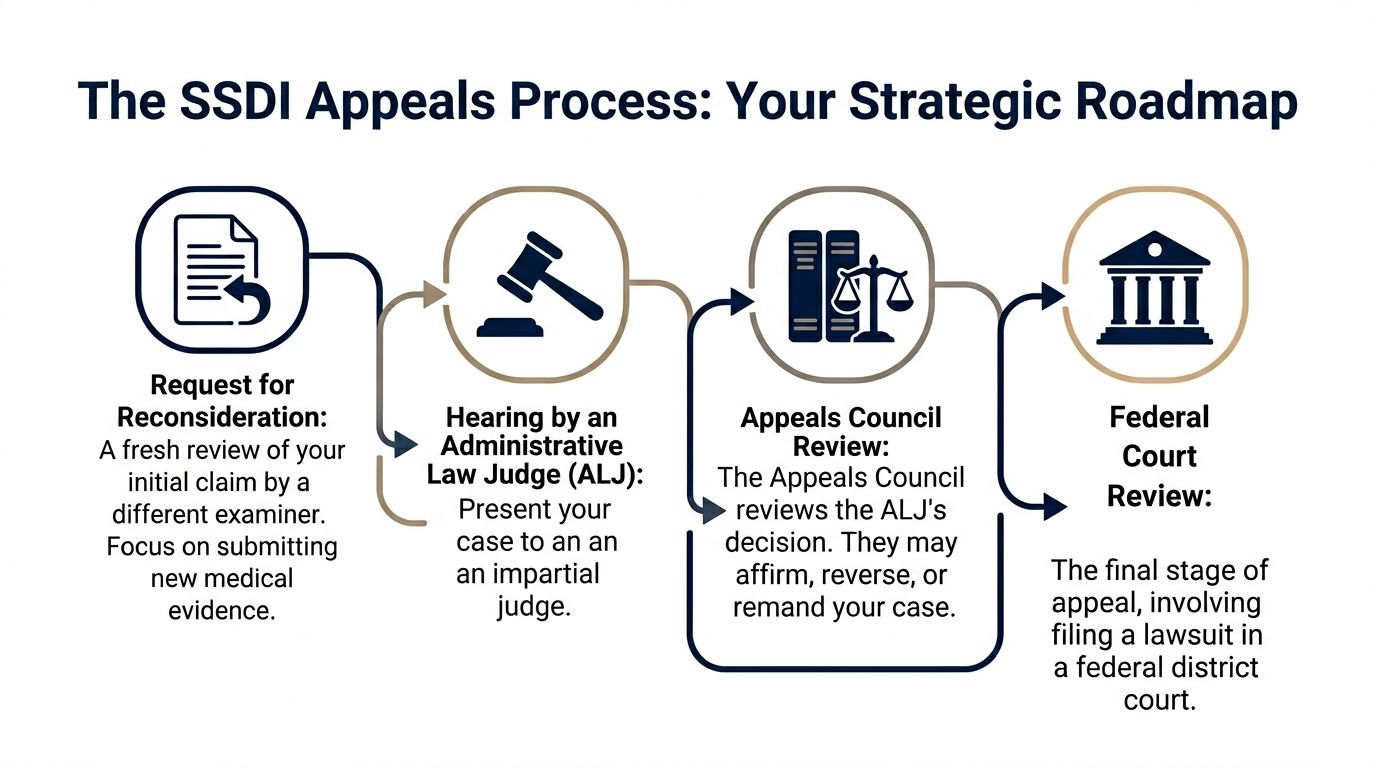
Reconsideration
The first appeal is reconsideration. A different reviewer looks at the claim again.
This stage is important because it preserves your rights and gives you a chance to submit updated evidence. It is also difficult. According to this discussion of Social Security appeals outcomes, reconsideration denial rates can be as high as 84%.
That number should shape expectations. Reconsideration is necessary, but it is not where the strongest cases are won.
The hearing level
The next major stage is the hearing before an Administrative Law Judge, called an ALJ. At this level, many legitimate claims receive a full review.
The same source reports that the ALJ hearing level has a national average 54% approval rate. That is why the hearing is so important. It is the stage where a judge can evaluate the whole picture, including medical records, work history, testimony, and whether Social Security’s earlier conclusions fit the evidence.
For claimants between 50 and 64, the hearing matters more because age and work background can be legally significant. A person with a long history of physical labor and a restricted ability to stand, walk, lift, or use the upper extremities may look different in front of a judge than in a paper review by an examiner.
What persistence looks like
The appeals path moves in this order:
Reconsideration
File the appeal on time and update the medical record right away.ALJ hearing
Prepare to explain your symptoms, treatment, failed work attempts, and past job duties clearly and consistently.Appeals Council
If needed, ask for review of the judge’s decision.Federal court
In some cases, the final step is a lawsuit in federal court.
What works and what does not
Some claimants treat reconsideration as a simple formality and submit nothing new. That wastes the opportunity.
A better approach is to use each level strategically:
- At reconsideration: correct missing records, update treatment, clarify work activity.
- Before hearing: build the theory of the case around functional limits, age, and vocational history.
- At hearing: present a clean, consistent story that matches the records.
Key takeaway: Do not read a second denial as proof that the claim lacks merit. For many applicants, especially older workers with physically demanding job histories, the hearing is the primary turning point where the case gets the depth of review it needs.
The process is slow and frustrating. But the structure matters. If you keep the deadlines and build the record with purpose, the appeal becomes something more than waiting. It becomes your chance to correct the original file.
Building Your Case Evidence for Claimants Over 50
For claimants 50 to 64, evidence must do two jobs at once.
First, it must prove the medical condition is real and serious. Second, it must show how that condition limits work in a way that fits Social Security’s rules, including the Medical-Vocational Guidelines, called the grid rules.
The grid rules can help older claimants, but only when the evidence is specific. They do not award benefits because someone is over 50. They come into play when age, education, past work, and remaining physical capacity are analyzed together.

Diagnosis is not enough
A common medical denial says there is insufficient evidence. As explained in this discussion of SSA denial letters and RFC evidence, a diagnosis alone is not enough. Social Security looks for longitudinal data on Residual Functional Capacity, or RFC, including proof such as a doctor documenting that a claimant cannot stand for more than 2 hours in a workday, which can contradict the baseline requirements for light work under SSA rules.
That is the key shift many claimants need to make. The winning question is not, “What is your diagnosis?” It is, “What can you still do, how long can you do it, and how consistently can you do it?”
What RFC means in daily terms
RFC is Social Security’s assessment of your maximum work ability despite your medical problems.
For someone with degenerative disc disease, spinal stenosis, knee arthritis, neuropathy, cardiac symptoms, cancer treatment effects, or neck and shoulder problems, RFC turns on details like these:
- How long you can stand
- How far you can walk
- Whether you need to alternate sitting and standing
- How much you can lift and carry
- Whether you can reach overhead
- Whether you can use your hands repeatedly
- How pain, fatigue, shortness of breath, or medication side effects affect pace and attendance
A chart that lists diagnoses will not answer those questions. A strong treating note will.
Evidence that helps older claimants most
For workers in this age range, the appeal improves when the file includes a combination of medical and vocational proof.
Medical records that describe function
The most useful notes do more than list complaints. They record findings that matter to work capacity, such as antalgic gait, reduced range of motion, weakness, sensory loss, positive imaging, balance issues, shortness of breath on exertion, or treatment side effects.
For example, these records tend to matter:
- Orthopedic records: surgery history, injections, range of motion findings, weight-bearing pain, instability, cane use.
- Spine and neck records: MRI findings, radicular symptoms, muscle weakness, numbness, reduced cervical or lumbar motion.
- Neurology records: gait disturbance, tremor, neuropathy, coordination problems, sensory deficits.
- Cardiology records: exertional intolerance, chest symptoms, medication side effects, activity restrictions.
- Oncology records: treatment fatigue, weakness, neuropathy, complications, recovery limits.
Doctor opinions that translate symptoms into limits
A persuasive medical opinion does not say “disabled.” That word alone carries less weight than claimants expect.
Better opinions answer practical work questions:
- How long can the patient sit at one time?
- How long can the patient stand and walk?
- How often must the patient elevate a leg, lie down, or change position?
- Can the patient stoop, kneel, crouch, climb, or reach?
- Would pain or treatment side effects disrupt regular attendance?
That kind of detail is where many appeals become stronger.
Work history proof
Social Security misunderstands past jobs because job titles can hide the true physical demands.
A “maintenance worker” might have lifted heavy equipment. A “machine operator” may have stood all day. A “nurse aide” may have performed repeated transfers and bending. A “driver” may have done more loading than driving.
For claimants over 50, this matters because the argument is not “I am sick.” It is “I cannot return to the kind of work I performed, and my age and limitations narrow the practical alternatives.”
Conditions common in this age group
Certain physical conditions need careful proof.
Degenerative disc disease and neck problems
Show how pain, reduced motion, nerve symptoms, and the need to change positions affect sitting, standing, reaching, and turning the head.
Knee and orthopedic problems
Explain instability, swelling, inability to kneel or squat, trouble on stairs, reduced walking tolerance, and whether standing on hard surfaces increases pain.
Neurological disease
Do not stop at the diagnosis. Document balance problems, hand use, numbness, gait changes, and how symptoms fluctuate.
Cancer and heart conditions
The file should reflect endurance, treatment effects, recovery complications, exertional limits, and whether symptoms interfere with sustained full-time attendance.
Practical tip: Keep a brief symptom and activity log. Record failed attempts to shop, drive, sit through appointments, climb stairs, or finish simple household tasks. A log does not replace medical evidence, but it helps you and your lawyer identify what your doctors should address.
The age factor
For claimants over 50, age is not a shortcut. It is a legal factor that can matter when your limitations reduce you to less demanding work and your past jobs do not give you skills that transfer easily.
That is why many appeals are won or lost on details that seem small at first glance. A note about needing to alternate positions. A physical therapy record showing limited standing tolerance. A treating source statement explaining why even sedentary work is unrealistic. Those details can align the medical record with the vocational rules in a way the initial application did not.
How to File Your Appeal Practical Steps
The first job is simple. File the appeal on time.
Do not wait until you have every record in hand before protecting the deadline. You can continue gathering evidence after the appeal is filed. What you do not want is to lose your appeal rights while trying to make the packet perfect.
What to gather before you start
Have these items in front of you:
- The denial notice: You need the information from the decision.
- Basic identification details: Social Security number, contact information, and claim details.
- Medical treatment updates: Any new doctors, testing, surgeries, hospital visits, therapy, or medication changes since the application.
- Work updates: Any work attempts, reduced hours, special accommodations, or stopped jobs.
- A short disagreement statement: Keep it focused.
What to say on the appeal form
Many people over-explain the case on the form. That is understandable, but not helpful.
The purpose of the first appeal filing is to preserve your rights and flag the core disagreement. A short statement is better than a long emotional narrative. Something like this works well:
I disagree with the determination because my medical conditions and functional limitations prevent me from performing my past work and other work on a sustained basis. I am continuing treatment and will submit updated medical evidence.
That kind of statement does three things. It preserves the issue, points to function, and avoids accidentally narrowing your case too early.
A clean filing process
Use a checklist mindset.
Confirm the deadline
Read the notice date and act immediately.Submit the reconsideration request
Complete the appeal forms carefully. Answer every question truthfully and consistently.Update medical sources
Add any doctors or facilities Social Security may not have considered.Describe changes since filing
New imaging, surgery, worsening symptoms, falls, cardiac episodes, treatment side effects, or failed work attempts all matter.Keep proof of submission
Save copies, confirmation pages, fax receipts, or certified mail records.
Mistakes to avoid
Some errors show up:
Arguing only from diagnosis
The appeal must focus on limitations, not labels.Leaving out recent treatment
If your records have grown stronger, make sure Social Security knows where to get them.Minimizing work attempts
Explain them clearly. A failed effort to keep working can support your case when documented correctly.Missing consistency
What you tell Social Security should fit what you tell your doctors.
If the forms feel overwhelming, get help early from a representative, lawyer, or a trusted person who can help organize the paperwork. The filing itself is administrative, but the consequences are legal.
When to Get Legal Help From a Disability Lawyer
You can file an appeal yourself and still benefit from legal help early, especially if you are between 50 and 64 and your case may turn on past work, transferable skills, and whether Social Security believes you can still do lighter work.
I have seen many denial cases reach a hearing with decent medical records but no clear legal strategy. That is often where representation makes a real difference. A lawyer is not there just to send paperwork. A lawyer frames the case around the rules that decide it.
For claimants in this age group, that often means asking hard, practical questions. Can you still perform your past work as Social Security classifies it, not just as your old employer described it? Was your job really medium or heavy work? Did you use skills that transfer to a seated or lighter job, or is Social Security assuming too much from a job title alone? Those issues matter in orthopedic, spine, joint, neuropathy, and other physical cases because the grid rules can become favorable only if the work history is described correctly and the medical proof matches the remaining work capacity.
Where a lawyer can change the outcome
A good disability lawyer builds a theory that fits both the medical evidence and the vocational rules.
For one person, the case may be: chronic back and knee problems rule out past medium work, and age plus limited transferable skills leave no realistic alternative jobs. For another, the stronger argument may be: pain, numbness, balance problems, or fatigue prevent full-time attendance and consistent production even if a few tasks can still be done in short bursts.
That strategy affects decisions such as:
- which treating source should be asked for a functional opinion
- how to document sitting, standing, walking, lifting, reaching, and hand-use limits
- whether failed work attempts help the case or create confusion if left unexplained
- how to describe past jobs so they are not overstated
- whether the grid rules may apply favorably at your age
Hearing cases are won in the details
By the time a case reaches a judge, small mistakes matter.
Judges look closely at gaps in treatment, inconsistent statements, daily activity reports, and the way past work was performed. A representative should know how to spot those problems early and address them before the hearing. That includes reading the file closely, getting missing records, preparing testimony, and deciding whether a medical source statement will help or merely repeat a diagnosis without work limits.
This becomes even more important for workers over 50. A case can be lost because the record says "degenerative disc disease" but never explains how long you can sit, how often you need to change position, whether you use a cane, or why you cannot sustain an eight-hour workday. It can also be lost because a skilled job from years ago is described too broadly, making it sound as if those skills transfer easily when they do not.
Cost is usually not the barrier people fear
Many disabled workers wait because they assume a lawyer will cost too much.
In SSDI cases, fees are commonly handled on a contingency basis. The lawyer is paid only if benefits are awarded, subject to Social Security's fee rules. That does not mean every case needs counsel immediately. A straightforward reconsideration with a short work history and clear new evidence may be manageable for some people. But once the case involves grid rule analysis, a disputed residual functional capacity, prior denials, or a hearing, the cost of going alone can be higher than the fee.
One practical option
Some claimants hire local counsel. Others look for legal aid or a firm that focuses on disability appeals. Melanson Law Group represents clients in disability claims and appeals, including reconsideration, hearings, Appeals Council review, and federal court matters.
Key takeaway: The best time to get legal help is while there is still time to correct the record, strengthen the medical proof, and present your age, work history, and physical limits in a way Social Security's rules recognize.
Your Path to Winning Benefits
A denial letter from Social Security Administration is upsetting because it arrives after months of waiting and after years of trying to work through pain or illness. But the letter does not decide the rest of the case by itself.
What matters next is how you respond.
For claimants 50 to 64, especially those with spine problems, knee damage, orthopedic injuries, neurological disease, cancer, or heart conditions, the appeal should be built around a few clear ideas:
The points that matter most
A denial is the start of the appeal phase
It tells you what Social Security thinks is missing.The deadline matters
Protect the appeal right first. Build the evidence immediately after.The hearing is the primary turning point
Many strong cases are not understood on paper alone.Function wins cases
Records must show what you cannot do reliably in a work setting.Age and work history matter
For older workers, vocational rules can become important when the evidence is specific and credible.
This process is demanding. It asks sick or injured people to become document keepers, historians of their own work lives, and careful witnesses about pain, fatigue, and physical limits. That is why strategy matters.
If you appeal on time, focus on functional proof, and treat the case as a legal and medical record-building process, your denial can become the point where the claim starts moving in the right direction.
If you received a denial letter and need help deciding what to do next, contact Melanson Law Group for a free, no-obligation consultation. They can review where your claim stands, explain the strongest next step, and help you move before the appeal deadline passes.