Your back, knees, neck, or heart may have reached the point where work is no longer realistic, but the SSDI process still asks you to prove the obvious. That’s where many people between 50 and 64 get stuck. They know they can’t keep doing the job they’ve done for years, yet the paperwork, deadlines, and denials make it feel like the system doesn’t see what daily life is really like.
If you’ve already been denied, you’re not alone. If you’re thinking about applying and trying to figure out whether your state is harder than another, that’s a fair question. But state numbers only tell part of the story. The better question is this: how do you build the kind of claim that works for someone over 50 with a physical condition?
Navigating SSDI When You Are Over 50
For older workers, SSDI cases often turn on a harsh reality. You may still be able to do something for a few minutes, an hour, or on a good day. That isn’t the same as being able to sustain full-time work.
A warehouse worker with degenerative disc disease may still lift a grocery bag. A machinist with knee damage may still walk from the parking lot to a waiting room. A delivery driver with heart disease may still sit through a short appointment. None of that answers the core SSDI question, which is whether you can keep up with work on a reliable basis.
What makes this age group different
Once you’re over 50, age can matter in your favor. Social Security doesn’t look only at diagnosis. It also looks at your ability to adjust to other work.
That matters because retraining is not equally realistic for everyone. A person in their twenties with a light work history is judged differently from a person in their late fifties who spent decades doing medium or heavy work and now has chronic pain, reduced mobility, and medication side effects.
Practical rule: Don’t present your case as “I have pain.” Present it as “Here is why I can’t do my past work, and here is why I can’t realistically shift to other work.”
What frustrated claimants often miss
Many claimants over 50 make one of these mistakes:
- They focus on the diagnosis alone. Social Security needs limits, not just labels.
- They understate their work demands. If your past job required standing, bending, climbing, carrying, or using your hands constantly, those details can decide the claim.
- They assume a denial means the claim is weak. It often means the file wasn’t developed well enough yet.
- They don’t connect age, education, and skills. For older workers, that combination can be as important as the MRI.
Social security disability approval rates by state become useful. They help set expectations. They do not decide your outcome by themselves.
Why SSDI Approval Rates Differ Between States
A 58-year-old warehouse worker with severe back pain can file the same federal disability claim in two different states and still face a different path to approval. The legal standard is the same. The handling of the file often is not.
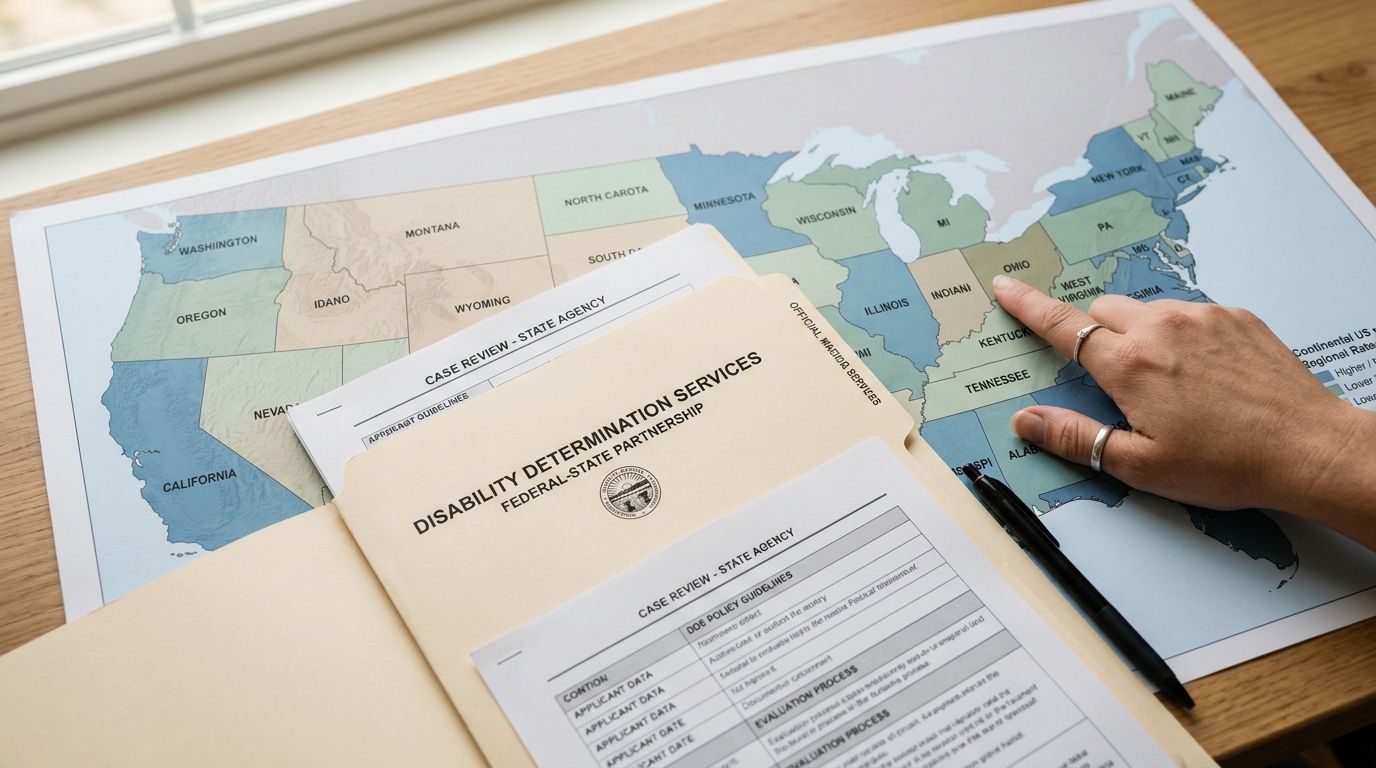
SSDI runs under federal law, but the first medical decision is usually made by a state Disability Determination Services office. That matters. Some offices get records faster. Some are slower to schedule consultative exams. Some are stricter about how clearly your doctor explains functional limits such as lifting, standing, walking, reaching, or using your hands.
For claimants over 50 with physical conditions, those differences show up in a very practical way. A thin file may fail in a stricter state office, while a better-developed file has a fair chance almost anywhere.
What changes in practice from state to state
The biggest differences usually come from claim development, not from a different legal rulebook.
Record collection speed
Some DDS offices get hospital, orthopedic, pain management, and primary care records quickly. Others struggle with delays, and the examiner may decide the case before the file fully explains your limitations.Quality of medical evidence
Imaging helps, but imaging alone rarely wins a case. Approval rates tend to reflect whether files contain treatment notes, exam findings, medication history, specialist opinions, and clear work-related limits.Local claimant profiles
States differ in age, job history, and the kinds of impairments that appear most often. That affects how often the grid rules may help an older worker with a long history of physical labor.Representation and case preparation
Some claimants file on their own and describe only diagnoses. Others submit detailed work histories and medical proof that ties the condition to specific job limits.
These are not small details. They often decide whether an examiner sees a diagnosis or sees a work-precluding condition.
Why older workers with physical impairments feel these differences more sharply
If you are 50 or older, the case often turns on function and vocational fit. Can you still do your past work? If not, do your age, education, and skill level make other work realistic?
That is why two people with the same MRI can get different results. One file may show degenerative disc disease and little else. Another may show reduced range of motion, failed conservative treatment, medication side effects, a history of heavy work, and a doctor who explains why sitting, standing, lifting, or reaching cannot be sustained through a full workday.
The second claim is easier to approve because it addresses the core question.
State averages matter, but only up to a point
Approval rates by state are useful for setting expectations. They are less useful for predicting the outcome of a well-prepared claim from a person over 50 with a strong physical case.
I have seen older claimants get discouraged by a low-rate state and assume the system is closed to them. That is the wrong conclusion. Lower-rate states usually leave less room for missing records, vague doctor notes, or incomplete job descriptions. Higher-rate states do not excuse weak evidence either.
The trade-off is simple. You cannot choose your state office, but you can control how complete your file is. For an older worker with a physical condition, that often means the difference between another denial and a serious chance at approval.
Social Security Disability Approval Rates by State
A claimant in New Hampshire and a claimant in Alabama can file with the same back problem, the same age, and the same years of heavy work behind them, yet face a very different climate at the first decision stage. That frustrates people, and it should. State approval patterns are real. They still do not decide whether a 52-year-old warehouse worker with spinal stenosis and a failed return to work should win.
For claimants over 50 with physical conditions, state rates are best used for expectation-setting. They show how strict or uneven a state may be at the early stages. They do not replace the question Social Security decides in your file: what you can still do, for how long, and whether your past work or any other realistic work remains within reach.
How to read this table
Three stages matter:
Initial approval
The first decision on the application.Reconsideration approval
The result after the first appeal. In many cases, this stage remains difficult.ALJ hearing approval
The decision after a hearing before an Administrative Law Judge. For older claimants with solid medical and work evidence, this is often the stage where the case gets a closer, more practical review.
SSDI Approval Rates by State
A full 50-state table with verified figures for all three stages was not available in the source material used for this article. Rather than fill the chart with gaps, the table below focuses on the states for which verified figures were available. That gives you something usable.
| State | Initial Approval % | Reconsideration Approval % | ALJ Hearing Approval % |
|---|---|---|---|
| Alabama | 34% | ||
| Arizona | 34.8% | ||
| Florida | 39.6% | ||
| Georgia | 39.4% | ||
| Massachusetts | 45% | 23% | 50% |
| Nebraska | 52.7% | ||
| Nevada | 38.8% | ||
| New Hampshire | 57.4% | ||
| North Dakota | 56% | ||
| Oklahoma | 39.7% | ||
| Rhode Island | 51.5% | ||
| Tennessee | 38.3% | ||
| Vermont | 54% |
The spread at the initial level is the first point to notice. Some states approve far more claims up front than others. For an older worker with arthritis, degenerative disc disease, a bad shoulder, or heart disease, that difference often means one extra lesson. A weak first filing gets punished faster in a lower-approval state.
Massachusetts is one of the few states in this data set with figures across all three stages. That matters because it shows a pattern claimants should understand. A case can struggle at reconsideration and still improve at the hearing level. I have seen that happen often with people over 50 whose records finally spelled out sitting limits, standing tolerance, lifting restrictions, cane use, or why pain medication makes full-time work unreliable.
What claimants over 50 should take from state rates
Use these numbers carefully.
If your state tends to approve fewer claims early, file as if you are building for appeal from day one. Get treatment notes that describe function, not just diagnosis. Make sure your doctor addresses how long you can sit, stand, walk, lift, carry, reach, and use your hands. Give Social Security a work history that explains what your past jobs required, especially if you spent years in medium or heavy work.
If your state tends to approve more claims initially, do not assume age alone will carry the case. Social Security still denies older claimants when the records are thin, the doctor avoids functional limits, or the job history makes transfer to lighter work look too easy.
For claimants over 50 with physical conditions, the practical takeaway is simple. State rates affect timing and difficulty. Evidence still drives the result. A denial in a tougher state may say more about the stage of the process than the strength of the case.
Your Age Advantage Understanding the Grid Rules
Many people over 50 have never heard of the Medical-Vocational Guidelines, often called the Grid Rules. They should. For the right claimant, these rules can change the outcome of a case.
The Grid Rules matter most when you have a physical condition, you can no longer do your past work, and the case turns on what other work Social Security thinks you could do.
Why turning 50 matters
Social Security doesn’t treat all age groups the same.
A younger worker is often expected to adapt more easily to new work. An older worker may not be. That’s especially true if the person spent years in physically demanding jobs and doesn’t have skills that transfer cleanly to lighter work.
The major age bands that often matter are:
Ages 50 to 54
You may still have an argument under the Grid Rules, but the fit has to be tighter.Ages 55 and up
The rules generally become more favorable if your work history was physical and your skills don’t transfer well.Around age 60 and above
Adjustment to new work becomes even harder to argue from Social Security’s side, especially with a long history of physically demanding work.
The four parts that drive the analysis
The Grid Rules do not ask only whether you are sick. They combine several factors:
| Factor | Why it matters |
|---|---|
| Age | Older claimants are not expected to retrain as easily |
| Education | Limited education can strengthen the vocational argument |
| Past work | Heavy or skilled physical jobs can cut both ways depending on transferability |
| Residual Functional Capacity | Your maximum work ability, such as sedentary or light work |
A practical example
Take a worker in the mid-fifties who spent decades in construction and now has degenerative disc disease, knee problems, and chronic neck pain.
If the evidence shows he can no longer do prolonged standing, frequent lifting, climbing, stooping, or sustained bending, then the case may not be about whether he can sit at a desk for a few minutes. It may be about whether he has transferable skills to sedentary work and whether sustained desk work is even realistic given pain, posture limits, and medication effects.
The strongest over-50 cases often win because the claimant cannot return to past work and cannot make a realistic vocational shift, not because the diagnosis sounds dramatic.
What does not work
Some claimants hurt their own cases by arguing in all-or-nothing terms. They say, “I can’t do anything.” Most judges won’t believe that if you still drive, shop, or attend appointments.
A better approach is precise. Explain what you can’t do often enough, long enough, or predictably enough for full-time work.
That means describing limits like:
- needing to change positions frequently,
- being unable to stand through a work shift,
- losing hand strength,
- needing unscheduled rest,
- missing work due to treatment or flare-ups.
Those functional limits are what make the Grid Rules useful.
Evidence for Common Physical Conditions in Claimants 50+
A diagnosis starts the claim. Functional proof wins it.
For claimants over 50, especially those with long work histories in physical jobs, the file should show not just what condition you have, but what work movements it prevents. Social Security usually gives more weight to consistent treatment records, objective testing, and a doctor’s opinion that translates medical findings into practical restrictions.

Orthopedic and spinal problems
Degenerative disc disease, lumbar stenosis, neck disorders, rotator cuff injuries, knee damage, and joint disease are common in this age range.
Useful proof often includes:
Imaging
MRI, X-ray, CT, or other scans that support the diagnosis.Exam findings
Reduced range of motion, weakness, gait problems, positive straight-leg testing, swelling, or reflex changes.Treatment history
Physical therapy, injections, surgery discussions, pain management, and follow-up visits.Work-related limits
How long you can sit, stand, walk, lift, carry, stoop, kneel, crouch, or reach.
A bare diagnosis of back pain is weak. A record that shows nerve involvement, failed conservative treatment, and limited ability to sit or stand consistently is far stronger.
Neurological disease, cancer, and heart conditions
These cases often turn on stamina, reliability, and side effects as much as raw diagnosis.
For these conditions, the most persuasive evidence often looks like this:
| Condition type | What helps most |
|---|---|
| Neurological disease | Neurology notes showing balance problems, tremor, weakness, gait change, numbness, coordination issues, or fatigue |
| Cancer | Oncology records describing treatment course, recurrence concerns, weakness, pain, and treatment side effects |
| Heart conditions | Cardiology records explaining shortness of breath, chest symptoms, fatigue, exertional limits, or recovery issues |
A cardiologist’s note that explains why you can’t sustain walking, standing, or exertion is usually more useful than a chart that lists the diagnosis without limits.
The opinion that ties it together
The most valuable medical opinion is the one that answers work questions directly.
That means a treating doctor or specialist explains, in plain terms, how long you can sit, how often you need breaks, whether you must raise a leg, whether you would miss work, or whether pain and fatigue would interrupt concentration.
For claimants over 50, that kind of opinion can connect the medicine to the vocational rules in a way that imaging alone cannot.
Common Denial Reasons and How They Differ by State
Two claimants can have similar medical conditions and still get very different results. In stricter states, ordinary weaknesses in a file become fatal. In more favorable states, the same weaknesses may still cause delay, but the claim may survive long enough to be developed better on appeal.
What low-approval environments punish most
When a state’s initial approval rate is lower, the common problems tend to hit harder:
Thin records
A diagnosis appears in the file, but there are few exams, few specialist notes, and little follow-up.Gaps in treatment
Months go by with no visits, which allows the reviewer to question severity.Vague limitations
The records say “pain” or “arthritis” but don’t say how sitting, standing, lifting, or walking are affected.Mismatch between job history and medical proof
The claimant says prior work was demanding, but the file doesn’t clearly show why those demands can no longer be met.
What that looks like in real claims
A person over 50 with degenerative disc disease may be denied if the file contains only an X-ray and a short primary care note. That same person may have a much better case if the record includes specialist treatment, exam findings, medication history, physical therapy notes, and an opinion describing limited standing, lifting, and postural tolerance.
A claimant with knee disease often runs into a similar issue. The diagnosis may be real, but if the file doesn’t explain balance problems, reduced walking tolerance, trouble with stairs, or inability to stay on the feet through a workday, the claim looks less vocationally serious than it is.
A better way to think about denials
Don’t ask only, “Why did they deny me?” Ask, “What proof did the file fail to translate?”
The denial often reflects a missing bridge between the medical chart and the work rules.
For older claimants, the most important bridge is usually this one: I cannot return to my past work, and my remaining capacity does not fit a realistic new job given my age and skills.
That argument has to be built, not assumed.
The ALJ Hearing Your Best Opportunity to Win
For many claimants, the hearing is the first stage where a real person listens to the full story. That matters. Paper reviews miss context. Hearings allow the judge to assess credibility, work history, treatment efforts, and the practical effect of your limitations.

Beyond state-level averages, individual ALJ approval rates vary dramatically. Nationally, the hearing approval rate is around 59%, but some hearing offices like Ponce, PR approve nearly 85% of cases, while others like Little Rock, AR, approve only 40%, according to this judge-specific disability approval rate tool.
Why the hearing level is different
The hearing stage is different for three reasons:
You can testify
The judge hears how your condition affects a normal day, not just what appears in the chart.The file can be updated
New records, better opinions, and clearer work descriptions can fix earlier gaps.Vocational issues come into focus
For claimants over 50, this is often where age, transferable skills, and residual functional capacity become decisive.
The judge factor is real
Statewide numbers can hide major differences inside the same system. One judge may focus heavily on treatment consistency. Another may scrutinize daily activities. Another may care most about whether the treating doctor gave specific functional limits.
That doesn’t mean the outcome is random. It means preparation should be specific.
If a judge tends to question pain cases, the file needs unusually strong functional detail. If a judge looks hard at treatment gaps, those gaps need to be explained with records or testimony. If the issue is whether you can do sedentary work, your case must address sitting tolerance, use of hands, need to recline, or positional changes.
A hearing isn’t won by repeating “I hurt.” It’s won by showing why your limits rule out sustained work.
What older claimants should expect
At a hearing, expect questions about:
- your past jobs and what they required,
- when you stopped working and why,
- how long you can sit, stand, and walk,
- what treatment you’ve tried,
- what a bad day looks like,
- whether your skills transfer to lighter work.
The best testimony is concrete, calm, and specific. Judges tend to trust details over slogans.
Building a Winning Appeal A Checklist for Older Claimants
An appeal should fix what the first file missed. For claimants over 50, that usually means sharpening the medical proof and the vocational story at the same time.

Appeal checklist that helps
Get a detailed RFC from the right doctor
A useful Residual Functional Capacity form comes from the specialist who treats the condition most tied to your work limits. Orthopedists, neurologists, cardiologists, and oncologists can all be important depending on the case.Write down your job duties as they were really performed
Don’t use a vague title like “laborer” or “manager” and leave it there. List lifting, standing, climbing, kneeling, reaching, use of tools, pace demands, and time on your feet.Create a symptom and activity diary
Keep it honest and practical. Note failed attempts to do household tasks, time spent resting, trouble climbing stairs, difficulty driving, or how pain increases after activity.Close treatment gaps where you can
If there were gaps because of insurance, transportation, surgery recovery, or other barriers, be ready to explain them clearly.
Documents that often make the difference
Not every piece of paper matters equally. These often do:
| Document | Why it helps |
|---|---|
| Specialist treatment notes | They usually contain stronger exam findings and condition-specific detail |
| Imaging and test results | They support objective medical findings |
| Medication history | It shows treatment intensity and side effects |
| Former coworker or supervisor statements | They can describe the true physical demands of your past work |
Prepare for the vocational questions
Older claimants often lose avoidable ground when they answer too broadly.
For example, if asked whether you can sit, don’t answer only yes or no. Explain whether you can sit long enough for work, whether you need to change position, whether pain builds, and whether you must recline or raise a leg.
The same goes for “light work” or “desk jobs.” Many people assume those jobs are automatically easier. They aren’t if your back, neck, shoulders, hands, or heart condition makes sitting, reaching, concentrating, or maintaining pace unreliable.
Bring the answer back to endurance, frequency, and consistency. Work requires all three.
Keep the appeal focused
The strongest appeal files are not the biggest. They are the clearest.
A focused appeal shows:
- the medical condition,
- the tested or observed limits,
- the demands of past work,
- the reason other work is not a realistic fit.
That’s the frame older claimants should build toward.
How Melanson Law Group Can Help Your Case
SSDI claims are hard enough without trying to decode approval trends, age-based vocational rules, and hearing strategy on your own. Older claimants with physical conditions often have strong cases, but strength on paper doesn’t happen by accident. Someone has to build the file properly.
That means identifying the medical records that matter most, making sure your doctors address work limitations directly, and preparing your testimony so it matches the documentary evidence. It also means understanding how an ALJ is likely to evaluate your case at the hearing stage.
Melanson Law Group is built for exactly that kind of work. The firm focuses on SSDI cases and brings the perspective of Jack Melanson, a retired Social Security judge who has handled more than 6,000 disability claims, together with a hands-on litigation approach. For claimants over 50, that combination matters. These cases often turn on details in work history, transferable skills, and the way physical limitations are described.
The firm helps clients gather medical evidence, prepare RFC support, organize records, and get ready for reconsideration and hearings where many cases are won. The representation is also zero upfront fee, with payment only if you win, which matters when you’re already under financial pressure.
If you’re in Massachusetts or dealing with a denial elsewhere, experienced help can mean the difference between a file that merely lists diagnoses and one that proves disability under the rules that decide the case.
Frequently Asked Questions About SSDI Rates and Appeals
Does my lawyer need to be in my state
Not always. SSDI is a federal system, and many parts of representation can be handled across state lines. What matters most is whether the lawyer understands Social Security practice, hearing preparation, and how to build medical and vocational proof.
Do higher state approval rates mean my case is strong
No. State averages are useful context, but they don’t measure the strength of your individual file. A well-supported claim in a tougher state can win. A poorly developed claim in a more favorable state can still lose.
If I’m over 50, does that guarantee approval
No. Age helps only when it works together with the rest of the case. You still need solid medical evidence, a clear work history, and proof that you can’t return to past work or shift realistically to other work.
What if I can still do some daily activities
That’s normal. Most disabled claimants can still do some things. The issue is whether you can do work tasks consistently, safely, and for a full schedule. Small daily activities don’t automatically disprove disability.
How long does the appeal process take in 2026
Timelines vary by region and hearing office. The verified data available here does not provide a nationwide 2026 timetable. What can be said confidently is that delays remain a real issue, so it’s important to appeal on time and keep your evidence updated while the case is pending.
How much does an SSDI lawyer cost
Fee rules in Social Security cases are governed by federal law, but the exact amount isn’t included in the verified data provided here. In practice, many disability firms work on a contingency basis, which means there is no fee unless the case is won. You should always ask for the fee agreement in writing.
If you’re tired of guessing what your denial means or whether your age and physical condition should qualify you, talk with Melanson Law Group. The firm helps SSDI claimants, especially older workers facing orthopedic problems, chronic pain, heart conditions, neurological disease, and other serious physical impairments, build focused appeals and hearing cases with no upfront fee unless you win.