

If you're reading this, there's a good chance your workday has turned into a series of small negotiations with pain. You try to get through a shift, a commute, a few hours at a desk, or even basic chores at home. Then the neck pain starts climbing. Your shoulders tighten. Your hand goes numb. You turn your head and feel a sharp catch, or you look down and the pain shoots into your arm. At some point, the question stops being “How do I get through today?” and becomes “How much longer can I keep working like this?”
Wondering what your claim could be worth? Try our free SSDI benefits calculator.
That fear is real, especially if you're in your 50s or early 60s. You may have spent decades doing physical work, driving, lifting, typing, supervising, or staying on your feet all day. Now your body isn't cooperating, and your paycheck may be hanging by a thread. A lot of people in this position have already done what responsible workers do. They saw doctors, tried therapy, took medication, used braces, got injections, and still didn't get their function back.
That's where degenerative disc neck disease stops being just a phrase in a medical chart and starts becoming a legal issue. Social Security doesn't award benefits because a diagnosis sounds serious. It awards benefits when the medical evidence shows that your condition keeps you from sustaining full-time work. For people over 50, that distinction matters even more, because the rules can work differently in your favor if your limitations are documented correctly.
Introduction Living with Neck Pain and an Uncertain Future
Neck problems have a nasty way of affecting almost everything at once. You can't sit comfortably for long. You can't look down, turn your head freely, or keep your arms in one position without aggravating symptoms. If nerves are involved, the trouble doesn't stay in your neck. It can travel into your shoulder, arm, hand, and grip.
For many claimants, the worst part isn't the diagnosis. It's the slow loss of reliability. You start missing work. You need extra breaks. You avoid certain tasks. You stop volunteering for overtime. Eventually a supervisor notices, or you notice first and realize you're no longer performing at the level your job requires.
Practical rule: Social Security cares less about what your condition is called and more about what it stops you from doing, hour after hour, day after day.
If you're between 50 and 64, this is the right time to get serious about strategy. Your claim isn't just about pain. It's about proving how that pain, stiffness, numbness, weakness, and reduced motion interfere with the specific physical and mental demands of work. It also means understanding how your age, past work, and remaining capacity fit into Social Security's framework.
Denied? You have only 60 days to appeal.
Talk to a disability attorney now. Free consultation. No fees unless you win.
Call (617) 683-1983A strong SSDI case for a neck condition usually turns on a few hard questions:
- Can you still do your past work: Not in theory, but as it was performed.
- Can you handle sustained work activity: Showing up is not enough if you can't keep your neck in one position, use your hands reliably, or stay focused through pain.
- Do your records tell the story clearly: Many claims fail because the chart lists symptoms but never connects them to concrete work limits.
- Are the age-based rules on your side: For workers over 50, that can be decisive when the case is built correctly.
You don't need a perfect case. You need an honest, well-documented one.
What Is Degenerative Disc Neck Disease
Degenerative disc neck disease is wear and breakdown in the discs of the cervical spine, the part of the spine in your neck. Those discs act like cushions and shock absorbers between the bones. Over time, they can dry out, flatten, crack, or bulge. When that happens, the space around nearby nerves can tighten, the joints can become irritated, and the body may form bone spurs.
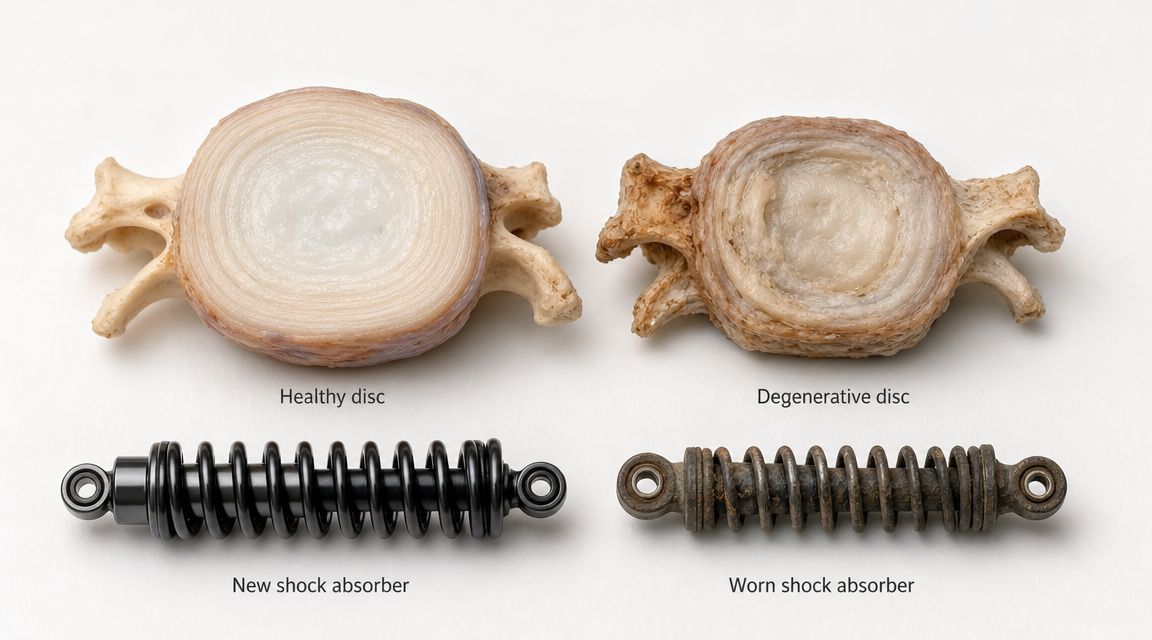
It's similar to tire tread wearing down. A newer tire absorbs bumps and keeps the ride steady. A worn tire doesn't cushion the road the same way. In your neck, that loss of cushioning can produce pain with movement, stiffness after rest, and irritation of the nerves that travel into the arms and hands.
Why it hurts
The pain can come from several places at once. The disc itself may be painful. Inflamed joints in the neck can ache and stiffen. Tight spaces around the nerve roots can trigger radiating pain, tingling, numbness, or weakness. If the spinal cord is compressed, symptoms can become broader and more alarming, including balance trouble, clumsiness, or loss of coordination.
That's why two people with the same MRI label can function very differently. One person may have mild, occasional discomfort. Another may struggle to hold a phone, look at a screen, drive safely, or carry groceries.
Why the diagnosis alone doesn't win SSDI
This condition is common with age. StatPearls notes on cervical degenerative disc disease explain that cervical disc degeneration is a naturally occurring phenomenon in the aging population, and one MRI study found abnormalities in 62% of asymptomatic adults older than 40, while more than 90% of people show some disc degeneration by age 60.
That fact cuts both ways. It validates that neck degeneration is real and widespread. But it also means Social Security won't assume you're disabled just because an MRI mentions degeneration.
The mere presence of degeneration isn't enough. You must prove what it does to your ability to work.
The symptoms that matter most
People usually come to disability lawyers with a cluster of symptoms, not just one complaint. Common patterns include:
- Axial neck pain: Deep, constant pain centered in the neck, often worse with prolonged posture.
- Radicular symptoms: Pain, tingling, numbness, or burning traveling into the shoulder, arm, or hand.
- Hand weakness: Trouble gripping, buttoning, typing, carrying, or holding objects without dropping them.
- Motion limits: Difficulty turning the head, looking up, or looking down long enough to do ordinary job tasks.
- Pain-related concentration problems: Not a separate neck symptom, but a common consequence of chronic pain.
If your records use terms like foraminal stenosis, radiculopathy, osteophytes, or myelopathy, don't panic. Those words usually describe the mechanism behind the symptoms you're already feeling.
How Neck Pain Limits Your Ability to Work
A neck condition becomes a disability case when it consistently interferes with work tasks. That's the translation Social Security expects. It's not enough to say, “My neck hurts.” You need to show what that pain forces you to stop, change, avoid, or do badly.

A warehouse worker with neck degeneration may not be able to look up to shelves safely, turn quickly, or carry objects without flaring arm pain. A bus driver may struggle with repeated head turning and sustained sitting. A receptionist may seem to have a “light” job on paper but still fail because looking down at a keyboard, using a phone, and staying seated with the head fixed forward all day becomes unbearable.
Work limits Social Security actually cares about
The most important restrictions are usually functional and specific:
- Postural tolerance: You can't keep your head in one position for long without increased pain.
- Neck rotation: Checking blind spots, scanning a workspace, or responding to people around you becomes difficult.
- Use of the arms and hands: Reaching, gripping, fingering, and handling can drop off when symptoms radiate downward.
- Lifting and carrying: Even “light” lifting may trigger pain or weakness if the neck and shoulders are unstable.
- Attendance and pace: Pain slows you down, forces unscheduled breaks, and can make regular attendance unrealistic.
Social Security also looks at whether you can do these things reliably. Plenty of claimants can perform a task once in an exam room. The fundamental question is whether they can repeat it over a full workday, five days a week.
Examples that resonate in a claim
You don't need legal jargon to describe your limits well. You need honest detail. Strong examples often sound like this:
- Desk work problem: You can sit at a computer briefly, but looking down or straight ahead for long periods causes neck spasm and arm numbness.
- Driving problem: Turning your head to merge or back up is painful and unsafe.
- Hand function problem: You drop files, tools, cups, or parts because your grip weakens or your fingers tingle.
- Sleep problem: Pain wakes you repeatedly, and the next day your concentration is shot.
- Position-change problem: You need to stand, sit, walk, stretch, or recline more often than an employer would usually allow.
When pain forces frequent position changes, reduced pace, and unreliable use of the hands, even sedentary work may stop being realistic.
Not sure if you qualify?
Get a free case review from a New England disability team. You only pay if we win.
Call (617) 683-1983
Why older workers get hit harder
Age matters in a practical way. A younger worker may have more vocational flexibility in Social Security's eyes. A worker in the 50 to 64 range often has a longer work history tied to a certain kind of labor, posture, or skill set. If your background is physical and your neck condition now limits lifting, reaching, head movement, and hand use, the pool of alternative work shrinks fast.
Here's a simple comparison:
| Work demand | Why neck disease can interfere |
|---|---|
| Sedentary jobs | Prolonged sitting, computer use, fixed head position, phone use |
| Light jobs | Reaching, carrying, standing, frequent head movement |
| Medium or heavier jobs | Lifting, pushing, pulling, overhead work, safety risks from limited motion |
The biggest mistake I see is understatement. Claimants describe what they can still do on a good day and leave out what happens afterward. Social Security needs the full picture, including flare-ups, recovery time, and what you can no longer do consistently.
Proving Your Condition The Social Security Way
A diagnosis starts the file. It doesn't win the case. Social Security wants objective medical evidence plus clinical notes that explain how the condition affects function.
That matters because spinal degeneration is common. A Medicare-based study on spinal degenerative disease prevalence reported an overall prevalence of diagnosed spinal degenerative disease of 27.3%, rising from 24.2% in 2005 to 30.1% in 2017, with disc degeneration listed as the most prevalent specific diagnosis at 12.2% on average. In plain English, a lot of people have these findings. Your records must show why your case prevents work.
The records that carry weight
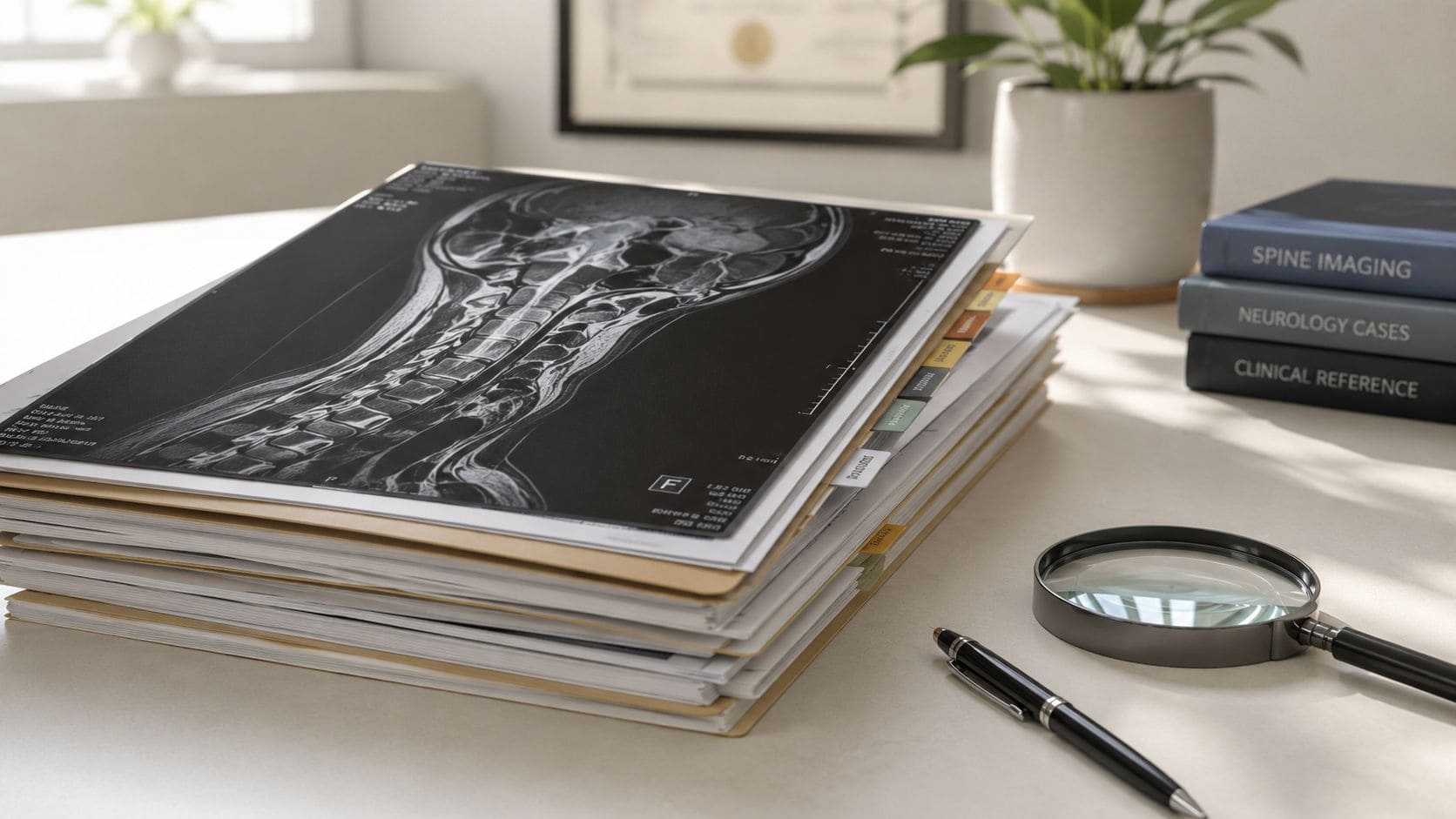
An MRI is usually the star witness in a neck case, but the written report matters more than many people realize. Social Security isn't looking at the image the way a spine surgeon does. It's looking for documented findings and whether your doctors connect them to your symptoms.
Useful records often include:
- MRI reports: These may describe disc space narrowing, herniation, stenosis, cord contact, or nerve root impingement.
- CT scans: Sometimes helpful when bony changes or arthritic changes need clarification.
- EMG and nerve conduction studies: These can support radiculopathy or nerve dysfunction when symptoms extend into the arm or hand.
- Physical exam findings: Reduced range of motion, decreased grip, reflex changes, sensory loss, positive provocative tests, or gait issues.
What judges and examiners look for
The strongest files don't just say “neck pain.” They show a chain of proof.
- Objective findings exist. The imaging and testing identify a real cervical problem.
- Clinical exams match the imaging. Your provider documents weakness, numbness, limited motion, pain behavior, or reduced function.
- Symptoms persist over time. The complaints aren't isolated. They appear consistently across visits.
- The records describe work-related limits. Not just medical labels, but inability to sustain posture, lift, reach, use hands, or maintain concentration.
If your MRI sounds dramatic but your office notes say you're “doing fine,” Social Security will often follow the office notes.
That's why medical records need narrative detail. A good treatment note might mention that pain worsens when upright or moving the head, that arm numbness interferes with gripping, or that symptoms continue despite treatment. A thin note that says “follow up in three months” doesn't do much for a disability claim.
Medical Treatments and Your Disability Claim
Many people feel defeated when conservative treatment doesn't solve the problem. From an SSDI perspective, that's often a critical part of the proof. A documented history of treatment can show that you didn't give up. You tried to stay functional, and your condition still kept getting in the way.
UCLA Health notes that pain may be worse when upright or moving the head and that avoiding painful positions or using a neck brace may help, but many patients still deal with ongoing symptoms after standard care. That lack of a clear roadmap when conservative care fails is exactly why disability claims become necessary for some workers. You can see that practical treatment discussion on UCLA Health's cervical degenerative disc disease page.
Why treatment history matters
Social Security expects you to follow reasonable medical treatment. If your doctor recommends physical therapy, medication management, injections, or specialist follow-up, you should generally pursue that care unless there's a solid reason you can't. The record of that effort matters.
A persuasive treatment history often looks like this in substance:
- You attended physical therapy, but relief didn't last or certain movements worsened symptoms.
- You used medications, but they caused side effects, didn't control the pain, or only helped partially.
- You tried bracing, home exercises, or activity modification, yet still couldn't tolerate normal work postures.
- You underwent injections or pain management, but symptoms returned or function remained poor.
- Surgery was discussed, performed, or deferred, and your doctors documented the outcome accurately.
What not to do
Don't stop treatment without explanation and assume your MRI will carry the case. It usually won't. Gaps in care invite bad assumptions. An examiner may conclude you improved, your symptoms weren't serious, or you chose not to follow advice.
If cost, transportation, insurance problems, or side effects interfere with treatment, tell your doctors. Get that explanation into the notes. Silence hurts disability claims.
Surgery doesn't automatically end the case
Some claimants think surgery means approval. Others think surgery means denial because Social Security will assume they're fixed. Both assumptions are wrong.
A surgery such as an anterior cervical discectomy and fusion may help some people, but the legal question remains the same. Can you sustain full-time work after treatment? If you still have chronic pain, limited neck motion, radicular symptoms, medication side effects, or lifting restrictions, the claim may remain strong.
Worried a misstep could cost you benefits?
A short, free consultation now can prevent an expensive mistake later. No upfront fees.
Call (617) 683-1983A failed course of conservative treatment is not a failure in your disability case. It's often the evidence that your doctors couldn't restore reliable work function.
The most useful treatment records don't just list procedures. They document your response. Better, worse, temporary relief, no durable benefit, new limits after surgery, ongoing numbness, reduced range of motion. That timeline matters because it tells the judge your condition has been persistent, not temporary.
Winning Your SSDI Claim After Age 50 The Grid Rules
For workers over 50, the Grid Rules can change the entire case. In such cases, the significance of legal strategy often goes unappreciated.
The Social Security Administration uses Medical-Vocational Guidelines, commonly called the grids, to decide whether a claimant of a certain age, education, work background, and residual functional capacity should be found disabled. These rules recognize a basic truth. It gets harder to shift into a new kind of work as you get older, especially when your whole career has been built around physically demanding jobs.

Why age 50 matters
Before age 50, Social Security often assumes you can adjust more easily to other work. After 50, and especially after 55, that assumption softens. The agency looks more seriously at whether your old job skills transfer and whether your physical limits leave you with any realistic work options.
If degenerative disc neck disease keeps you from doing your past work and also prevents the full range of sedentary or light work, the grids may support approval. This is especially true for workers whose jobs were physical and whose education or skill set doesn't translate neatly into less demanding work.
The key concepts you need to understand
Here are the terms that drive many over-50 cases:
- Past relevant work: Jobs you've done long enough and recently enough for Social Security to consider them.
- Exertional level: The physical demand of work, such as sedentary, light, or medium.
- Residual functional capacity: What Social Security thinks you can still do despite your impairments.
- Transferable skills: Skills from past work that could realistically carry over to other jobs.
A neck case gets interesting when the claimant can't sustain even a seated job in the normal way. Sedentary work sounds easy to people who don't live with neck pain. In real life, sedentary jobs often require prolonged sitting, forward head posture, frequent hand use, computer work, and consistent pace. Those demands can be brutal for someone with cervical pain, radiculopathy, and hand weakness.
A common over-50 scenario
Consider a worker in the 50 to 64 age range with a long history of physical or semi-skilled work. Their records show ongoing neck pain, reduced range of motion, numbness into the hands, limited lifting, and the need to alternate positions frequently. If they can't return to prior work and their remaining capacity doesn't line up with a full range of sedentary or light jobs, the grid framework becomes powerful.
This isn't automatic. You still need proof. But the strategy changes. Instead of arguing only that you're severely impaired, you're also showing that your age and work history make adjustment to other jobs unrealistic.
Where these claims are won or lost
The battle often comes down to a few points:
| Issue | Why it matters under the grids |
|---|---|
| Past work classification | If Social Security misclassifies your old job as easier than it was, the case gets harder |
| Sedentary work capacity | If your records suggest you can sit and use your hands normally all day, the agency may deny |
| Transferable skills | Skills that sound transferable on paper may not be usable with pain, posture limits, or hand symptoms |
| Age category | Claimants over 50, and then over 55, may benefit from more favorable vocational treatment |
The strongest over-50 neck cases don't rely on sympathy. They rely on matching medical limits to the grid rules with precision.
If you're in this age group, don't argue your claim the same way a 35-year-old would. That's a strategic mistake. Your age is not an afterthought. It's often one of the most important facts in the case.
Building Your Case With Evidence That Wins Hearings
At the hearing level, judges are not looking for a thicker file. They are looking for a file that proves work-related limits. In a cervical degenerative disc disease case, especially for someone between 50 and 64, the winning evidence usually does one thing well. It connects the medical record to specific job limits that fit the Grid Rules strategy instead of fighting it.

A judge can work with honest limits. A judge cannot do much with vague complaints, scattered records, or a doctor note that says only "disabled."
The evidence checklist I'd want in a neck case
Build the record to answer the core question: what can you still do, and for how long?
- Complete treatment records: Primary care, orthopedics, neurology, pain management, physical therapy, imaging, and surgical follow-up.
- Imaging and test reports: MRI findings matter. EMG results matter when numbness, weakness, or hand symptoms affect reaching, handling, or fingering.
- A doctor opinion that gives work limits: An RFC form or detailed letter should explain how long you can sit, stand, look down, turn your head, lift, reach, and use your hands.
- Medication history: Show what you tried, whether it helped, and whether side effects such as drowsiness or slowed focus interfered with function.
- A symptom journal: Keep it short and factual. Note pain flares, poor sleep, dropped objects, headaches, position changes, and activities you had to stop or cut short.
- Third-party statements: A spouse, adult child, former coworker, or supervisor can describe what they see, such as reduced driving, trouble carrying items, or the need for frequent breaks.
What a good RFC should say
A useful RFC does not speak in generalities. It gives limits a judge can put into a vocational question.
The best opinions usually address:
- How long you can sit at one time and over a full day
- How long you can stand or walk
- How often you need to change positions
- How much you can lift and carry
- How often you can reach, especially overhead
- Limits in handling, fingering, gripping, or keyboard use
- Restrictions in looking up, looking down, or turning the neck
- Time off task from pain, headaches, or medication
- Expected absences from work
That level of detail matters more for older claimants than many people realize. If Social Security argues you can still do sedentary work, the RFC needs to show why even desk work breaks down. Neck pain cases are often lost on that point. A person may be able to sit in a chair, but not hold the same head position, look down at paperwork, turn side to side, type steadily, or use the hands without numbness.
Want a straight answer about your claim?
Free consultation with an experienced SSDI team. No fees unless you win.
Call (617) 683-1983The details that make testimony believable
Consistency decides close cases.
If your medical notes say you are doing well, but your hearing testimony describes constant disabling symptoms with no good days at all, the judge will notice the mismatch. The answer is not to exaggerate. The answer is to describe your limits the same way every time, with real examples.
Say what happens when you read for 20 minutes. Say what happens after driving, folding laundry, carrying a grocery bag, or working at a computer. Explain whether you need to stop, change positions, lie down, stretch, use ice, or ask for help. Specific examples sound true because they usually are.
One more point. Organize your evidence around function, not diagnosis. Many claimants assume the MRI wins the case. It does not. The hearing is usually won when the MRI, treatment history, doctor opinion, and testimony all support the same conclusion: you cannot sustain competitive work, and if you are over 50, your remaining capacity does not fit realistic job adjustment under the Grid Rules.
When to Partner with an Experienced SSDI Attorney
There are times when handling your own claim makes little sense. If you've been denied, if your hearing is coming up, or if your file is full of diagnoses but thin on functional proof, you need help. That's not weakness. That's case strategy.
A skilled SSDI attorney does more than file paperwork. The attorney identifies what evidence is missing, pushes for targeted medical opinions, prepares you to testify clearly, and challenges bad assumptions about jobs you supposedly can still do. At the hearing level, that can be the difference between a denial and a fully favorable decision.
Signs you shouldn't keep going alone
Some trigger points are obvious:
- You received a denial letter: Initial denials are common, and many good cases need a stronger appeal record.
- You have a hearing notice: This is not the moment to improvise.
- Your records are medically dense but vocationally weak: Plenty of scans, very little explanation of how work is affected.
- Social Security says you can do sedentary work: In a neck case, that issue often needs aggressive pushback.
- Your age puts the Grid Rules in play: A representative should know how to frame the case around them.
What experienced representation actually adds
At hearing level, someone has to do the legal translation. Your surgeon may understand the anatomy. Your pain doctor may understand your symptoms. The judge needs someone to connect those facts to Social Security's standards.
That includes:
- analyzing whether your past work was classified correctly
- showing why “sedentary” isn't realistic in your actual condition
- obtaining an RFC that speaks Social Security's language
- preparing to question the vocational expert
- highlighting treatment compliance and failed conservative care
- organizing the file so the most important evidence isn't buried
For many claimants, the ideal time to get legal help is not after the hearing is scheduled. It's earlier, when the medical record can still be shaped and strengthened.
Melanson Law Group is one option for claimants who want focused SSDI representation. The firm is based in Cambridge, Massachusetts, and its team includes retired Social Security judge Jack Melanson and attorney Ned Melanson. Their work includes hearing preparation, medical evidence review, record development, and representation on a no-fee-unless-you-win basis.
The bottom line is simple. If degenerative disc neck disease has pushed you out of work or is clearly taking you there, don't wait for Social Security to figure your case out on its own. It usually won't.
If your neck condition is keeping you from working and you're worried about what comes next, talk with Melanson Law Group. They assist people with SSDI claims and appeals, including cases involving degenerative disc disease, chronic pain, and work-limiting orthopedic conditions.